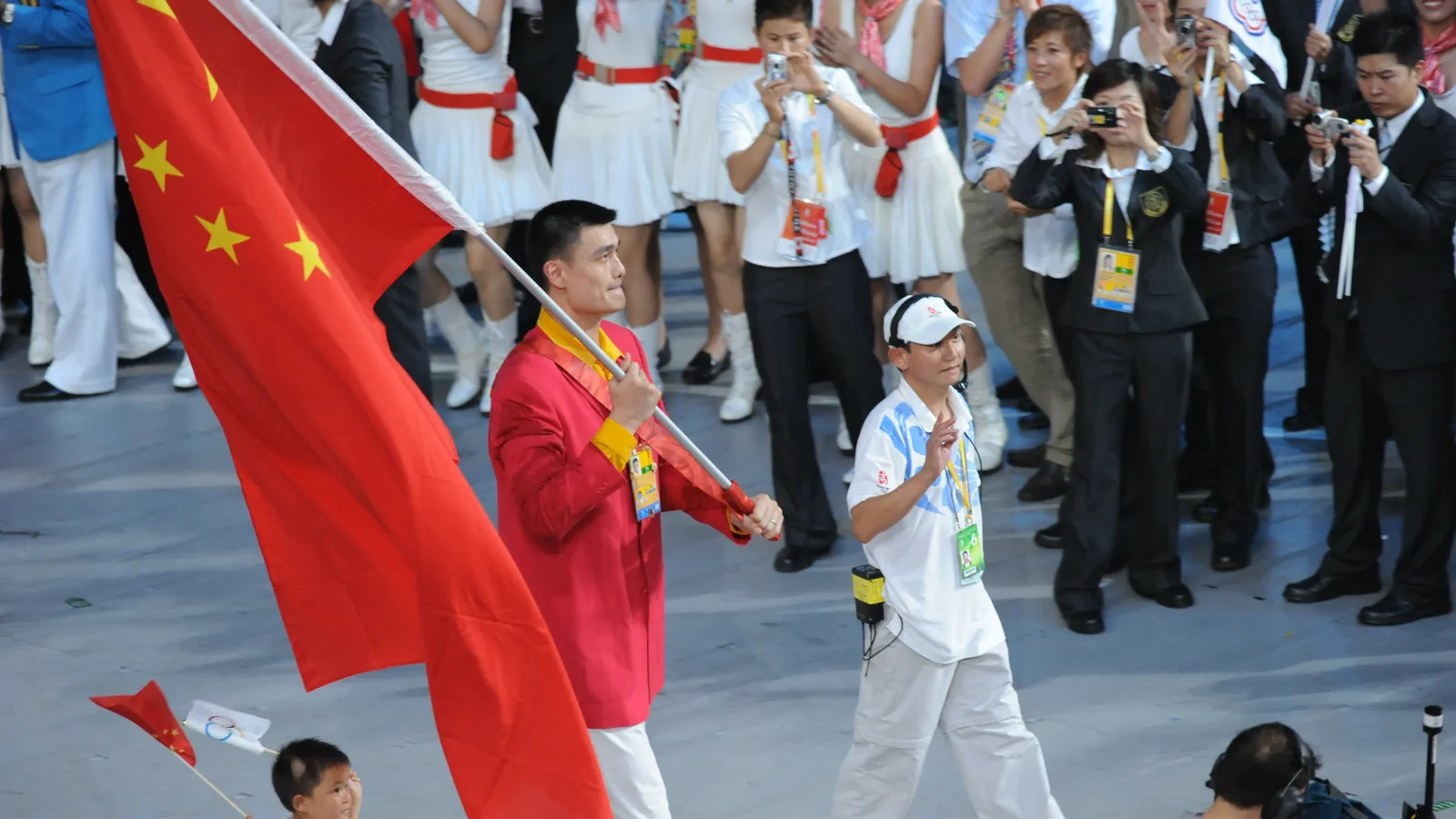
He is the only figure in this series of five with no Olympic medal, and he is the most important of them all — because nobody ever asked him to win. They asked him to become.
The flag, and the foot
Beijing, the eighth of August, 2008. The Bird’s Nest holds ninety-one thousand people and a country’s whole idea of itself, and the man carrying the flag for the host nation is seven foot six, the tallest human being in the building, walking the way you walk when the bone in your left foot is broken.
He knew. The national team staff knew. The Houston Rockets’ medical staff, a continent away, knew, and had spent the spring writing anxious letters about it. Yao Ming had a stress fracture of the left foot, diagnosed that February, and the ordinary treatment for it is a season on the shelf. Instead there was a surgery, a rush, a careful arc of rehab calibrated to one date — the eighth of August — because there are expectations a man can decline and there are expectations that are not addressed to the man at all.
Two nights later he played the United States, and on China’s first possession he drifted out beyond the three-point line and made a three-pointer, the first basket of the game. It was, by the numbers that get kept, the most-watched basketball game in the history of the sport, an audience past a billion. What they saw was a friendly giant in a red jersey, smiling at Kobe Bryant. What was actually happening was a body being spent to buy something that does not appear on any scoreboard. Not a medal — that was never on the table. Credibility. The presence of China in a room China had not been allowed into. He was there to make his country legible, and he paid for the trip with the only currency the transaction accepted.
Understand that and you have understood Yao Ming. Everything else — the numbers, the All-Star votes, the Hall of Fame jacket — is downstream.
The tall boy
He was born in Shanghai on the twelfth of September, 1980, into a lane house and a system. His mother, Fang Fengdi, stood six foot two and had played for the national team. His father, Yao Zhiyuan, stood past six foot seven and had done the same. This matters less as genealogy than as design. In a Chinese sports system built to produce, two retired national-team basketball players marrying and having a son is not a family; it is a project with a due date. By the time he was a teenager the machine had already decided what it was going to make, and what it was going to make was tall.
There is a detail from those years that stays with me, because it is the opposite of the public story. As a child he lost most of the hearing in his left ear — the family’s account is an illness and a medication — and he has spent his whole life turning his head to bring conversations into range. The most watched Chinese body of the century, and the left side of it is partly quiet. He learned early that people would talk to him from the side he could not hear, that applause would arrive slightly muffled, that being a symbol does not mean being heard. He is, by all accounts, a man who compensates by watching mouths move.
At thirteen he was in the Shanghai youth programme. At fourteen the system was watching him the way a farmer watches weather. In the Chinese framing he was xiao juren — 小巨人, the Little Giant — and that nickname is not only about size. It keeps the giant a child. It says: loved, watched, and expected to behave. There is affection in it and there is a leash in it, and Yao grew up inside the dual meaning, learning to be enormous and obedient at the same time.
Here is the thing an English-language reader will not feel in the bones, and it is the whole architecture of the story. China was not built to win at basketball. China was built to win at table tennis, at diving, at badminton, at weightlifting — sports where the system’s method, the relentless mass production of technique, delivers gold the way a factory delivers product. Basketball was never one of those. China has never won an Olympic medal in men’s basketball and never seriously expected to. So when the system sent Yao Ming out into the world, it was not sending him for a podium. It was sending him to be present — to make a China that had been a rumour into a fact other nations had to account for. This is the strangest assignment in the whole series, and the loneliest: to succeed at a thing that has no medal at the end of it, where success is not a result but an impression, and where you cannot ever be finished because impressions have no final score.
To understand the arrangement he was born into, hold two facts at once. The first is domestic: this was Shanghai in the early 1980s, a city of lane houses and rationing and a basketball culture that was real but provincial, where a child’s height was a fact the neighbourhood discussed the way it discussed the weather. The second is structural: in the Chinese system of that era, a talented athlete’s body was not a private possession. The juguo tizhi — the whole-nation system — identified children young, funded their training from the state’s pocket, and in exchange claimed their competitive futures. The deal was unwritten and total. A very tall boy born to two former national-team centres was not scouted; he was anticipated. The system knew what it intended to make before the boy knew what he wanted to be, and it began making it while he was still in primary school.
He was never chasing a title China already knew how to win. He was the first Chinese athlete asked to win nothing and to mean everything.
The negotiated exit
Before Houston, there was a negotiation that English readers skip, and skipping it makes Yao look like a fortune that simply happened. It did not simply happen. It was permitted.
When the NBA came for him in 2002, the deal had to be assembled across three Chinese institutions — the Shanghai Sharks, the Chinese Basketball Association, and the sports bureau above them — plus a player who, under the rules that made him, was not entirely his own property. The reporting over the years has been contested in its details but consistent in its shape. The initial demands were reported at figures that would have made the whole thing impossible, and the eventual agreement was a compromise that still took years, and still left everyone slightly unhappy.
Why did the system let him walk? Two reasons, and they are not noble. First, because a Chinese athlete standing in the NBA was a kind of presence China had never owned, and presence was the goal. Second — and this is the part that gets left out — because there was money in it, and the market logic of the NBA was a language the system was just learning to read. He was the first Chinese athlete made global by the market rather than by the state’s honour ledger — the first whose value was calculated in jerseys and television rights and the opening of a national market, not in the currency of medals. The state permitted the exit because the state saw the export.
And the state had a warning it could not forget. In the same summer, Wang Zhizhi — the first Chinese player ever to reach the NBA — stayed in America to play summer league instead of returning for national duty, and was publicly denounced, dropped from the national team, and frozen out for years. Yao’s negotiation happened in the shadow of Wang’s punishment. Everyone at the table knew what refusal cost. The permission that let Yao go was the same permission that could be withdrawn, and it was threaded through with the understanding that he would not be Wang Zhizhi. He would be grateful. He would return. He would behave.
The precise terms have never been fully public, and the reporting around them has hardened into legend: a buyout to the Sharks, a share of his NBA salary routed home, a cut to the association, and a national-team clause that functioned as a leash. What is not in dispute is the shape of the thing. For months the greatest basketball asset China had ever produced sat in a queue while institutions negotiated over his future, and when the deal finally closed the country did not celebrate an athlete’s opportunity so much as ratify an export licence. He arrived in Houston not as a free agent of his own talent but as a negotiated settlement between systems, and he understood that from the first day, and he never once said so out loud.
One body, two owners
Houston on one side. The bureau on the other. For nine seasons those two systems each behaved as though they owned the same seven foot six, three-hundred-and-ten-pound body, and neither of them was responsible for the whole of it.
The NBA schedule is eighty-two games of controlled collision. And every summer, when an American player rests and repairs, Yao flew back and played for China — the 2002 World Championship weeks before his rookie season began, the Asian Games, the 2003 Asian Championship, the 2004 Athens Olympics, the 2005 Asian Championship, the 2006 World Championship, the 2008 Olympics, the Asian Championships. He did not skip. He was not built to skip — he had been raised inside an expectation that made skipping unthinkable, and he carried it with a public decency that cost him, year by year, the only thing a giant actually needs: an off-season.
Count the calendar and it stops being a metaphor. A nine-season NBA career is roughly seven hundred and forty regular-season games of controlled collision; Yao played four hundred and eighty-six of them. Into the same years, between those seasons, he stacked a world championship, two Asian Games, three Asian Championships, three Olympic tournaments and a home Olympics — summer after summer of international competition that no American star of his era was ever asked to absorb, in a body that took longer than anyone else’s to recover and was never once allowed to finish recovering. The arithmetic is not complicated. A giant of his size needs his summers the way a bridge needs maintenance, and the schedule gave him none, because both systems looked at the same man and each assumed the other one was looking after him.
There is a physics to what happened next. A human frame of seven foot six and three hundred and ten pounds is a triumph of the human genome and a design failure of the human foot. The navicular bone, the arch, the mechanics of a march that no skeleton was engineered to survive — his feet were always going to be the bill. And the bill came, over and over. A toe infection. A stress fracture. A fracture in 2009 that cost him the playoffs. Another, in the left ankle, in December 2010. Each time he came back; each time the body came back a little less. Nobody in either system had charge of the whole ledger, so the ledger was settled on his feet.
This is where the article has to resist the hagiography. The comfortable version says he gave his body for his country and it was noble. The uncomfortable version — which is closer to true — is that two institutions each extracted what they needed from one man and neither of them slowed down, and the man was too dutiful and too decent and too well-travelled by the rules of his own upbringing to say stop. It is not a scandal. It is a system. But it is also a pair of feet, and the feet are gone.
The votes that were not his
He came into the league as a curiosity, and America told him so, sometimes cruelly. Charles Barkley said on national television that if Yao ever scored nineteen points in a game he would kiss Kenny Smith’s backside — the kind of gag that assumes the punchline is the man himself. Then in November 2002 Yao scored twenty points on nine-for-nine shooting against the Lakers and Shaquille O’Neal, and Barkley had to kiss a donkey live on air. I include it not for the comedy but for the temperature. The tallest player in the league was, for a season or two, a question America was asking out loud: is he a player, or is he a marketing tool? He spent a decade answering by being a real competitor, and the question never fully went away.
But the purest expression of the whole story happened in a voting tabulation. In his rookie season, Yao was voted a starter in the 2003 All-Star Game — over Shaquille O’Neal, the most dominant player alive — on the strength of more than a million votes, a flood of them from China. He did not top the ballot — Kobe Bryant did, with 1,474,386 votes — but he was the leading vote-getter among Western Conference centres and fourth in the league, more than two hundred and thirty thousand votes clear of Shaquille O’Neal, and the first rookie voted a starter since Grant Hill in 1995. And then he walked onto the floor in Atlanta and scored two points in seventeen minutes, and everyone in American basketball understood that the ballot had not measured the player. It had measured the expectation. An entire nation had reached into an American institution and voted, through one man, for its own arrival.
There is a version of this that America found flattering and China found insulting, and both readings were self-serving. To the American press, the flood of votes proved that the All-Star ballot had been invaded by a foreign audience that had not watched a minute of basketball. To China, it was the first exercise of a new kind of power — the discovery that the country could reach into an American institution through the internet and change what America saw when it looked at itself. Neither side asked the obvious question, which was what it cost the man standing in the middle, who had been voted into a room he had not yet earned and had to walk into it with his head up anyway.
He knew. That is the detail that matters and the one that is hardest to explain to a foreign reader: it was not that he did not know the votes were not his. He knew exactly. He was, by every account, embarrassed by them, and he played the game anyway, and he never once complained about the burden of being voted for by people who had not seen him play, because to complain would have been to reject the country that had sent him, and rejecting the country was not a thing he was capable of doing, and so he simply absorbed the embarrassment along with everything else and kept his face kind. The votes were the expectation made arithmetic. He took the arithmetic on the chin.
The Shanghai Shake
There is a question running underneath the American half of this story, and the technique is the only thing that ever answered it. Is he a player, or is he a marketing tool? The votes did not answer it. The endorsements did not answer it. The answer was in the low post, on the nights the ball went in and there was nothing anyone could do about it, and it is the part of Yao Ming that the record books flatten into “19.0 and 9.2” and the culture flattens into “the tall Chinese guy”.
He was, for a window of years, a genuinely great basketball player — not great for a Chinese player, not great considering his size, but great at the craft, in the way the league’s most respected veterans meant it when they said it. What makes that remarkable is that he did it in exactly the direction the ordinary laws of size say you cannot. The taller the player, the worse the hands, the stiffer the wrist, the clumsier the feet; height without coordination is not an advantage but a condition with a jersey. Yao Ming was the exception the law was not built to contain.
The body: not the height, but what he did with it
Start with what the body actually was, because the number most people carry around is the wrong one. Seven foot six is the headline, and seven foot six on its own is a liability. The history of the league is littered with men past seven foot two who could not play — too slow, too stiff, too easily pushed off their spot, useful for one thing (a blocked shot, a rebound) and helpless at the rest. The second thing, the thing that made him Yao Ming, was that he moved.
His feet — the same feet this story ends on — were, while they lasted, among the most precise in the league for a man of any size. His touch was a contradiction of his hands. A seven-foot-six man should not shoot eighty-three per cent from the free-throw line; the mechanics of very long arms and very large palms work against it, and the league’s history of enormous centres is a history of missed free throws. Yao shot 83.3 per cent for his career and 86.6 per cent in 2008-09 — higher than Kobe Bryant’s 85.6 that season and clear of Dwyane Wade or LeBron James, better than most of the guards who were supposed to be the shooters. When opponents invented a strategy — the deliberate foul, Hack-a-Shaq — out of Shaquille O’Neal’s weakness at the line, nobody ever tried it on Yao, because fouling Yao Ming was simply a slow way of conceding two points.
| Measure | Figure |
|---|---|
| Listed height | 7 ft 6 in / 2.29 m |
| Listed weight | 310 lb / 141 kg |
| Standing reach | 9 ft 7 in / 2.92 m |
| Career free-throw percentage | 83.3% |
| Best free-throw season | 86.6% (2008-09) |
The low post: the Shanghai Shake
His low-post game had a nickname — the Shanghai Shake, a wink at Hakeem Olajuwon’s Dream Shake — and the comparison was not a courtesy. The footwork was that good. He could go left or right without a weak side; he kept a library of turns (front, reverse, half, and the false turn that is not a turn at all) and chained them with changes of pace, so that the defender was never being asked the same question twice. The cruellest sequence was the standard one: a hard fake toward the baseline, the defender’s weight committing, and then the reverse turn back into the middle and the ball laid in before the help could arrive. On a seven-foot-six frame, that kind of movement is close to a contradiction in terms, which is precisely why it worked. Defenders had been trained against two kinds of big man — the immovable kind and the athletic kind — and Yao was neither. He was a technician the size of a building.
In 2006-07 his post-up game was about as efficient as any big man’s in the league. That is not a curiosity. That is a first option on a team with a playoff seed.
The two shots nobody could reach
If the footwork was the art, the hook and the fadeaway were the arithmetic, and the arithmetic was unfair. A hook shot released from Yao’s hand leaves it close to eleven and a half feet above the floor — his standing reach carried the ball to nearly three metres before he extended, and the arm and the angle added the rest on top. There is no defender in the league who can reach that. The block does not exist; the best a defender can do is hope the ball misses, and for a man with that touch it often did not. He could hook with either hand, and from further out than a hook is supposed to travel, out toward the free-throw line where the arc made it a real weapon rather than an emergency.
Then the fadeaway, which arrived later and became his most reliable kill: catch on the block, back to the basket, turn, rise, release at a height no human hand can contest. He hit it off either shoulder at better than half. This is the part the “friendly giant” version of Yao Ming edits out — that he was not merely hard to move and pleasant to interview, but for a stretch of years one of the most difficult covers in the sport, and the only strategic answer the league had was to double him.
| Shot | Return |
|---|---|
| Field-goal percentage inside 3 ft | 65-70% |
| Mid-range, inside 16 ft | 45-50% |
| Hook shot release | above 11 ft — unblockable |
| Fadeaway | better than half, off either shoulder |
The axis: the centre as playmaker
The double-team is where Yao turned into something more interesting than a scorer. Because he was a genuinely skilled passer — a fact the statistic hides, recording only 1.6 assists a game — the double did not solve the defenders’ problem so much as hand him the solution. He could see over the top of it and find the opposite big man on the high-low, or swing the ball to the open shooter on the weak side. Houston built a roster of shooters around him for exactly this reason, and the Yao–McGrady pick-and-roll became the franchise’s signature: he could roll to the rim, pop to the mid-range, or hand the ball off and let the guard attack, and the defence had to honour all three. A centre who draws a double on every possession and can pass out of it is worth far more than his assist line says, and everyone who played with him knew it.
The wall: the thing the blocks do not measure
Defence is where the reputation undersells him in one direction and oversells him in another. He averaged 1.9 blocks a game for his career and 2.0 in his best season, which is excellent but not historic; the shot-blocking giants of his era posted bigger numbers. But blocks are the box score’s way of counting the shots that were altered into not being taken at all. With Yao standing in the middle, the geometry of the floor changed. Guards drove into the lane, saw seven and a half feet of him, and pulled the ball back out; opponents settled for floaters and contested jumpers they would not otherwise have settled for. That is the whole defensive value of a player who never had to jump twice. He rarely left his feet, which is why he rarely got fooled, and he rarely fouled while blocking, which is why he could stay on the floor. At the other end he was a better rebounder than his 9.2 career average suggests — he boxed out to let guards take rebounds when the scheme asked, and his offensive rebounding was relentless for a man who was double-teamed by design.
The limits: the bill, paid at both ends
None of it was free, and the limits were structural rather than accidental. Yao could not defend a pick-and-roll, because there is no version of a seven-foot-six frame that can show on a guard and recover to a rolling big man, and even in his own era the league’s smarter teams attacked exactly that. In his era the mid-range was still the coin of the realm and the three-point line belonged to specialists, so the weakness could be hidden. In the league that came after him — five shooters, a big man who can drag him to the arc, the pick-and-roll spread to the sideline — the same weakness would have been a season-long emergency. He was the last dominant centre built for a game that was already ending.
And the deeper limit was the body itself. The same mass that made him immovable made every step expensive; the same feet that could pivot like a guard’s carried 310 pounds for thirty-odd minutes a night. He could run a fast break, but not ten of them, and the fourth quarter found him a half-step slower than the first. His coaches managed his minutes the way a curator manages a fragile text — around thirty-two a game, never more — and everyone in the building understood why: the engine was magnificent and the chassis was not rated for the mileage. The injuries were not bad luck, and they were not only the schedule. They were the arithmetic of putting a seven-foot-six body into an eighty-two-game league and then giving it no summer.
| Measure | Figure |
|---|---|
| Career blocks | 1.9 per game (peak 2.0) |
| Defence against the pick-and-roll | the weakness his era hid |
| Career minutes | 32.5 a game — managed, never maximised |
What the technique proves
The technique is not a sidebar to the expectation story. It is the proof of it. The American question — player or tool? — was answered in the low post, and the answer was: a player, one of the best at his position for a window of years, a man who would have been remembered as a champion in another body or another era. Which makes the rest of the story harder, not softer. It would be easier if Yao had been merely a phenomenon, a gentle giant who sold jerseys. He was not. He was a great player whose greatness had no trophy at the end of it, because the two systems that made him spent him at both ends — the state in the summer, the league in the winter — and the one thing neither of them protected was the thing that made the greatness possible.
Liu Xiang was a sprinter who had to become a technician to compete. Li Na was an attacker who had to become an individual. Ma Long became perfect and found that perfection is a cage. Deng Yaping turned a body too small into a weapon. Yao Ming is the inverse case: he had the body the gods give once in a generation, and the tragedy is that the body was the least of what he had. The skill, the touch, the mind for the game were all better than they had any right to be, and it was still not enough to buy him a ring, a medal, or a healthy thirty-second year. The gift was real. The gift was spent.
The feet that failed
February 2008. The stress fracture, and the Beijing Olympics bearing down, and the decision the whole country was waiting for him to make before he was permitted to think it through. He had said, publicly, that missing a home Olympics would be a regret he could not live with — and that sentence was both true and, in a sense, not entirely his. The Rockets wanted him healthy for the winter. The nation wanted him in August. He chose August, and the surgery, and the rush, and the flag, and the broken-foot march into the Bird’s Nest, and the three-pointer over the United States, and the quarterfinal exit that was, by any honest accounting of Chinese basketball, an overachievement.
It is a real question, and it has no clean answer, whether the expectation ended his career early. He retired on the twentieth of July, 2011, at thirty years old — not ancient for a centre, but not young, either, and not close to the natural end of a player of his skill. He had foot surgery again that year and the surgeons were no longer offering a whole body back. Nine seasons. Eight All-Star teams. A career average of nineteen points and nine rebounds. No NBA Finals. No Olympic medal. A mountain of expectation, and a body that finally could not carry it up the last hundred metres.
The injuries were not a single collapse but a slow, documented erosion, and laid end to end they read less like bad luck than like a bill arriving in instalments. Almost all of it settled in the same foot — the left, the load-bearing side — the one part of a seven-foot-six architecture that carried the most weight and got the least rest.
| Year | Injury | Cost |
|---|---|---|
| 2005 | Osteomyelitis, left big toe | Surgery; 21 games missed |
| 2006-07 | Fractured bone, right leg (below the knee) | 32 games missed |
| 2008 | Stress fracture, left foot | Rushed back for Beijing |
| 2009 | Hairline fracture, left foot | Playoffs ended against the Lakers; surgery that July cost him all of 2009-10 |
| 2010 | Stress fracture, left ankle | Five games in 2010-11, then retirement |
I will not pretend I know which fracture was the one, or that any single summer killed him. What I know is that two systems spent the same man and nobody was charged with the whole of him, and that the man had been raised to be spent, and did not know how to say no. The medal he never won is the point. There was never going to be a medal. The assignment had no podium, which means it also had no finish line, which means he could only ever stop by breaking.
What you build with the shell
Here is where he became, to my eye, the most interesting athlete in this series — more interesting, in a way, than the ones with the gold.
He did not vanish into the comfortable afterlife of the retired giant. He went to work in the gap. In 2009, while still playing, he bought the Shanghai Sharks, the club that had produced him. In 2017 he became chairman of the Chinese Basketball Association and tried to do the thing the system had never let anyone do: professionalise it, separate the league from the bureau, let the sport breathe. It did not fully work. The reforms ran into the owners’ interests and the bureau’s reflexes and the sheer inertial weight of how Chinese sport has always been run, and in 2024 he stepped down from the job. Read that honestly: the man who had been the system’s greatest export tried to change the system from inside and was, in the end, outlasted by it. That is friction worth keeping, not smoothing over.
The reform he attempted was not cosmetic. He wanted to separate the league from the sports bureau, put the clubs on a professional footing, cap salaries, build a domestic pipeline instead of importing finished American players, and give players a measure of the contractual freedom he himself had never been granted. Some of it moved — the league professionalised at the edges, the draft and salary rules changed, youth programmes multiplied. But the bureau’s reflexes are older than any chairman, and the clubs had interests of their own, and the apparatus is built so that no single person, however famous, can bend it far. When he stepped down in 2024, the honest reading was that he had spent seven years learning the distance between being the system’s greatest symbol and being able to change it.
And he did other things. In 2019 he was elected chairman of the FIBA Asia Central Board, a seat inside the governing body of Asian basketball. The Yao Foundation, youth basketball, years of work that few outside China will ever see. And one campaign that cost him something in his own country: he agreed to front the fight against shark fin soup, a delicacy woven into the banquet culture he had grown up inside, and he took the domestic flak for it — criticised for lending a foreign conservation agenda a Chinese face. He did it anyway. He was, by then, a man who had learned that being a bridge means standing in the middle of the traffic and taking hits from both directions.
Because that is what he actually built. Look at what he was — a seven foot six body standing precisely on the seam between two systems that did not trust each other: the Chinese sports system, which wanted to keep him and own his meaning, and the American market, which wanted to sell him and could not stop calling him a curiosity. He did not resolve the seam. He could not. Nobody could. What he did was stand in it for a decade with astonishing patience and good humour, and turn it into an opening — the one Chinese body the world was willing to look at, the one American export China was willing to let in. After Yao, the world could no longer imagine Chinese sport as something it had to be taught to respect. After Yao, there was a door, and it did not close behind him. Everyone who came after — every Chinese athlete who now walks into a foreign arena as an expected thing rather than an exotic one — walks through a gap he held open with his own ribs.
The accounting
So what did it cost to become the symbol a billion people needed him to be, and who was he once the country stopped expecting?
You will not get a clean answer, because he has never given one and probably does not have one. He is still, in the public record, the most relentlessly, publicly decent man in the story — the one who took the votes, the fractures, the fees, the demands, the condescension and the adoration, and answered all of it with the same patient courtesy, and seemed to fill the space where a private life might have been with public duty. Whether that decency was his nature or his training or the only strategy available to a man whose body was never fully his own — that question is the one I would most like to ask him, and the one he is least likely to answer on the record, and that silence is the real summit of his career.
What I can tell you is what the case teaches, because the whole reason we tell these stories is that the extraordinary, understood deeply, becomes our own.
The next time you are handed an expectation that was never yours to choose — a role, a title, a burden your family or your country or your company has already decided you are for — do not ask how to meet it and do not ask how to escape it. Both of those questions keep you inside someone else’s frame. Ask instead what it could translate. Yao Ming did not beat the expectation and he did not flee it; he converted it. He became the bridge — the one body the world would look at, the one export China would admit — and by converting the burden rather than carrying it, he left a door open that had been a wall, and everything after him passed through it.
And when the expectation finally outlives your ability to carry it — his feet failed at thirty, and the game was finished at thirty, and the medal was never in his hands at any point — do not measure yourself by the podium you were never going to reach. Measure what still stands where you forced the gap open: the door he kept open, the institution he later ran, the idea of normalcy he manufactured for everyone who came after. If the thing you were expected to be would leave nothing behind once you can no longer be it, then you were only carrying an expectation, and it used you and you are spent. If it left a door open, you were building a bridge.
Build the bridge. The flag, the city of the flag, and everything China expects of its tallest son — none of it required a medal. All of it required a man willing to stand in the middle and take both sides of the traffic. He did, for as long as the body held, and then the body broke, and the bridge stayed open, and the expectation, having finally stopped, left behind the only thing worth leaving: an open door and a country that no longer has to be introduced.
The honours, in full
Set the record down and the paradox sharpens. The man this story insists was never asked to win spent his career collecting everything that could be counted except the two things everyone counts — a championship and an Olympic medal. What follows is the ledger, and it is the counter-argument to every version of Yao Ming that reduces him to a marketing instrument: the votes may have been borrowed, but the honours were earned.
The NBA
| Honour | Detail |
|---|---|
| 2002 NBA draft | First overall pick — the first international player without US college experience taken first |
| All-Star selections | 8 (2003-2009, 2011) — voted a Western Conference starter each time |
| All-Star vote leader | 2005 and 2006 — the most votes of any player in the league in both years |
| All-NBA Second Team | 2007, 2009 |
| All-NBA Third Team | 2004, 2006, 2008 |
| All-Rookie First Team | 2003 |
| Western Conference Player of the Week | 6 times |
| Western Conference Player of the Month | 2 times |
| Franchise rank | seventh in Rockets points, sixth in rebounds, second in blocks |
| No. 11 retired | 2017 — the first Chinese player so honoured by an NBA team |
The CBA
| Honour | Detail |
|---|---|
| CBA champion | 2002 — the Sharks’ first, ending Bayi’s six-year run |
| Regular-season MVP | 2001; the 2002 award is recorded to him by some sources and to Liu Yudong by others — reported, contested |
| Finals MVP | 2001 — awarded to him in a finals his team lost |
| CBA season rebounding, blocks and dunk leaders | three, three and two (1999-2000 to 2001-02) |
| The 2002 finals opener | 21 of 21 from the field — 49 points |
| The 2002 finals, on average | 41.3 points, 21 rebounds, 4.3 blocks |
| Single-game blocks | 13 — a CBA record |
China
| Honour | Detail |
|---|---|
| FIBA Asia Championship | 4 titles (1999, 2001, 2003, 2005) |
| FIBA Asia Championship MVP | three times (2001, 2003, 2005) — the Naismith Hall of Fame records three; FIBA’s own record lists two |
| Asian Games | silver, Busan 2002 |
| Olympic Games | quarter-finals, Athens 2004 and Beijing 2008 — no medal |
| Olympic flag bearer | Athens 2004 and Beijing 2008 |
| 2006 World Championship | scoring champion, 25.3 a game — China’s only world-tournament scoring title |
| China records | 39 points in a game (2004) |
Beyond the game
| Honour | Detail |
|---|---|
| Naismith Memorial Hall of Fame | Class of 2016 — the first Chinese, and first Asian, inductee |
| FIBA Hall of Fame | 2023 |
| Laureus World Sports Awards | Best Newcomer 2003; Spirit of Sport 2015 — one of a very few Chinese recipients, with two |
| Time 100 | 2004 — named among the world’s most influential people |
| ESPN | Global Most Promising Athlete, 2000 |
| China Charity Award | 2018 |
| Asian Hall of Fame | inducted, Class of 2025 |
After the game
| Role | Years |
|---|---|
| Owner, Shanghai Sharks | from 2009 |
| Chairman, Chinese Basketball Association | 2017-2024 |
| Chairman, FIBA Asia Central Board | from 2019 |
| National Committee of the CPPCC | 12th, 2013-2018 |
| National People’s Congress | 14th |
| Vice-chair, All-China Youth Federation | — |
The career, in numbers
| Competition | Games | Points | Rebounds | Blocks | Free throws |
|---|---|---|---|---|---|
| NBA regular season | 486 | 19.0 | 9.2 | 1.9 | 83.3% |
| NBA playoffs | 28 | 19.8 | 9.3 | — | — |
Set the rows down and the paradox closes where it started. He never won the thing the expectation implied. He won almost everything else — and then he spent the rest of his life trying to hand the game back to the country that had sent him.
Frequently Asked Questions
Did Yao Ming ever win an Olympic medal?
No. China has never won an Olympic medal in men's basketball, and Yao's best Olympic finishes were the quarter-finals at Athens 2004 and Beijing 2008. He was China's flag bearer at both Games, and at Beijing he played on a left foot that had been surgically repaired that spring.
How tall was Yao Ming, and why was he not one of the league's clumsy giants?
He was listed at 7 ft 6 in / 2.29 m and 310 lb / 141 kg, with a 9 ft 7 in standing reach. He also shot 83.3 per cent from the free-throw line across his career and 86.6 per cent in 2008-09, higher than Kobe Bryant's 85.6 that season. Very tall centres are usually poor shooters and poor movers; his touch and his footwork ran against the size that produced them, which is why opponents never tried the deliberate foul on him.
Why did Yao Ming retire in 2011 at thirty years old?
A run of left-foot fractures between 2008 and 2010. He had a stress fracture repaired in early 2008 so he could play the Beijing Olympics; a hairline fracture suffered in the 2009 playoffs cost him the whole of the following season, and a stress fracture of the left ankle in December 2010 limited him to five games before he retired in July 2011. He announced his retirement on 20 July 2011, after nine NBA seasons.
What did Yao Ming do after his playing career ended?
He bought the Shanghai Sharks in 2009 while still playing, became chairman of the Chinese Basketball Association in 2017, and stepped down in 2024 after a reform attempt that ran into the owners and the sports bureau. He has chaired the FIBA Asia Central Board since 2019, and has worked through the Yao Foundation and a public campaign against shark fin soup.