The last image of Ma Long’s Olympic career was not an explosion. It was a quiet.
Paris, August 9, 2024. The men’s team final against Sweden, and the oldest man on the floor — thirty-five, with a knee that had been drained, injected, and argued with for years — did what he had always done. He administered the outcome. A doubles point here, a steadying presence there, the match resolved with the same unvarying precision that had resolved hundreds before it. When it was over, he had won his sixth Olympic gold medal, more than any Chinese athlete in history, and he stood apart from the celebration for a moment, watching the young ones jump.
Nobody who was there remembers him screaming. That is the strangest thing about the greatest player table tennis has ever produced. They call him The Dictator — the nickname Chinese fans gave him, and it is not political, it is descriptive — because his table tennis does not defeat opponents so much as it administers the outcome, the same way every time: no drama, no weakness, a game so complete and so patient that he simply waited until there was nobody left to beat.
This is not a story about trophies. The record sheet is accurate and entirely missing the point: six Olympic golds, the only male player in history to complete the career double Grand Slam, three consecutive World Championships, sixty-four months at world No.1 — thirty-four of them consecutive, from March 2015, the longest run any man has ever held. All true. All beside the question. The real story is about what happens to a person who becomes so good that winning stops being a question and becomes only a count — and what it costs to be the man who made victory look inevitable.
The boy with the insufficient forehand
Anshan, Liaoning, is a steel city. In the 1990s it was furnaces and soot, and a five-year-old boy named Ma Long was given a paddle because the neighborhood had a table and the table was where children went. There is a photograph from those years, the kind every Chinese sporting family keeps: a small boy, serious face, paddle held like a tool rather than a toy. He was not a prodigy in the explosive sense. He was a prodigy in the patience sense — the kind of child who would rather be correct than spectacular, who would drill the same footwork until it was no longer a movement but a reflex.
Liaoning is not incidental to this story. The province has produced more of China’s table tennis champions than any other place on earth — the sport’s own steel country, where the game is played on concrete tables in factory yards and the expectation is not that you might win but that you will. Ma Long entered the national team as a teenager, and by eighteen he had been named world junior champion. He was the future. Everyone agreed on this.
Then the future was told it had a flaw. The national team coaches, studying the junior world champion, delivered the verdict that would define him: his forehand was not powerful enough. Not explosive enough to kill a point the way Wang Liqin killed points, not violent enough to end rallies the way the sport’s new power players were ending them. He was too safe. Too balanced. Too controlled. In a sport that was falling in love with brute force — the roaring backhand, the kill-shot forehand — he was being told he did not possess the one weapon that seemed to matter.
Here is the part of the story that is easy to skip and impossible to overstate. He did not go looking for more power. He did not try to become louder. He answered the diagnosis of his flaw by building a game with no flaw to attack — not louder, but wider; not faster, but with no exploitable seam.
The Japanese media would eventually give it the perfect name. They drew his ability as a radar chart — six dimensions of the sport: speed, power, technique, serve and receive, defense, mentality — and found every side maxed out. They called him the hexagonal warrior, rokugata no senshi. No empty side. No crack in the armor. Where other champions had one enormous strength, he had none — and that was the point. A game with one enormous strength can be attacked. A game with no weakness cannot be beaten; it can only be waited out.
Record at a glance — the core numbers that back the “hexagonal” claim
| Metric | Value | Significance |
|---|---|---|
| World champion total | 31 | Most by any male player in table tennis history |
| Olympic gold medals | 6 | Most by any Chinese athlete across all sports |
| Months at world No.1 | 64 (34 consecutive) | Longest uninterrupted reign since rankings began |
| Career double Grand Slam | Yes — only male player | Olympic singles + World Championships + World Cup, twice |
| Full set of nine major titles | Yes — only male player | Olympics, Worlds, World Cup, Asian Games, Asian Champs, Asian Cup, Pro Tour Grand Finals, National Games |
The years of losing to the future
But completeness takes time, and time was the one thing the dynasty did not want to give him.
English readers need the context that makes all of this legible: table tennis is China’s national religion in miniature. It is the sport of ping-pong diplomacy, the one event where China expects not to compete but to sweep — a full podium, a clean medal table, an outcome decided before the first ball is struck. A men’s singles final between two Chinese players is understood at home not as a contest but as a coronation: the passing of the throne from one unbeatable player to the next. Wang Liqin’s reign. Wang Hao’s claim. Zhang Jike’s explosion. The real drama of Chinese table tennis is never whether China will win. It is who among the Chinese will be allowed to be next.
The throne does not wait for anyone, and in Ma Long’s early twenties, the throne kept going to Wang Hao.
This is the part of his biography that the highlight reels omit. The greatest player in the history of the sport spent the most important years of his youth losing the biggest finals to a man who seemed to own the future. Wang Hao beat him at the World Championships — the semifinal in 2009, the semifinal again in 2011, the semifinal a third time in 2013. The pattern was brutal and consistent: Ma Long would arrive as the world’s most complete technician, and Wang Hao — with his unorthodox, devastating backhand — would find the one seam that still existed. The seam of experience. The seam of not yet knowing how to win.
His own coach, Liu Guoliang, added a second verdict to the first. Ma Long, Liu said, was too well-behaved. Too much the good student. He lacked the wolf — the killer’s heart that separates champions from technicians. In the Chinese table tennis idiom, the highest praise is not for the player who plays beautifully but for the player who, when the match is on the line, wants to tear the other man’s throat out. Ma Long, by Liu Guoliang’s diagnosis, wanted only to play correctly. And in the biggest moments, correctness was not enough.
Then came 2012. The London Olympics. Ma Long was the world’s top-ranked player — and he was not selected for the singles event. The spots went to Zhang Jike and Wang Hao. He was twenty-three, ranked first on earth, and the dynasty had decided he was not ready, or not wanted, or simply not next. He watched from the sideline as Zhang Jike won the gold that should have been his to contest, and the image of that Olympics is Zhang Jike ripping open his shirt, not Ma Long standing at the edge of the frame.
The detail that matters: he did not leave. He did not go to Europe to make money and disappear, as so many Chinese players had done before him. He stayed inside the machine that had declined him, and he trained. Not for revenge. For completeness. He had been told his forehand was weak, and he had built the hexagonal game. Now he had been told he was not the chosen one, and he built something harder: patience as a form of power.
Was the rejection decisive or convenient? The question is worth holding open. The convenient reading — the one his biographers prefer — is that the early verdicts made him, that being told he was not good enough ignited the engine of his perfection. The inconvenient reading is that they cost him years he can never get back, the prime of his twenties spent waiting instead of winning, and that the man who emerged from the waiting was not liberated by it but shaped by it, the way a tree is shaped by wind. Both readings are true. The truth is not a lesson.
The Dictator
The nickname arrived as his dominance did, in the mid-2010s, and English readers keep misreading it. “The Dictator” carries no political charge in Chinese fan culture. It is not a critique. It is affectionate awe — the same awe that gave him “The Emperor” and “Captain Long” — for a player whose game is so technically total, so unvarying in its perfection, that his wins feel less like victories and more like the administration of a system. He does not defeat you. He processes you. The outcome is arrived at the way a government arrives at a budget: inevitably, impersonally, on schedule.
There is a chilling quality to this, and the Chinese fans who love him know it. They are not celebrating his violence; they are celebrating his inevitability. Watching Ma Long at his peak was not watching a battle. It was watching a theorem being proved. The opponent would try the forehand — covered. The backhand — covered. The short game, the long game, the angles, the pace — every dimension answered, every question already answered before it was asked. The rally would lengthen, the opponent would run out of ideas, and Ma Long would administer the final point with the same expression he had worn since Anshan: the serious face of a boy who would rather be correct than spectacular.
The contrast that defined his era was with Zhang Jike — the other man born in 1988, the one who did not wait. Zhang Jike was the Zang’ao, the Tibetan mastiff, the nickname Liu Guoliang gave him for his ferocity. He was the violent genius, the man who completed his own Grand Slam in 445 days, who tore his shirt open after winning in London, who kissed the table and screamed. He was chaos in a sport that rewarded control, and the fans who found Ma Long boring — and there were many — preferred Zhang Jike’s drama. Ma Long’s wins were correct. Zhang Jike’s wins were events.
This is the honest negative that the medal count hides: for years, a significant portion of the sport’s audience found Ma Long’s perfection dull. His matches lacked the blood temperature of Zhang Jike’s brawls. His celebrations were restrained. His interviews were polite and unilluminating. He was the civil servant of champions — and the insult was not entirely wrong. The machine he built was so seamless that it was easy to forget there was a person inside it.
But the machine kept running. And the deeper layer — the one English readers miss entirely — is that Ma Long was not just the greatest player. He was the keeper of the dynasty gate. He was the man who held the next generation at bay exactly long enough to complete the double Grand Slam, and whose refusal to be passed was itself a kind of team service: he carried the continuity of Chinese table tennis in his own aging body.
The succession drama is the real plot. By 2015, the throne was supposed to pass. Fan Zhendong — born 1997, the terrifying teenager, the designated heir — was arriving exactly on schedule. The script was written: the old guard would step aside, the new emperor would ascend. Ma Long, at twenty-six, was supposed to be the transitional figure, the man who lost to the future so the future could begin.
He refused.
The refusal to be passed
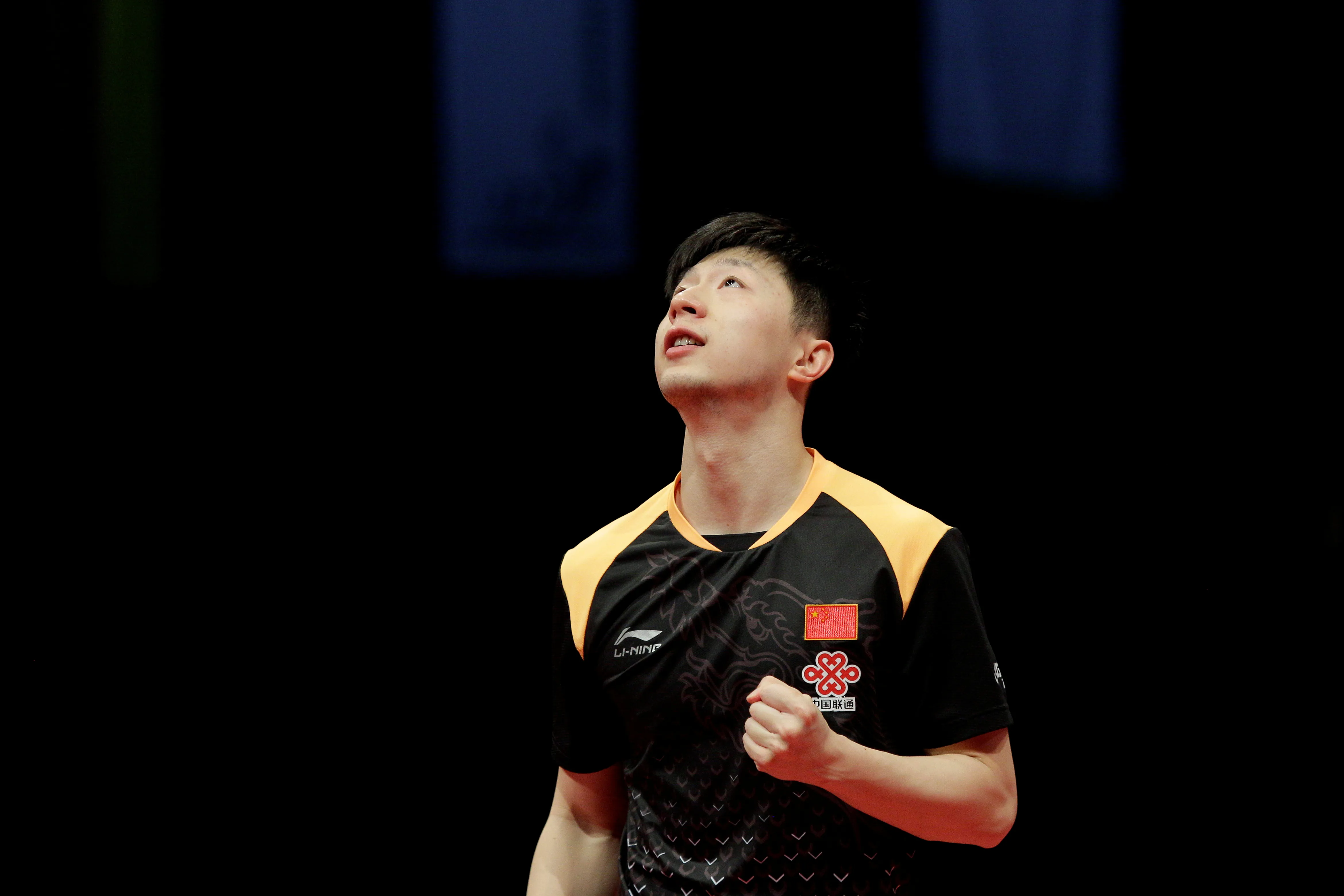
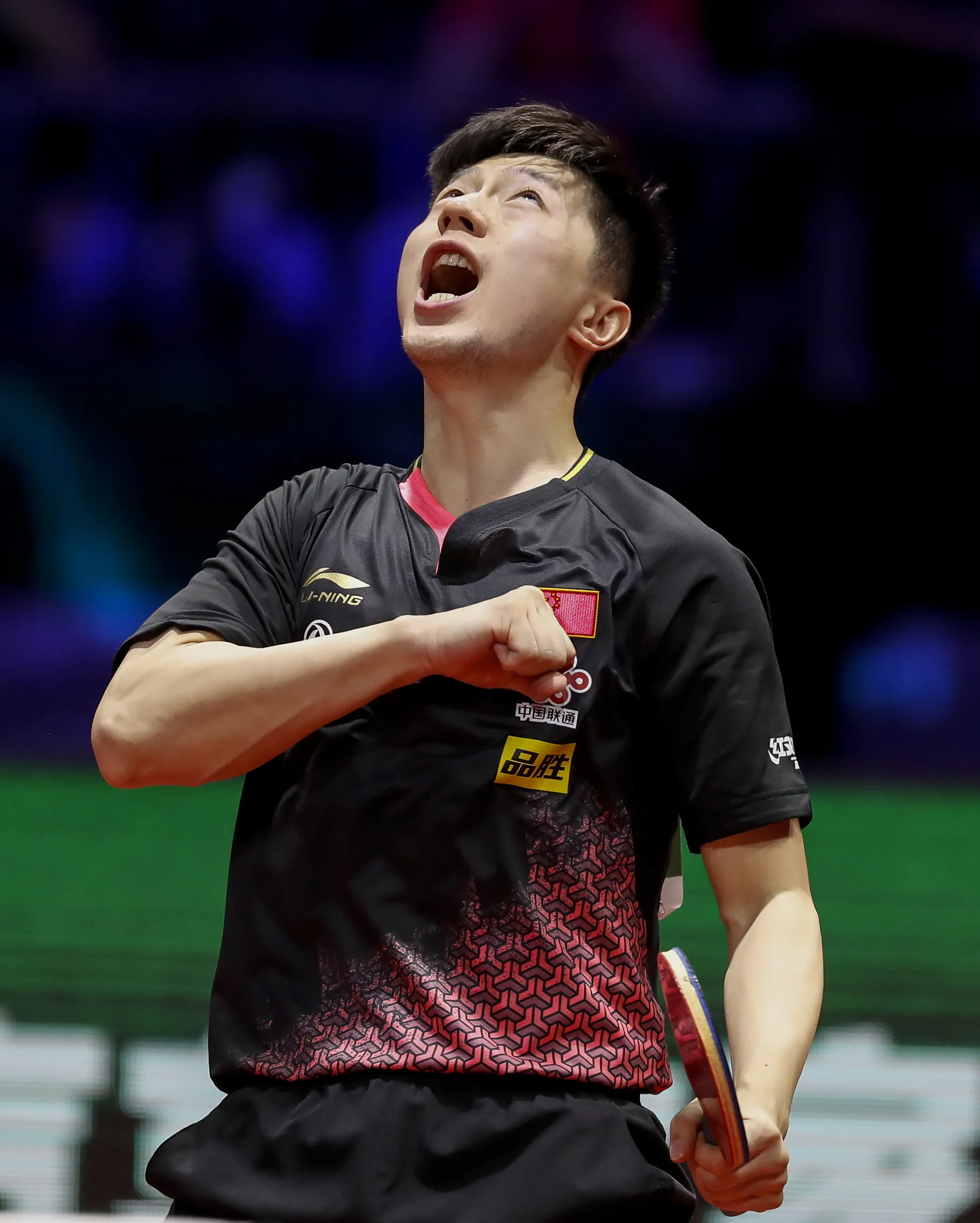
Suzhou, 2015. The World Championship final. Ma Long versus Fan Zhendong — the man who was supposed to succeed him versus the man who refused to be succeeded. Ma Long won, and the win was not just a title. It was a declaration that the succession would not proceed on schedule. Two years later, Düsseldorf, 2017. The same final. The same two men. Seven games, decided by two points, with Fan Zhendong — the future, the heir, the younger, faster, harder-hitting player — throwing everything at the hexagonal wall and finding nothing to break. Ma Long won again, and the roar he let out — the rare explosion — was not the roar of a man celebrating a title. It was the roar of a man who had been told for a decade that he was not powerful enough, not chosen enough, not the future, and had outwaited every single person who had been told he was.
Budapest, 2019. The third consecutive World Championship. The final was against a Swedish player — Mattias Falck, the first non-Chinese finalist in sixteen years — and Ma Long won that too, completing the three-peat that no man in the modern era had managed. But the real opponent was still the clock, and the clock was still losing.
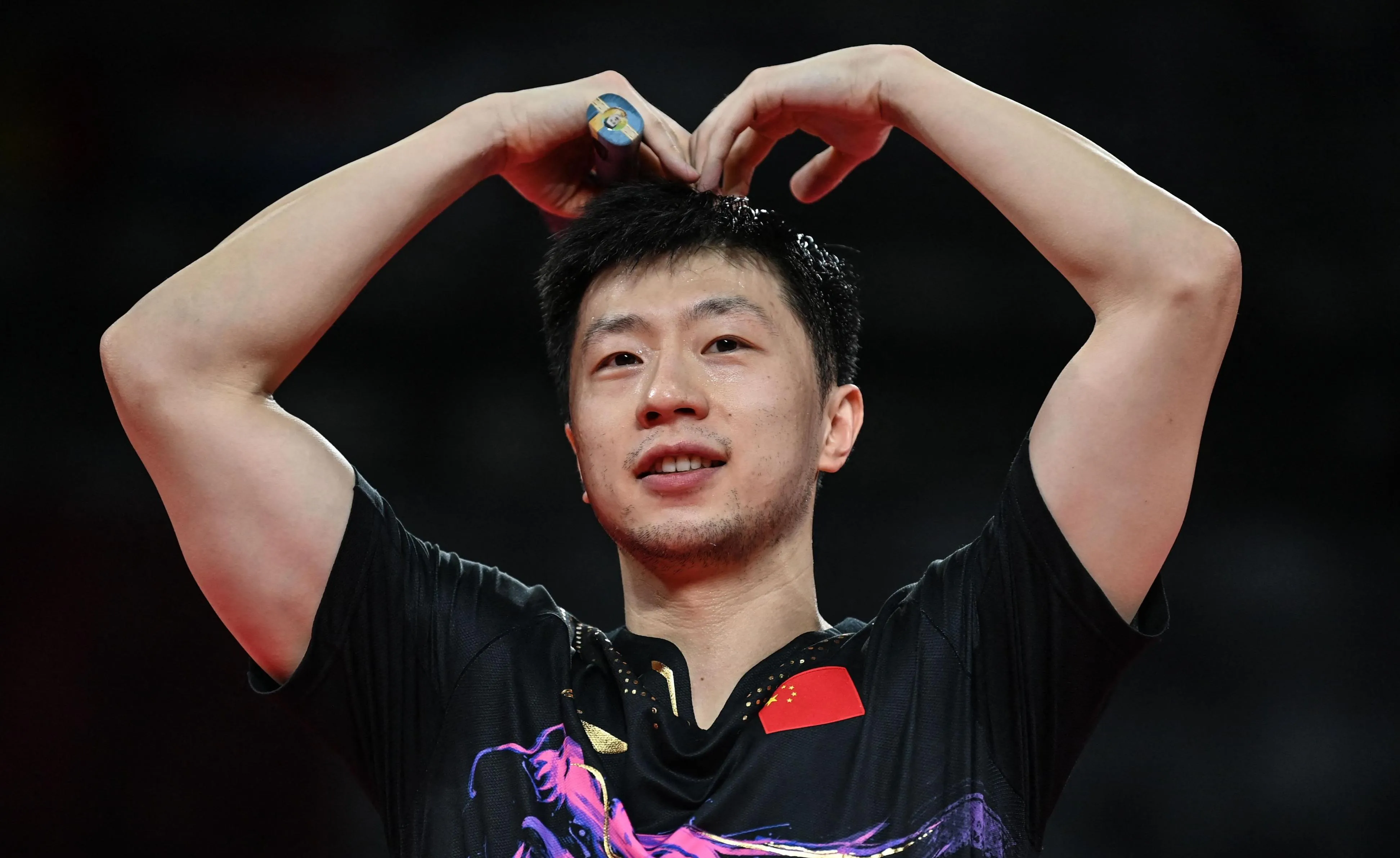
Rio, 2016. Olympic gold at twenty-seven — old, by the sport’s brutal calendar, for a first Olympic singles title. The global press had already anointed successors; the succession had already been written. He won anyway, beating Zhang Jike in the final, and for one moment the machine showed a human gesture: he made a heart with his hands above his head, the image that ran on every front page the next morning. It was the only time the civil servant looked like a man who had just won something he desperately wanted.
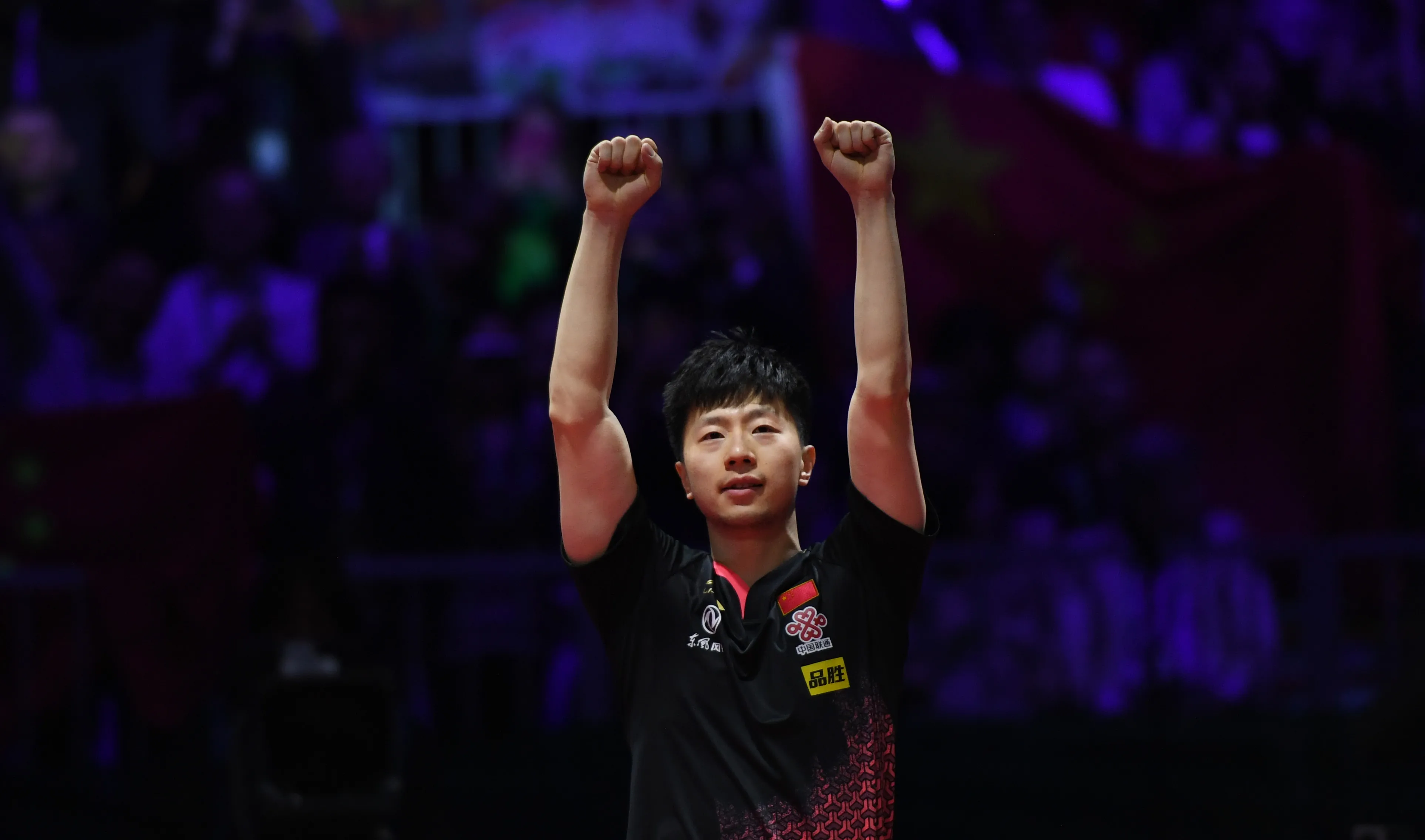
Tokyo, 2020, held in 2021, in the empty arena. He was thirty-two. Fan Zhendong, twenty-four, was the favorite — the heir, the man whose entire career had been a waiting game for this exact moment. The final was not close. Ma Long administered it the way he administered everything: no drama, no weakness. He became the only male player in history to complete the career double Grand Slam. The man who had been told at eighteen that his forehand was not powerful enough had just beaten the future with a game that had no need of power. He had outwaited a generation. He had outwaited time itself.
And then the strangest part of the story: he had to find out what was left.
The perfection is the cage
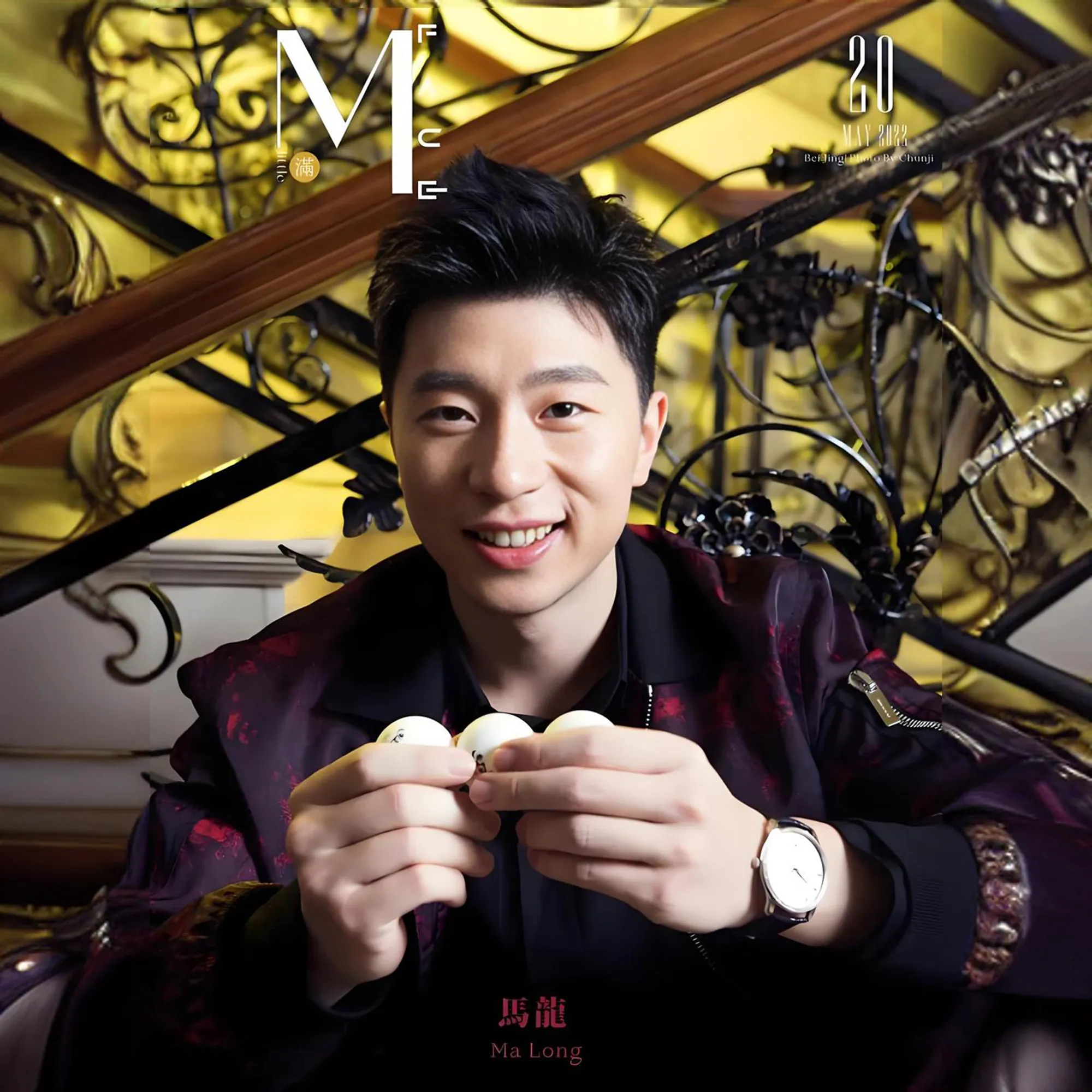
This is the question the medals hide. When you are so good that nobody can beat you, how do you stay a person inside it?
The Chinese fans who called him The Dictator were not wrong, and the word carries a loneliness they also understood. A dictator has no peers. A dictator has no rivals — only subjects, only outcomes, only the endless administration of the inevitable. Ma Long spent the second half of his career inside a machine of consistent winning, and the machine was of his own making. He had engineered a game with no weakness, and the cost of that engineering was that nobody could touch him — and nobody could reach him either. The roar at Düsseldorf was so memorable precisely because it was so rare. The rest of the time, he won the way a system wins: correctly, completely, alone.
There is a detail from the Tokyo final that the cameras caught and the commentary did not explain. When the last point ended, when the double Grand Slam was complete, Ma Long did not collapse or scream or cry. He stood at the table for a moment, then walked to the net and shook the hand of the man who had been born to succeed him. Fan Zhendong looked like he had lost to a law of physics. And Ma Long looked like a man who had just finished proving something he had been told his whole life he could not prove, and had discovered that the proof did not feel the way he had expected it to feel.
The perfection is the cage. The thing that made him unbeatable is the thing that made him unreachable — by opponents, by the sport, by the very succession drama he had outlasted. He had held the dynasty gate so long that the dynasty had nowhere to go but through him, and when he finally opened the gate, in Paris, it was not because he had been passed. It was because he had decided, at last, to pass it himself.
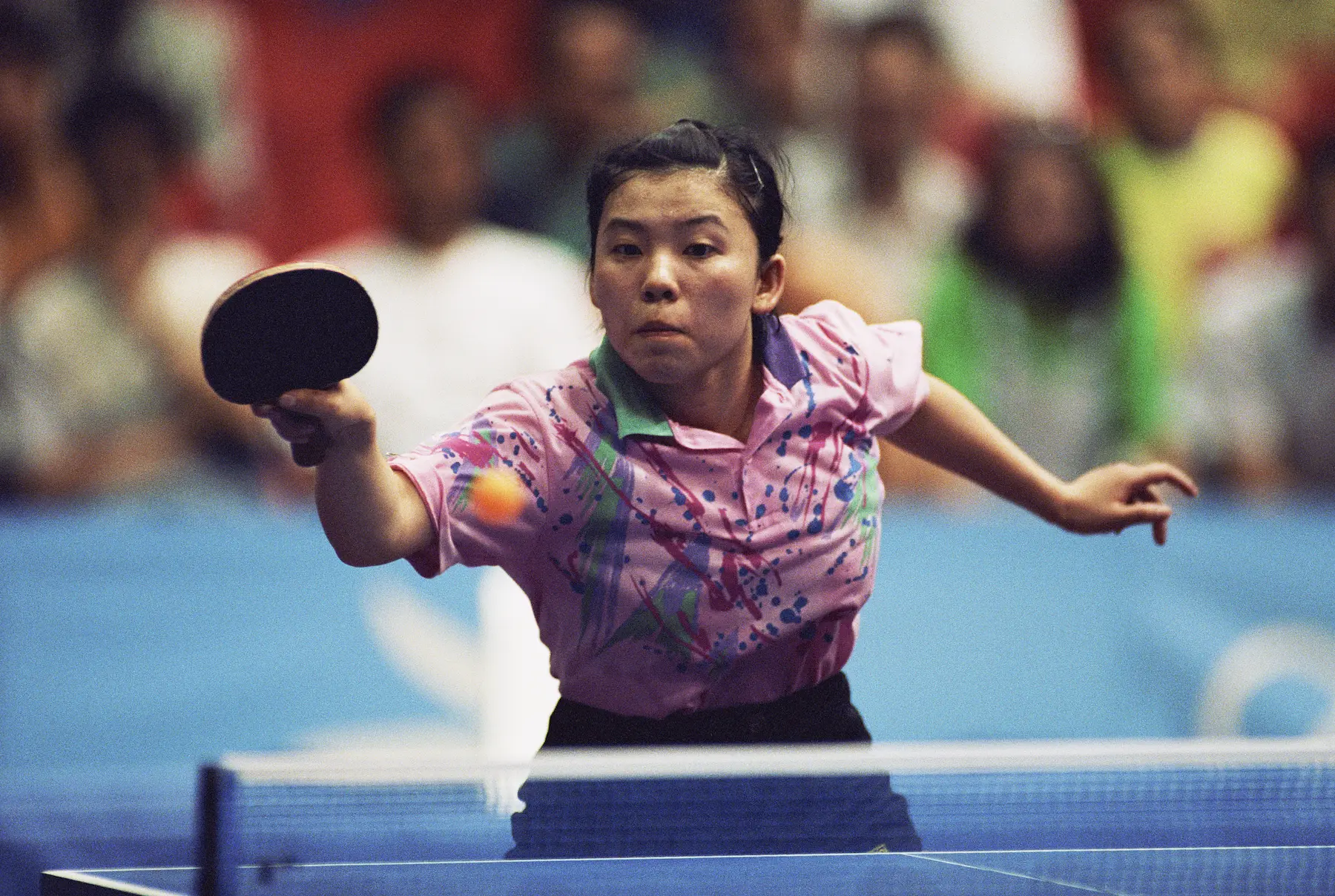
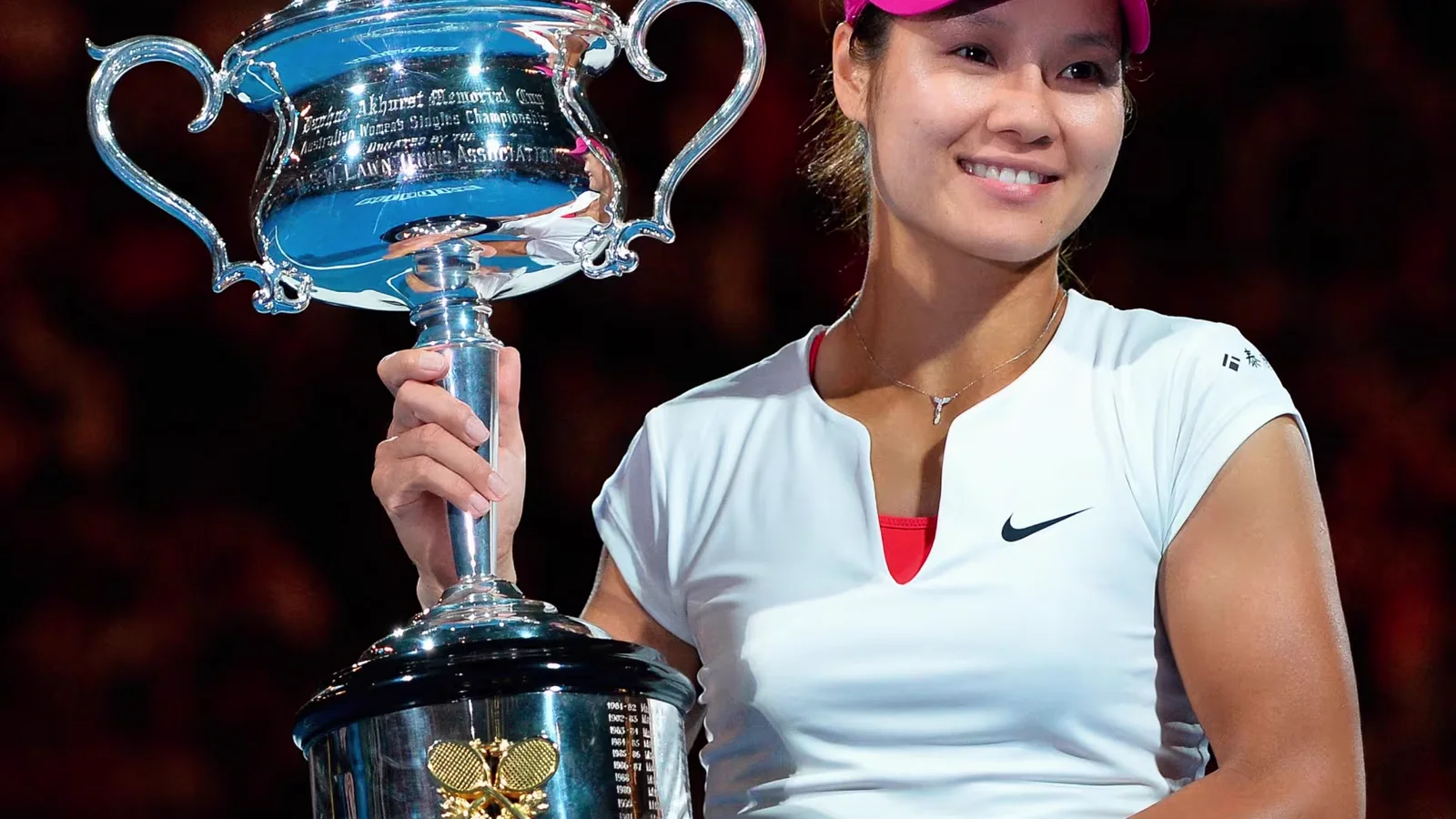
He completes a quartet the Athletes archive has been assembling — four answers from the same nation to one question about what greatness costs. Liu Xiang carried the weight of a nation until his body broke under it. Li Na refused the role it offered her and won on her own terms. Deng Yaping, the dynasty that preceded his in the same national sport, was declared too small and outgrew the measurement meant to end her. Ma Long outwaited time itself — the fourth answer, the quiet one.
The last administration
Paris, 2024. He did not play singles. The singles spots went to Wang Chuqin and Fan Zhendong — the next generation, the names born to succeed him — and Fan Zhendong finally won the Olympic gold that had been promised to him since 2015. The coronation proceeded at last, on a schedule that Ma Long had dictated. He played the team event, the oldest man on the floor, the captain, the carrier. And in the final, against a Swedish team led by Truls Möregårdh — the man who had stunned Wang Chuqin in the singles draw — Ma Long did what he had always done. He administered the outcome.
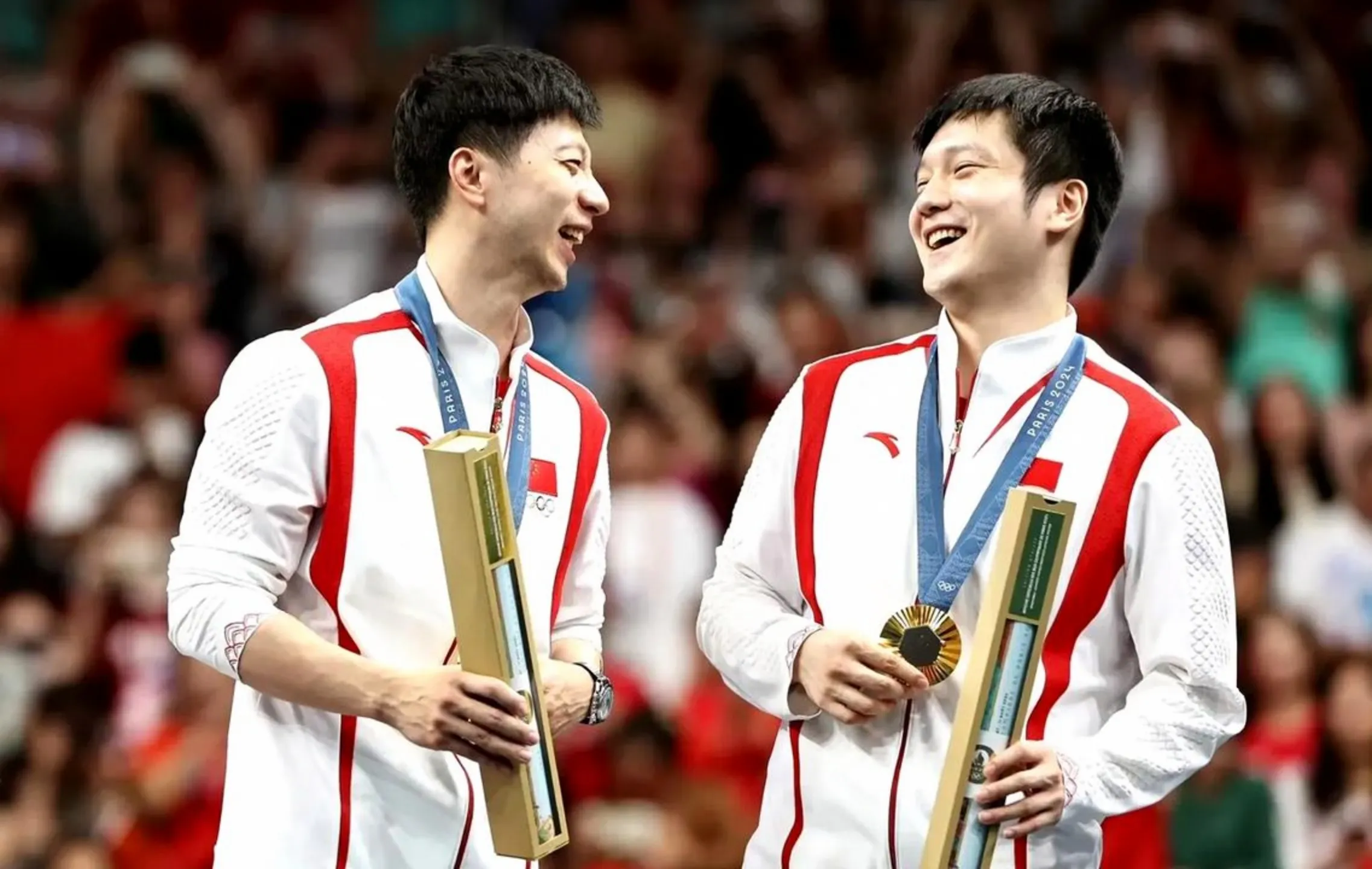
When it was over, he had six Olympic golds, more than any Chinese athlete in history, and he stood apart from the celebration, watching the young ones jump. The image is the whole story. The greatest player in the history of the sport, at the end of his last Olympic match, not exploding, not weeping, not claiming the moment. Just watching it happen, the way a man watches a system he built continue to run without him. He had already said it would be his last Olympics. The administration was over.
The question the story has been carrying since the first paragraph is the question Ma Long had to answer in the years after the table. When you have spent your entire life proving you could win, and winning becomes the thing everybody expects, the win stops being yours. It becomes a count. It becomes a service. It becomes the administration of an outcome that was decided before you arrived. And the person inside the machine has to find something that is still their own.
The practical lesson of his life is not about table tennis. It is about the diagnosis of insufficiency. The next time you are told you lack the one thing that seems to matter — the raw power, the talent, the timing, the youth — do not ask how to acquire more of what you were told you lack. Ask instead what a complete version of your own game would look like: not louder, but wider; not faster, but with no exploitable seam. Ma Long was told his forehand was too weak and answered by becoming the most balanced player the sport has ever seen — a game with no weakness to attack, which is harder to beat than a game with one enormous strength. And when you finally reach the top of the thing you were told you could not win — ask what the win was for, and what you are building that will still be you once the winning is over.
The Anshan boy who was told his forehand was not powerful enough became the man who made winning look inevitable. He outwaited a generation, then outwaited the next one. He held the dynasty gate until the dynasty had to rewrite its own succession around him. And in the end, the thing people remember is not the explosion of a win but the silence of one — the oldest man on the floor, watching the young ones jump, holding six gold medals and the quiet knowledge that the administration was finally, completely, over.
They called him The Dictator. It was affectionate. It was accurate. And it was the loneliest nickname in sport — because a dictator, in the end, has nobody left to beat, and has to decide what that means for the life after the table.
The six sides
The Japanese media did not invent the hexagonal warrior because Ma Long had a radar chart. They invented it because, when they scored him across the six dimensions of the sport — speed, power, technique, serve and receive, defense, mentality — every side came back maxed, and the shape on the page was a perfect hexagon with no short edge. The nickname has stuck for fifteen years because it is still the most precise thing anyone has said about his game.
But a hexagon is not a technique. It is the absence of a hole. This is what the six sides actually were — the forehand, the backhand, the serve, the receive, the footwork, and the tactical brain that wired them together — and why none of them could be attacked.
The forehand: not louder, but perfectly calibrated
They told the junior world champion his forehand was not powerful enough. What they got instead was the most textbook forehand in the modern game — and the distance between the two is the whole story of Ma Long.
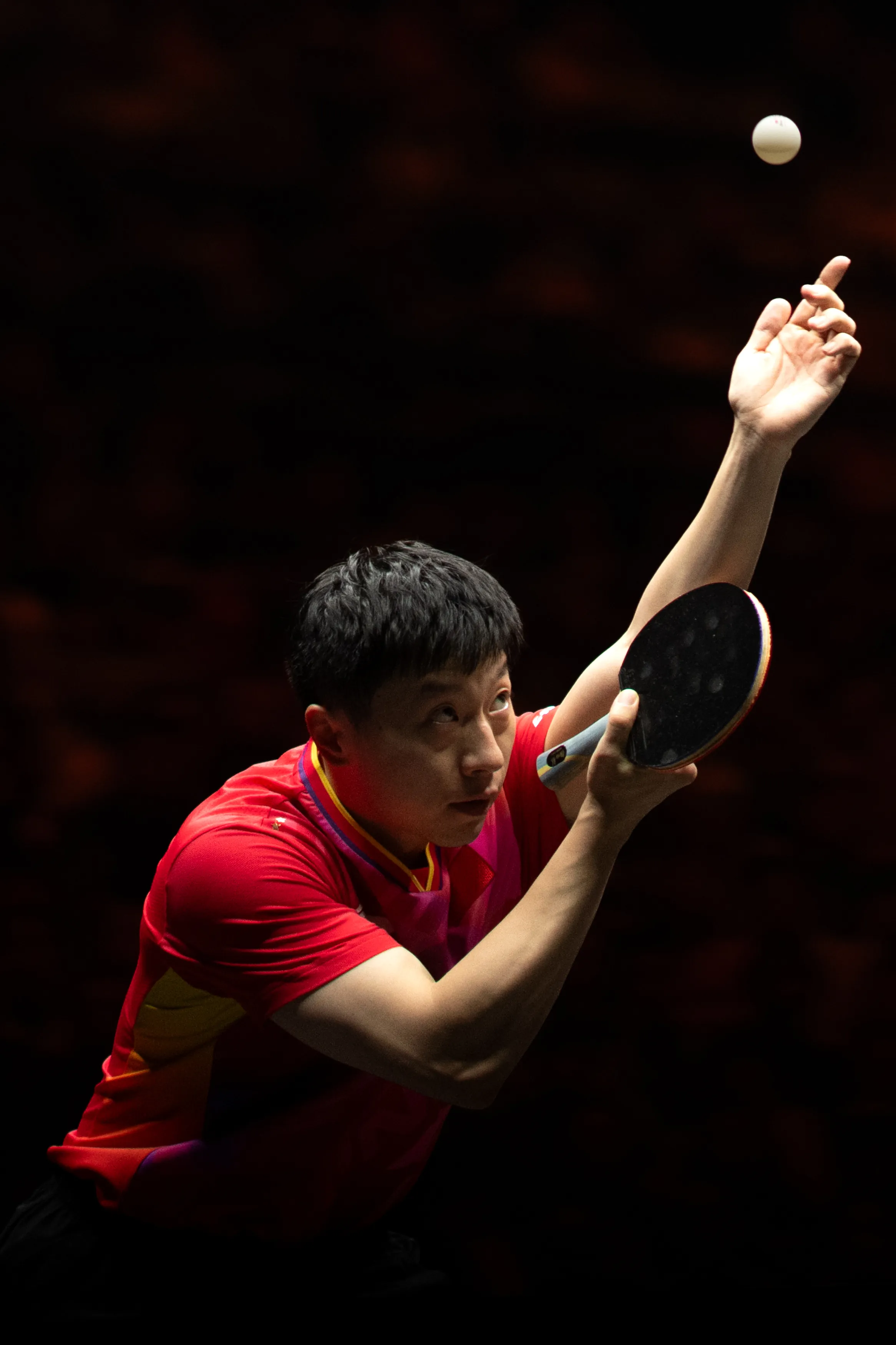
His frame was built for repeatability, not spectacle. He turned hips and waist together into the take-back, coiling the lower body like a wound spring so the stroke released through the core rather than the arm. He met the ball at almost the same point every time — in front of and to the right of his body, roughly thirty centimeters out — so that the contact never drifted, even at the speed of a world final. And he finished short: not a long arm swing but a fast forearm snap that made the arc and the spin, which is why he recovered so quickly. A small stroke comes back fast.
The genius of the forehand was that it was not one shot but a set of gears, selected by situation.
The forehand’s three gears
| Gear | The shot | What it does |
|---|---|---|
| Attack | Inside-out power loop | Side-steps into the forehand and drives low, fast and to the corners — the point-ending ball |
| Rally | Continuous looping | The second and third loops lose no quality; he keeps pressing until the opponent breaks |
| Defense | Quick block / counter-loop | From an awkward position, blocks on the rise or counter-loops — defense turned back into attack |
Most players have one good first ball and a fading second. What made Ma Long’s forehand total was the rally gear: he could hit the first loop hard, the second harder, and the third with no drop in quality, so that opponents who survived the opening exchange were beaten by the fifth ball instead of the first. That is not power. It is the calibration of power, sustained.
The forehand also covered the table. His Chinese nickname, Captain Long’s fast steps, was about exactly this: he could use the forehand from anywhere, including the backhand corner, because his footwork let him side-step into position and still recover. In the Rio 2016 meeting with Zhang Jike, Zhang moved him corner to corner and every forehand came back at the same high quality, until the man with the fastest hands in the sport had no seam left to aim at.
The backhand: the shot he spent a career rebuilding
If the forehand was the gift, the backhand was the project. It is the most evolved part of his game, and it is the answer to the question of why a player with slowing legs got better as he got older.
There were three backhands in one career.
The first was a transition shot. Before roughly 2012, his backhand existed to feed the forehand: a forward push with a tucked elbow and a short forearm snap — remarkably safe, almost impossible to force an error from, and not remotely a weapon. Its job was to keep the rally alive long enough for him to side-step and end the point with the forehand. It was a transfer station, not a destination.
The second arrived around 2015, when the sport’s backhands went nuclear — Zhang Jike’s banana flick, Fan Zhendong’s cannon — and Ma Long, to his credit, did not pretend otherwise. He rebuilt the shot: the backhand rip became a genuine attacking weapon, the chiquita became a routine serve-receive rather than an occasional trick, and he added the ability to change direction mid-rally, suddenly ripping down the line out of a cross-court exchange. The Macau World Cup in 2024 was the demonstration. Against Wang Chuqin — a man who had beaten him six times in a row — Ma Long played reverse-spin serves and a backhand-first game, the angle rip and the punch and the rip up the middle, and swept him 4-0 by beating him at the thing Wang Chuqin does best. It was the least Ma Long-like performance of his career, and it was his most complete.
The third backhand belongs to the second half of his life, and it is not really a backhand at all. It is a knife. The side-cut: when the opponent unloads a heavy loop, Ma Long does not block it back and does not try to out-hit it. He slides the face of the racket across the side of the ball and cuts under it, producing a heavy side-and-back spin. The ball lands and then sinks and bends sideways; the opponent, already committed to the next attack, finds the ball short and heavy and swings through nothing. The side-cut is not a defensive shot — it is a rhythm weapon. It turns a fast exchange slow, turns topspin into something that behaves like a knuckleball, and the adjustment it demands (new racket angle, new timing, new footwork) is where rallies go to die. Only Truls Möregårdh leans on the shot more often than Ma Long, and nobody uses it more surgically.
The backhand’s three phases
| Phase | The shot | Its role |
|---|---|---|
| To 2012 — the transition backhand | Forward push, tucked elbow, short forearm snap | Extremely safe, almost error-proof, but not a weapon — a transfer station that kept rallies alive for the forehand |
| 2015 — the rebuilt backhand | The rip, the chiquita, the mid-rally direction change | A genuine attacking shot; the Macau 2024 route to beating Wang Chuqin at his own game |
| After 30 — the side-cut | A sliced, side-under-spin cut against heavy attack | A rhythm weapon: the ball sinks and bends, the opponent swings through nothing — the “wiser with age” signature |
The serve: a magic trick performed at the chest
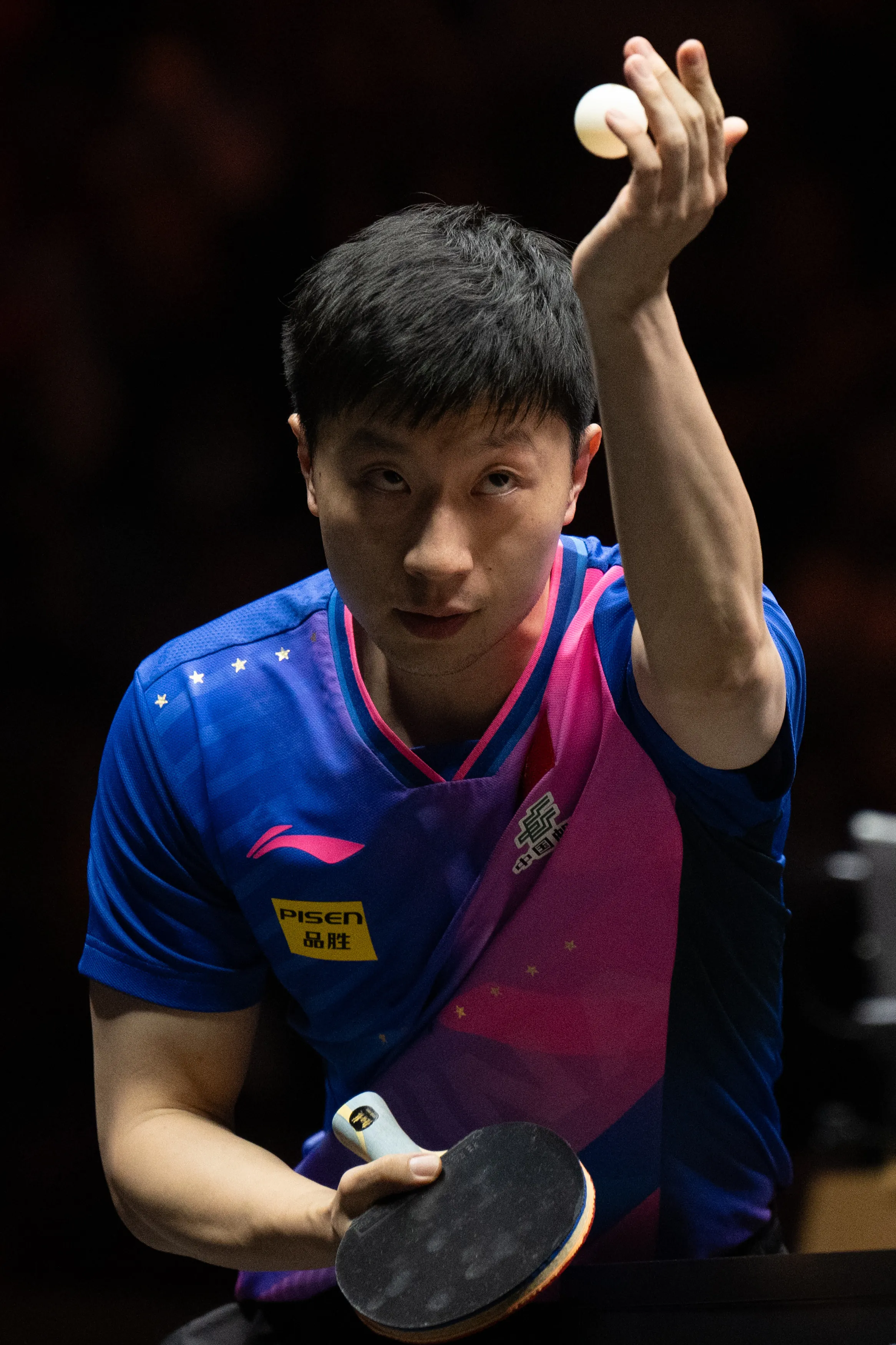
Ma Long’s serve is the kind of technique that looks simple until you try to read it. He raises his elbow in the take-back — an unusual, almost awkward “shelf” position — and strikes the ball in front of his right chest rather than down at waist height. That high contact point is the whole trick. Because the ball is struck close to the body and high, the opponent cannot see the racket face or the friction at the moment of contact. The side-backspin and the side-topspin versions begin identically and end with a wrist adjustment too small to see.
From that one frame he produces at least three completely different balls.
The shovel serve: one motion, three spins
| Variation | The contact | What the ball does |
|---|---|---|
| Left side-backspin | Brushed down the lower-left of the ball | Sinks and curves toward the opponent’s backhand |
| Left side-topspin | Brushed up the lower-left of the ball | Kicks forward and up; a push floats high |
| No-spin | Pushed flat, racket face forward | Looks like backspin, carries almost none; a drive flies out, a push pops up |
The serve was not there to win points directly, though it often did. It was there to control what came back and to set up the third ball. The classic pattern: serve short to the forehand with sidespin — the angle sharp, the spin heavy — so the opponent either cannot flick it with quality or flicks it into the zone Ma Long has already anticipated, and the third ball is a side-step forehand power loop. The serve was the first move of a combination, not a lottery ticket.
The receive: the ceiling of the short game
If there is one area where Ma Long is not merely great but the best in the world, it is the receive. He does not win it with the banana flick. He wins it with the short game — with touch, disguise, and an understanding that the receive is not a reply but the first shot of his own attack.
The hardest receive in table tennis is the short ball to the forehand corner, the point on the table furthest from the body. Ma Long has three complete answers, and he chooses among them not to survive but to steer.
Reading the short ball: three receives
| Return | The shot | The purpose |
|---|---|---|
| Push short | Right foot into the table, body close, ball struck at the instant of the bounce — net-skimming, short, still spinny | Deny the attack, force a push back, wait for the ball to rise |
| Flick | A disguised flick that looks like a push until the wrist flips | Attack out of the short game; the disguise makes it unreadable |
| Long push | A deep, fast, low drive to the baseline instead of a short ball | Break the short game by attacking it long — push the opponent back |
The combination is the weapon. Two short pushes bring the opponent to the net; one long push sends them retreating; another short push brings them in again. Sometimes a flick, sometimes a push, sometimes a long ball — the opponent is made to guess, and a receiver who is guessing is already being attacked. That is why the receive, statistically a defensive phase for most players, was a scoring phase for Ma Long.
The footwork: the operating system
None of it works without the part of the game nobody films. Ma Long’s footwork is the operating system his technique runs on, and its defining quality is not speed but earliness. He reads the opponent’s stroke and moves as the ball is struck, so that by the time the ball arrives he is already in position. He looks unhurried because he is never reaching; he is always waiting.
The side-step is textbook: a small pad with the left foot, a single precise step with the right, the body clearing enough room for a full forehand and — the part most players never master — a fast recovery, so the forehand corner he just vacated is safe again before the opponent can exploit it. And then there is the cross-step to the forehand, which is where his range came from. Sent to the wide forehand, most players make a do-or-die lunge: they either reach the ball or they do not, and the point ends either way. Ma Long cross-steps, saves the ball, counter-loops it — and is back in position for the next ball. The lunge has a sequel. That sequel is the difference between defending a corner and owning the table.
The tactics: a library, not a weapon
Everything above is hardware. The reason the hexagon closed was the software — a tactical mind that could pick a different system for every opponent.
The base pattern was the one-three-five combination. The first ball, the serve, controlled the return. The third ball, based on the quality of that return, was either a direct attack or another layer of control. The fifth ball, if the third had not finished it, kept escalating. The terror of the pattern was its continuity: not a coin-flip winner, but pressure applied ball after ball after ball, so that the opponent who survived the third still had to survive the fifth, and then the seventh.
On top of that he layered rhythm. He could play fast — taking the ball on the rise, ripping close to the table, blocking early — and he could play slow — pushing short, side-cutting, absorbing pace. In any given rally he would alternate between them, speeding up to drive an opponent back and then dropping a slow ball to pull them forward again, so that the opponent was never comfortable and never set.
And beneath it all, the placement. Ma Long’s tactical signature was not hitting the hardest ball but hitting the ball that made the opponent run. Backhand, backhand, then the wide forehand; the opponent scrambles across, and the next ball goes back to the backhand. He was not winning a hitting contest. He was winning a footrace, because the man who moves more misses more.
Why the hexagon held
The Japanese chart scored six attributes and found no gap. What it could not show was the three things that made a gap impossible.
First, there was no weakness to aim at. Test the forehand and you meet the best forehand in the world. Test the backhand and you meet a wall. Test the short game and he pushes shorter than you. Test the long game and his counter-loop is fiercer than your attack. Every opponent arrived with a plan, and every plan was the same plan — find the seam — and there was no seam.
Second, he could change systems. Against a backhand-dominant opponent he could play the forehand game; against a forehand-dominant opponent he could grind with the backhand rhythm; against a younger, fitter opponent he could refuse the physical contest entirely and win with control, rhythm and the first three balls. Need to beat a mirror of himself, and he would reach for the patterns that mirror had never seen. He was not a style. He was a library of styles, and he chose the book that beat you.
Third, and strangest, he got better as he got older. After thirty, his legs slowed and his results steadied — because he had begun to play with his mind instead of his body. The side-cut appeared more often, saving energy. The tactics grew richer to compensate for the lost speed. The key points, which he had once lost to Wang Hao, he now owned, because experience and nerve had become their own weapons. At the Paris Olympics in 2024, at thirty-six, he won a sixth gold as the core of the men’s team. At the 2025 National Games, at thirty-seven, he won the mixed doubles. That is not a technique. That is the sport, understood to its limit.
Liu Xiang redefined the technical efficiency of hurdling; Li Na redefined the attacking ceiling of Asian tennis; Ma Long redefined how complete a table tennis player could be. Before him, the word “complete” meant a player with no obvious weakness — and, implicit in the praise, no standout strength. Ma Long broke the equation. He showed that complete could mean every part was a strength, and that the strengths, wired together, made a system harder to beat than any single weapon ever could.
Liu Guoliang, who had once told the young Ma Long he was too well-behaved, gave the game its summary: “No matter who any country sends out, he goes first — and he doesn’t lose for four years.”
He did not merely win a great many matches. He showed where the ceiling of table tennis, in technique and in thought, actually sits.
Championship Record
Core data overview
Ma Long — Championship statistics (through September 2026)
| Category | Titles | Notes |
|---|---|---|
| World champion total | 31 | Most by any male player in table tennis history |
| National-level and above | ~161 | Through the 2026 National Championships |
| ITTF GOAT certification | April 2026 | ITTF centenary documentary officially names him the GOAT |
Olympic Games — 6 gold medals (the most by any Chinese athlete)
| Games | Event | Final |
|---|---|---|
| London 2012 | Men’s team | Gold |
| Rio 2016 | Men’s singles | Gold |
| Rio 2016 | Men’s team | Gold |
| Tokyo 2020 | Men’s singles | Gold |
| Tokyo 2020 | Men’s team | Gold |
| Paris 2024 | Men’s team | Gold |
Ma Long is the first male player in Olympic history to successfully defend the table tennis men’s singles title. He won the first in Rio 2016 and the second in Tokyo 2020, making him the only man to achieve Olympic singles gold twice in the sport’s modern era.
World Championships — 14 titles
| Category | Years | Final result |
|---|---|---|
| Men’s singles (3) | 2015 · 2017 · 2019 | Three-peat — matching Zhuang Zedong’s 54-year-old record |
| Men’s team (9) | 2006 · 2008 · 2010 · 2012 · 2014 · 2016 · 2018 · 2022 · 2024 | Nine gold medals — record for any male player |
| Mixed doubles (2) | 2011 · 2017 | Two gold medals |
The three consecutive men’s singles titles earned him permanent possession of a replica of the Swaythling Cup — the original is held by the ITTF.
- 2015 Suzhou: defeated Fang Bo 4-2 — his first World Championship singles title; celebrated by leaping onto the table
- 2017 Düsseldorf: defeated Fan Zhendong 4-3, overcoming a 9-12 deficit in the decisive fifth game with a stunning 10-12 comeback
- 2019 Budapest: defeated Mattias Falck 4-1 — completing the three-peat and the first non-Chinese finalist in sixteen years
World Cup — 11 titles
| Category | Year | Final result |
|---|---|---|
| Men’s singles (3) | 2012 Liverpool · 2015 Sweden · 2024 Macau | First world-level singles title: 4-0 vs Timo Boll; Perfect 4-0 vs Fan Zhendong without losing a game; 4-3 vs Lin Gaoyuan after trailing 0-3 — his 30th world title |
| Total participation | 8 editions | 3 gold, 2 silver, 3 bronze — one of the most decorated players in World Cup history |
Other major championships
Selected tournament records
| Tournament | Titles | Notes |
|---|---|---|
| ITTF Pro Tour Grand Finals | 7 | All-time record (2008, 2009, 2011, 2015, 2016, 2020) |
| ITTF Pro Tour singles | ~50 | All-time record |
| Asian Championships (singles) | 4 | 2009 · 2012 · 2013 · 2023 |
| Asian Cup (singles) | 4 | 2008 · 2009 · 2011 · 2014 |
| Asian Games | 5 | Including 2010 men’s singles gold |
| National Games | 3 | Men’s singles champion (2013, 2017) |
Historical status certification
On April 23, 2026 — the centenary of the International Table Tennis Federation — the ITTF released the documentary Who is the Table Tennis GOAT?, officially certifying Ma Long as the greatest athlete in the sport’s history. The official evaluation criteria — Olympic gold medals, World Championship titles, World Cup titles, Pro Tour titles, and cumulative months at world No.1 — show Ma Long leading in every category by a significant margin.
He is the only male player to complete the career double Grand Slam twice — collecting Olympic, World Championship, and World Cup singles golds on two separate occasions. He is also the first male player to have won all nine major singles titles: Olympics, World Championships, World Cup, Asian Games, Asian Championships, Asian Cup, Pro Tour Grand Finals, and National Games — the achievement Chinese fans call the Super Grand Slam.
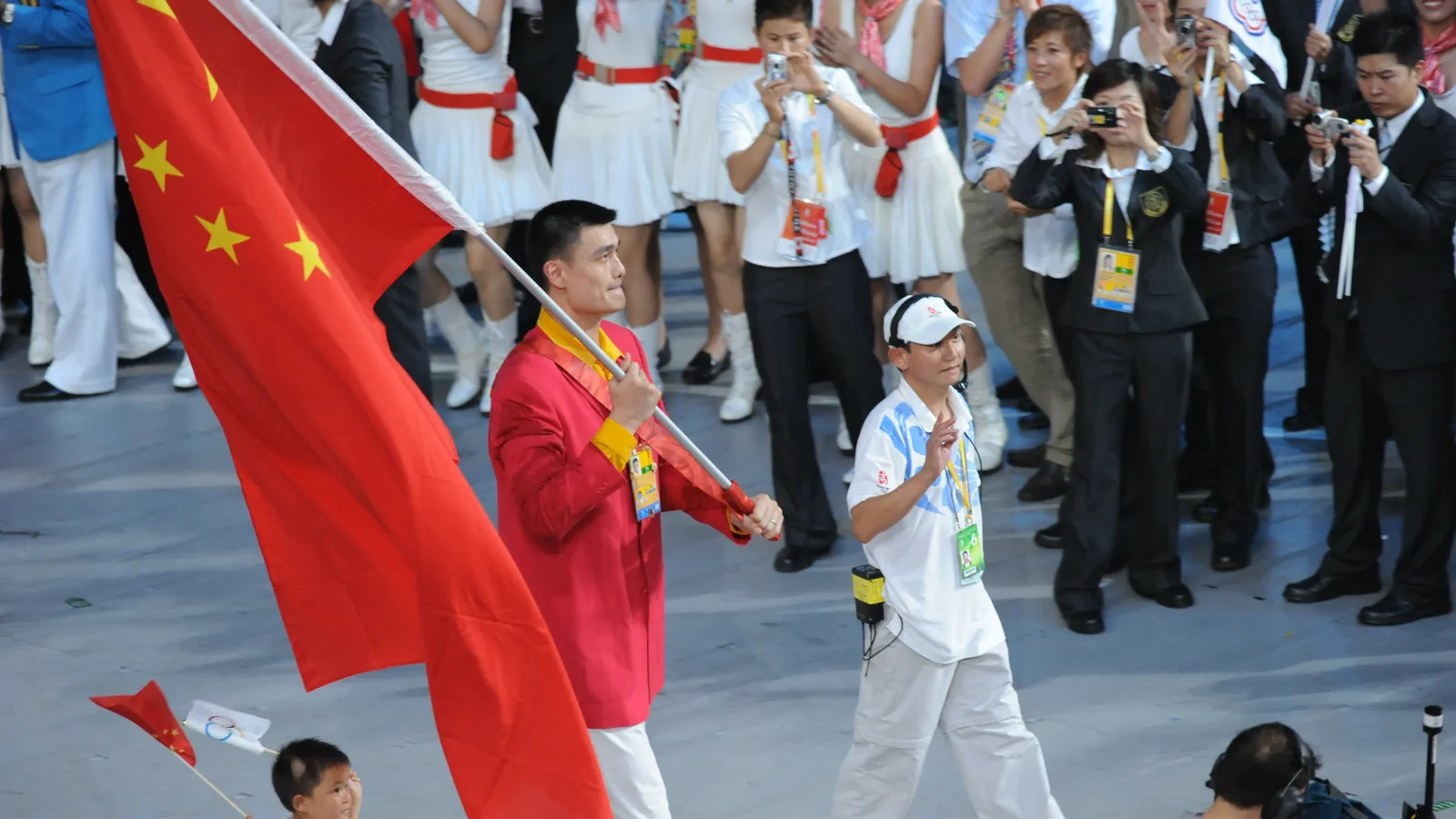
Additional milestones: He served as the flag bearer for the Chinese delegation at the 2024 Paris Olympics opening ceremony. In October 2024, he received the Outstanding Sporting Career Award from the Association of National Olympic Committees. In April 2025, he assumed the role of Vice Chairman of the Chinese Table Tennis Association.
Frequently Asked Questions
How many Olympic gold medals does Ma Long have?
Six — London 2012 (men's team), Rio 2016 (men's singles and men's team), Tokyo 2020 (men's singles and men's team), and Paris 2024 (men's team). No other table-tennis player has more than four, and six is the most Olympic golds ever won by any Chinese athlete.
Is Ma Long the only male player to complete the career double Grand Slam?
Yes. He is the only male player to have won the career double Grand Slam — Olympic men's singles golds at Rio 2016 and Tokyo 2020, three consecutive World Championship singles titles (2015, 2017, 2019), and three World Cup singles titles.
What does the nickname "The Dictator" mean?
In Chinese fan culture the nickname (暴君) carries none of its Western political charge — it is affectionate awe for a player whose game is so technically total and so consistent that his wins feel like the administration of an outcome rather than a battle. Reading it as a criticism misses the meaning entirely.
Who beat Ma Long in the years before he won everything?
It was Wang Hao, who beat him in the biggest matches of his early prime — the 2009, 2011 and 2013 World Championship semifinals — before Ma Long outwaited that rival and the generations behind him.