The world measured her at 1.50 metres and called her finished before she had beaten anyone who mattered. She spent the next decade outgrowing every unit of measurement the world owned — except the one it opened with. Then the system that had measured her small came back and asked her to belong to it.
I. Barcelona, August 1992
The first thing the cameras caught was the difference in height.
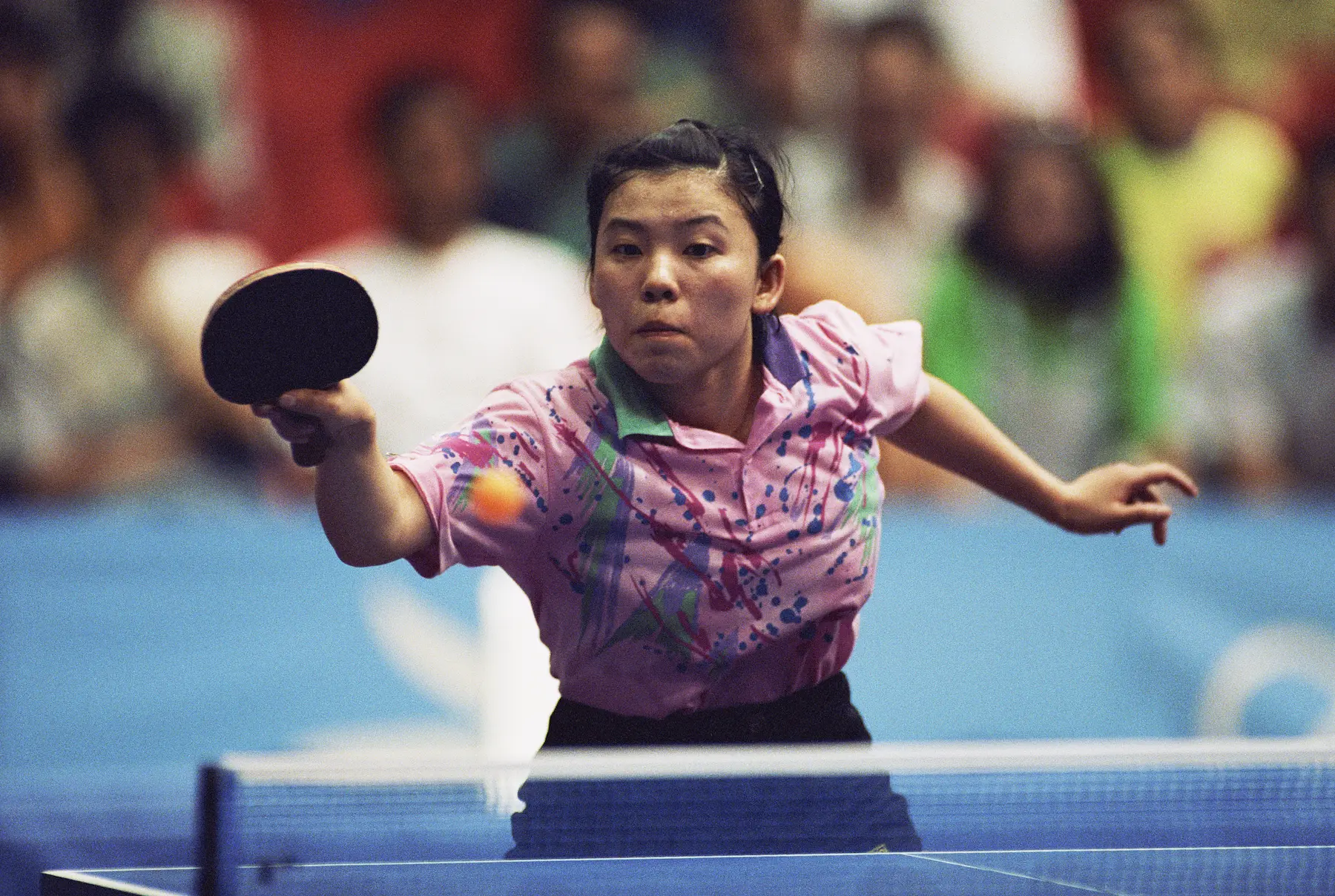
The two women on the court at the Palau Sant Jordi wore the same red shirts, carried the same straight-handle blades, and played the same ruthless, close-to-the-table game — because one of them had built that game and the other had agreed to build it alongside her. Qiao Hong was taller, the way most of the women’s tour was taller. Her doubles partner of four years, her roommate in the Olympic village, stood barely higher than the net post. The scoreboard did not measure height.
No coach sat courtside. Chinese table tennis had a working rule then: when two of its own meet in a final, the chair stays empty and the two players sort it out alone. This is a polite way of saying the nation’s most-watched sport had reached a point where its internal arguments were decided in public, in front of a world that was only there as a witness. There was no one to tell Deng what to do. There never had been, really.
Deng Yaping won, in four games. Days earlier she and Qiao had taken the doubles gold together; now she had beaten the same woman for the singles. Which meant that at nineteen, the shortest person on the floor of the biggest table-tennis stage on earth had become the best in the world at a game that, by every physical metric her own country’s selectors believed in, had been built for somebody else. The hug at the net lasted a few seconds, and then she was a champion, and then she was something stranger: a proof.
Remember Qiao Hong, because the legend tends to file her under “Deng’s partner.” She was a great champion in her own right — she had won the world singles title at Dortmund in 1989, two years before Deng took it in Chiba. In Barcelona it was simply Deng’s turn. But the shape of the event is worth holding onto: the shortest woman in the sport beat her own doubles partner, her roommate, to take the gold, and the margin between them was not talent. It was everything that had been done to them both by a system that had once measured one of them and found her wanting.
II. The number
Here is a number that appears in every account of her life, in every language, repeated so often it functions less as a fact than as a drum: 1.50. One point five zero metres. The world never let her forget the number that was supposed to end her — and in the end, the world was right to keep it. The number made her.
To understand why it nearly ended her before she beat anybody, you have to understand how China found its champions in the 1970s and eighties. Talent identification was blunter than the folklore remembers. Selectors measured children the way stockmen measure yearlings — height, reach, hand span, foot size — and treated those numbers as near-deterministic predictions of what a body could become. The logic had a perverse internal consistency: the state planned to invest in a child for a decade, so it wanted a body that could not be outgrown by the competition. A girl of 1.50 metres, in that calculus, was a dead end. The tape measure spoke first. The table spoke second, if at all.
Deng Yaping grew up in Zhengzhou, the railway city on the Yellow River plain, where Beijing is straight up the iron road and the land between is wheat fields that run flat to the horizon — a landscape that rewards things that grow low and fast. Her given name, Yaping, carries the character ping — duckweed, the smallest green thing, the one that covers whole ponds. Her father, Deng Dasong, was a table tennis coach. He put a racket in her hand at five that was larger than her hand. He strapped sandbags to her ankles and drove her through footwork patterns until her legs gave out, in the way such stories are told in families — with the details worn smooth by repetition and none of the actual pain surviving. At thirteen she won a national junior title. At fifteen she was beating adults. And still, when her name came before the national team selectors, the objection was not her game. It was her height.
The account preserved on Baidu Baike — as close as China has to an official archive of these judgments — records that four of the five selectors voted against admitting her, on exactly those grounds. The majority, presumably, had watched her stand up. They had not watched her play.
She got in, finally, in 1988, at fifteen. Within a year she had a world title. Within two she was the world No. 1. The selectors did not revise their principles. They revised their files.
But it is worth asking, forty years later, whether the height rejection was decisive or convenient. The story has become so central to her legend — the short girl, the closed door — that it now reads as fate, preordained and necessary. Yet the machinery of Chinese sport also liked its origin stories. A champion who had to climb over the system’s own miscalculation was a champion who proved the system’s flexibility — provided she eventually came inside. The rejection made her useful twice: first as the girl who was told no, later as the girl who made the people who said no look generous when they finally said yes. Both uses required her to remain, forever, a centimetre less than the ideal. The metric that was supposed to disqualify her became the metric that defined her.
III. Making the game come down to her
A table tennis table is seventy-six centimetres high. A tall player stands over it and looks down at the ball’s arc, reading spin as a vertical drop. A 1.50-metre player, crouched into the stance Deng developed, sees the ball nearly flat — spin travelling toward her as a horizontal track, not a curve. This is not decoration. It is the entire sport.
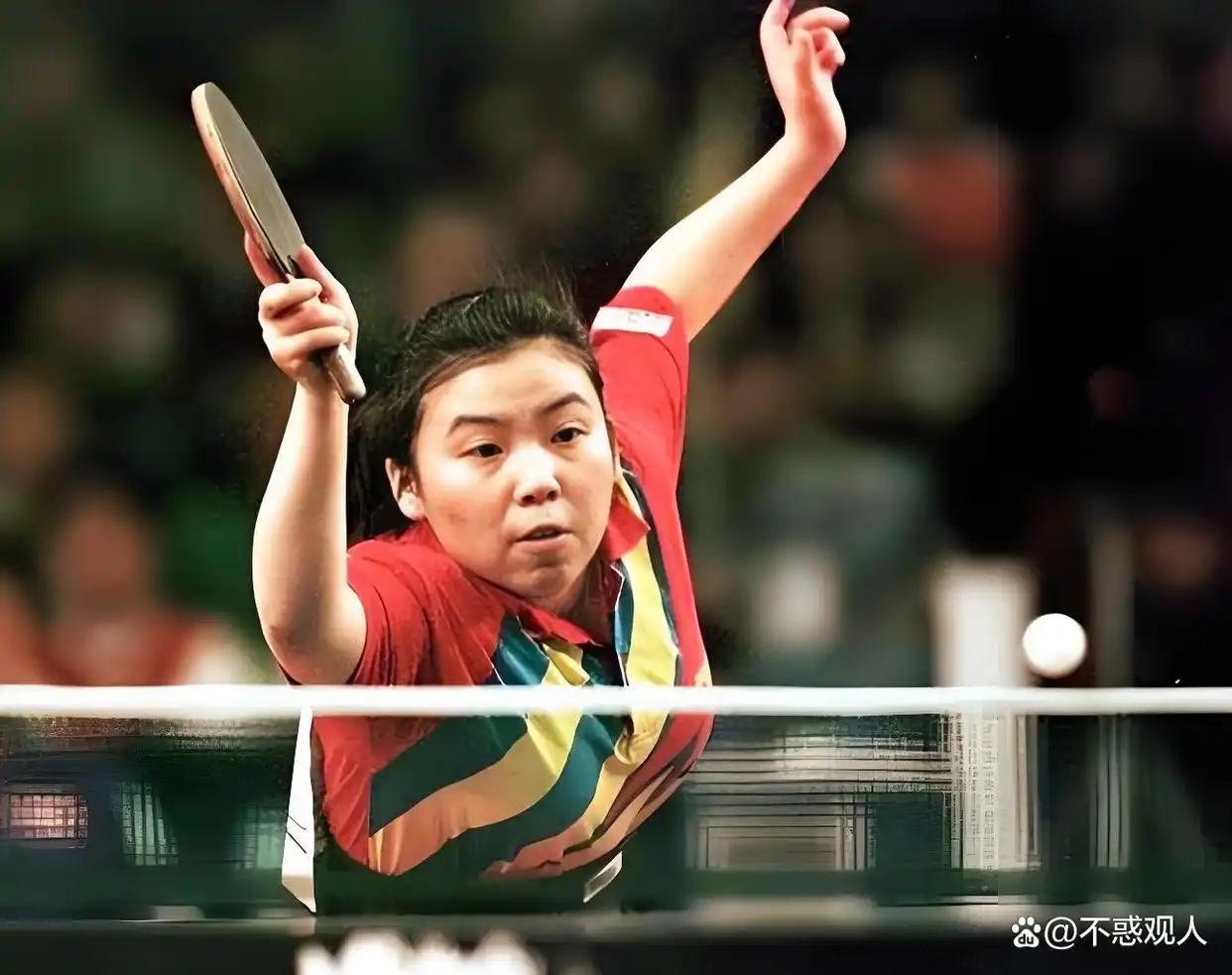
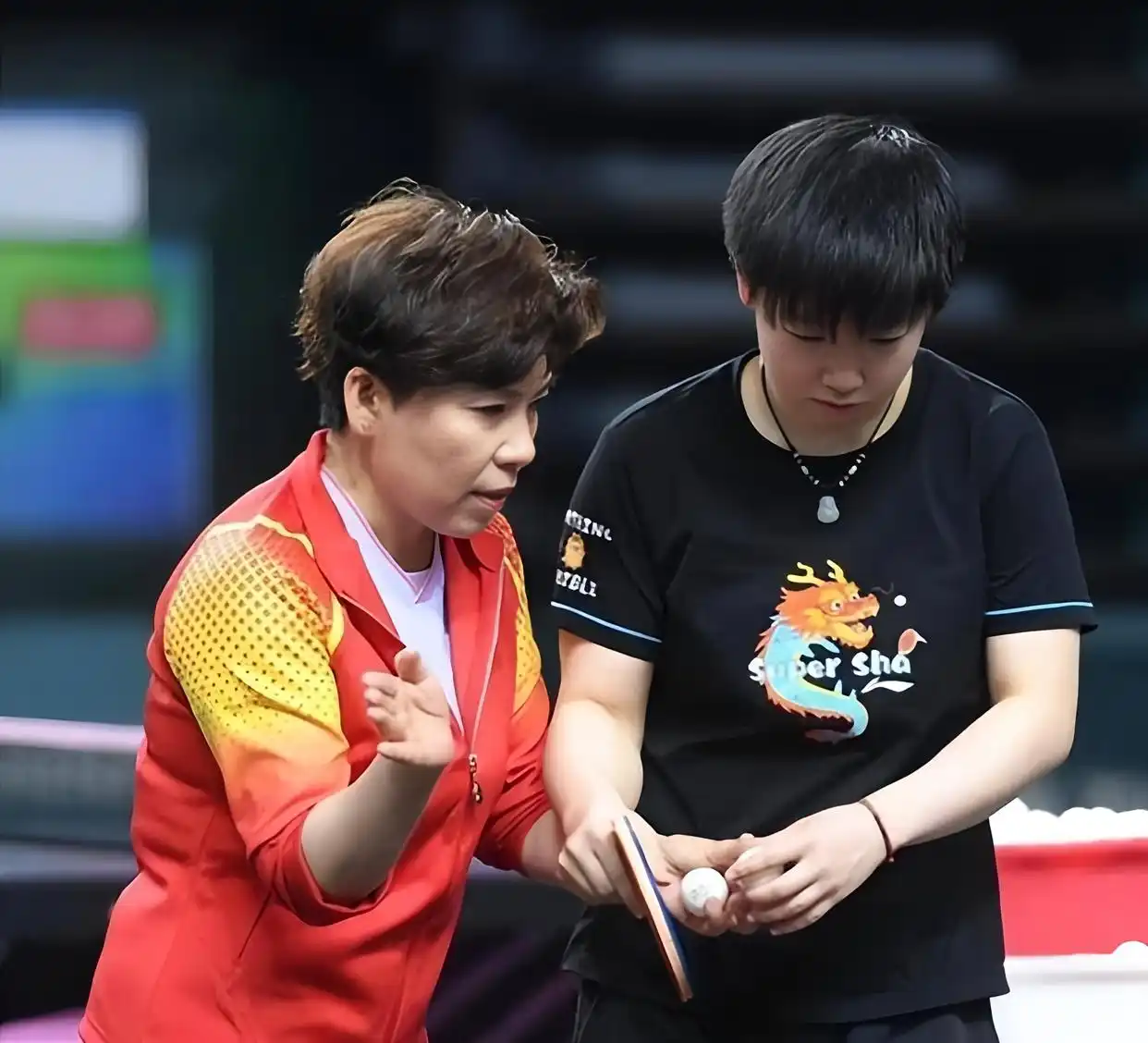
The low centre of gravity that her height forced on her gave her a first step that made taller players look anchored. And table tennis at the top level is not about reach; it is about time. Whoever takes the ball earlier takes the other player’s time away. Deng took the ball on the rise, at the top of the bounce, before its rotation could fully take hold — a microsecond decision repeated thousands of times per tournament, in a crouch that eventually ground her knees down like millstones. Her forehand was a full-body whip, the racket head arriving a beat after her hip: that is how a small woman hit harder than players ten centimetres taller — not with length, with rotation. And her backhand, the traditional weak side of the penhold grip, she turned into a weapon the women’s game had never seen, a wrist-loaded snap that converted a defensive block into an attack.
This was not hard work. It was a reinvention of physics. The table could not be made taller, so she made the game come down to her. The women’s game, which had been a game of spin and patience and defensive stamina, learned to fear the top of the bounce.
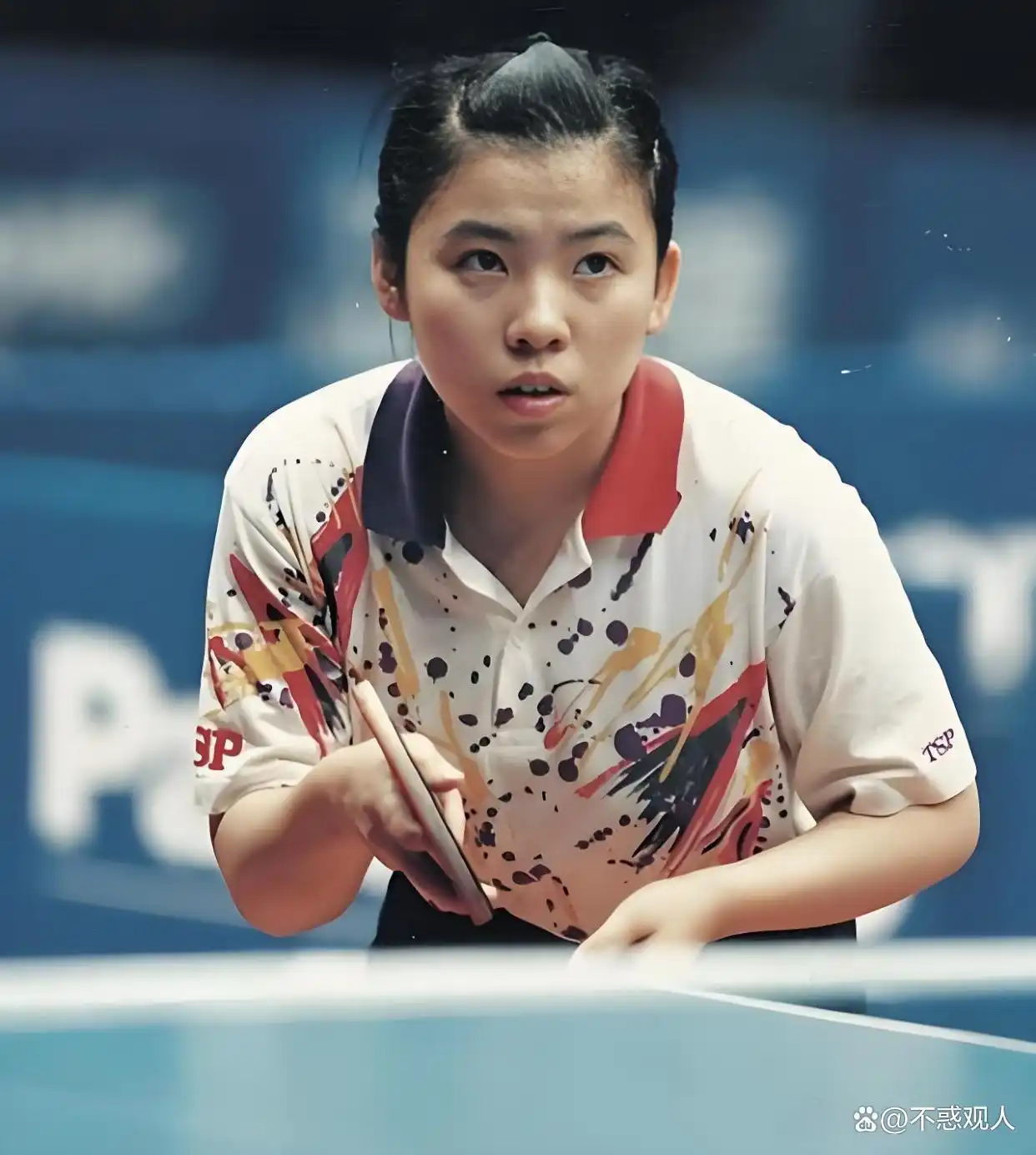
And the cultural moment matters, because she was not merely winning. She was winning at the crown jewel. Table tennis in China is not a sport the way other sports are sports. Ping-pong diplomacy — 1971, the first crack in the wall through which China opened itself to the world — made the little white ball the country’s handshake with modernity. By the eighties and nineties, the whole-nation system, the jǔguó tǐzhì, had elevated it into the one event where China expected to be unbeatable. Every other sport could lose and be forgiven a little. Ping-pong could not lose at all. Into that machine walked the shortest champion it had ever fielded, and her dominance became the national sport’s proof of itself. The system had measured her small, and she had made the system look prescient. From the stands she looked like a machine that had been built at the wrong scale and had decided to win anyway.
IV. Two rubbers, one attack
The physics of her game were described in the last section. This is the hardware.
Deng Yaping played a racket that, by the standards of the women’s tour, was a deliberate provocation. The forehand side was ordinary inverted rubber — the attacking surface every serious player used. The backhand side was long pimples: a sheet of tall, thin, unyielding grains that does not grip the ball so much as refuse it, sending it back with its spin turned inside out. The tour called it the weird racket. And for most of the history of the weird racket, it had meant one thing — defence. A long-pimple player sat back, absorbed what was thrown at her, and waited for the other woman to make the mistake. It was a way of surviving.
Deng used it to attack. That inversion — taking the sport’s most passive equipment and making it the opening move of the most aggressive game in the women’s draw — is the single fact from which everything else about her follows.
| Face | The rubber | What it did |
|---|---|---|
| Forehand | Inverted rubber | The attacking surface — spin, drive, and the closing shot of most rallies |
| Backhand | Long pimples | A dead, unyielding sheet of tall grains that returned the opponent’s spin reversed |
| The tour’s verdict | A defensive racket | The configuration was expected to survive rallies. Deng used it to win them. |
The backhand: four ways to make the ball lie
Long pimples work on a principle the sport calls the reversal. A normal rubber grabs the ball and hands the opponent’s spin back; long pimples let the ball sink into the grains and return it with the rotation reversed. Loop a heavy topspin at her backhand and the ball came back as backspin. Push a backspin and it came back as topspin. The harder the opponent spun, the more spin returned — inverted. The ball also travelled with a floaty, unhurried heaviness that no inverted rubber produced.
The reversal is why the rubber is called strange. But strange is not a technique, and her opponents learned that the label was an underestimation. She built four separate strokes on the same sheet of pimples and used them to run the tempo of the rally.
| Stroke | The ball it met | What came back |
|---|---|---|
| 磕 — the block-chop | A heavy topspin loop | Heavy backspin, short and sinking — aimed wherever the opponent least wanted to run |
| 拱 — the arc | A backspin push or serve | Topspin, fast and flat, forcing the opponent to switch mid-rally from pushing to looping |
| 弹 — the punch | A high or loose ball | A flat, sudden winner; the long-pimple contact made the spin unreadable, so there was no pace to borrow |
| 挡 / 拨 — block and drive | The rally itself | The pace dial: a soft block that swallowed the opponent’s power, or a driven block that seized the initiative |
The point of the four was not variety for its own sake. It was control of rhythm. Deng could give a fast player slow and a slow player fast, a looper backspin and a pusher topspin, a short ball to the opponent who wanted length and a long ball to the one who wanted short — all from the same side of the same bat. The opponent was never allowed to settle into the shot she had prepared for. She was always adjusting, and a player who is always adjusting is always a fraction late.
The forehand: the closing argument
The backhand ran the rally; the forehand ended it. Deng’s forehand was the most feared in the women’s game of her decade — faster, flatter and more relentless than anything the tour had met — and it was built on the Chinese close-table attacking tradition rather than the big European loop.
She stood almost against the table and took the ball at the top of the bounce, sometimes on the rise, before the rotation had fully taken hold. The stroke was short, driven from the forearm, and recovered in an instant, which is what allowed the next ball and the next: the machine-gun forehand that players describe as a blur. When the loop became unavoidable in the late eighties, she did not defend the old game — she learned the new one and folded it in. Her loop was a Chinese loop, small and fast and forehand-led, closer to a topspun drive than to the European arc, and she could move between driving and looping inside a single rally. The opponent was never allowed to decide whether she was facing a fast-attack player or a looper, because the answer changed with every ball.
The serve: thrown to the ceiling
Her serve was the other half of the first move. Deng threw the ball almost to the ceiling, let gravity load it on the way down, and met it with a wrist that could make three different spins come out of one motion. The high toss was not showmanship: the extra height meant extra time and extra load, and, just as usefully, a rhythm the receiver had not been given and could not rehearse against.
| Variation | The contact | What the ball did |
|---|---|---|
| Right-side backspin | Brushed down the right of the ball | Curved toward the forehand and sank |
| Right-side topspin | Brushed up the right — the same motion | Kicked forward; a push floated high |
| The no-spin ball | Pushed flat | Looked like backspin and carried almost none; a drive flew out |
The serve existed to set up the third ball, and the serve-and-attack combination was the highest-percentage pattern in her game. The accounts of her peak put its conversion above sixty per cent — another way of saying that a receiver who gave her even a slightly loose return had already lost the point. Serve short to the forehand and attack the weak reply; serve long to the backhand and counter-loop the loop she had forced; serve at the body and wait for the awkward ball. The serve set the trap; the forehand closed it.
The footwork: the height was paid in steps
Everything above depended on the thing her body made most expensive. A small player has less reach, which means more ground to cover, which means the footwork cannot simply be good — it has to be early. Deng’s feet were never still. She lived on a continuous, high-frequency shuffle of small adjustment steps, moving between every ball so that she arrived at the next one already in position. Great players are said to wait for the ball; Deng could genuinely wait, because her feet had done the travelling before the ball arrived.
The side-step cleared the forehand side completely and still recovered in time to cover the forehand corner. The cross-step carried her to the wide forehand and — the part most players never manage — back again. On the shortest body on the tour she built one of the largest effective coverage areas, because coverage is not arm-span. It is the first step, repeated.
The four characters
Chinese coaching reduces the attacking game to four characters — fast, accurate, ruthless, variable — and Deng pushed all four to the edge at once. Fast meant early contact and instant recovery, so the next ball arrived before the opponent had finished with the last. Accurate meant placement so exact that opponents were moved to the precise spot she had chosen, not merely to a corner. Variable meant the long pimples themselves — a dimension of change no other woman in the draw possessed — layered under changes of pace, length, spin and line, so that the opponent was always adjusting. Ruthless meant that on the biggest points she attacked harder, not safer.
That last one is the part the record understates. The Deng of the scoreboard is the Deng of the blowout; the Deng of the close match was worse. Trailing, she did not become careful — she raised the aggression, and the change of gear was itself a weapon. Opponents who had found a way to win points discovered that the way stopped working precisely when the points mattered most. In her, technique and nerve were not two qualities. They were one quality, and the technique had been built to be trusted when it counted.
What she changed
Three things, and they outlasted her.
She ended the height argument. Before Deng, the sport’s talent-identification logic treated a small body as a dead end, and the tape measure spoke before the table did. She answered it with four Olympic golds, eighteen world titles and eight straight years at world No. 1, and made the number that was supposed to finish her look irrelevant. Every short player who came after her walked through a door she had forced open.
She rewrote what long pimples were for. Before her, the weird rubber was a defensive instrument, and its players were survivors. Deng turned it into an attacking surface — the long-pimple arc and the long-pimple punch were winning shots, not holding shots — and lifted the whole style from support act to lead. After her, no coach could tell a young long-pimple player that the only honest way to play was to defend.
She set the technical direction for a generation of Chinese women. Not pure fast attack and not pure loop, but the fusion: close-table speed with the loop folded in, a game that could hit early and spin hard from the same stance. The champions who followed — Wang Nan, Zhang Yining, Li Xiaoxia — played different games, but they played inside the direction Deng had proved. She was the shortest player in the sport, and for a decade she was also its template.
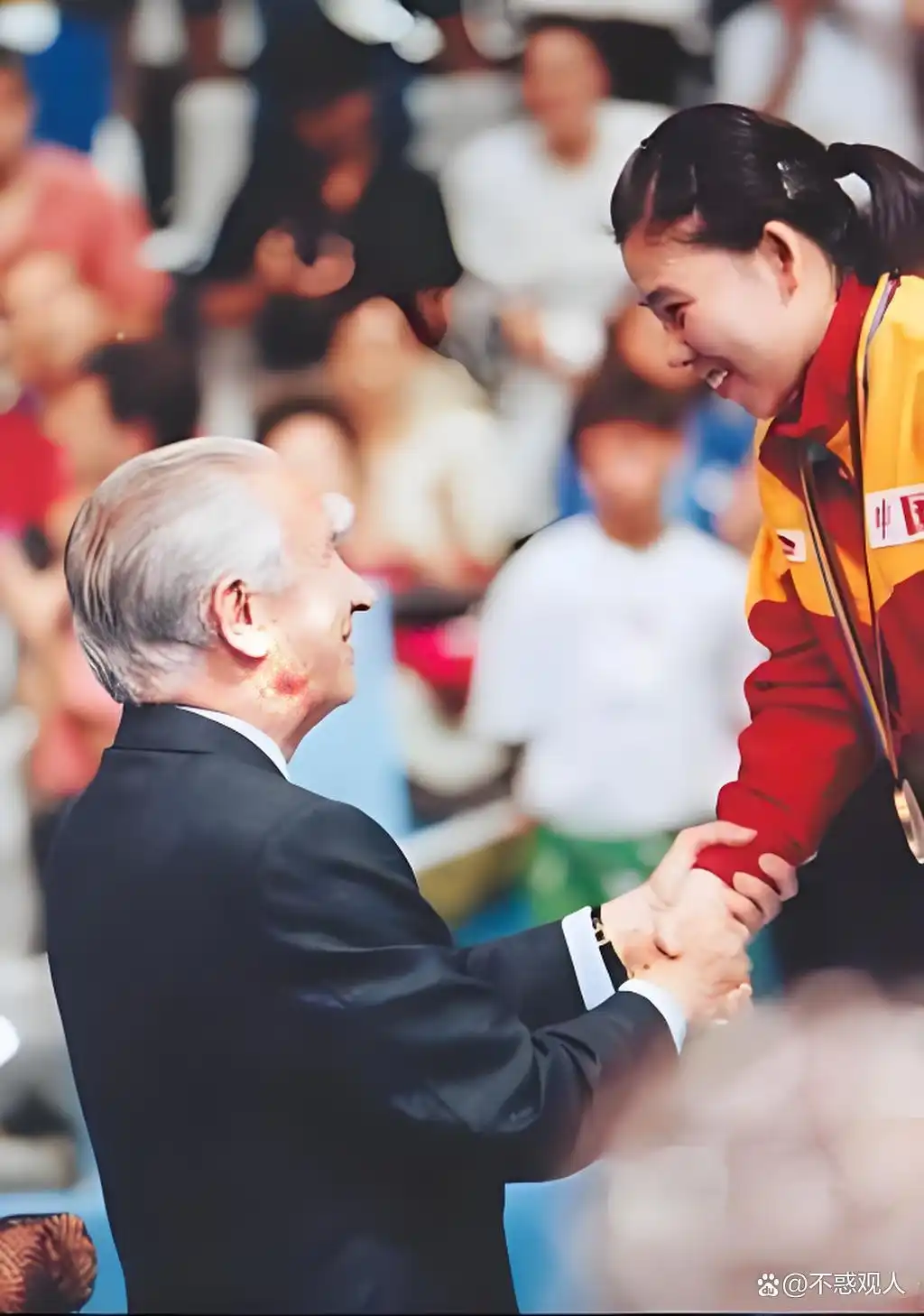
Samaranch, who placed the gold medal around her neck, called her a symbol of Chinese sport. It was a large sentence, and the table underneath it was smaller than she was. What it measured, she reversed.
V. The dynasty, and what it cost
The record on paper is a weapon: four Olympic golds, eighteen world titles, eight straight years at world No. 1 from 1990 to 1997, the greatest female player the sport has produced. The record on the body is something else entirely.
There were defeats, and they matter because the legend forgets them. In Chiba in 1991, at the world championships, the two Koreas fielded a single team — the first time since the peninsula’s division — and beat China in the women’s team final. Deng was on the court for that loss, and it thudded through China like a small national emergency: a captain’s defeat in the one event that could not lose. She cried, and then she spent the next year making sure the world would not see her cry on that scale again. Barcelona was the answer.
In 1994, in Hiroshima, the blade turned against her in a way that was also a lesson about history. He Zhili — the world champion who had left China, married a Japanese man, and taken the name Koyama Chire — beat Deng in the Asian Games final, celebrating loudly, in a manner Chinese fans still describe as a wound. The defector had beaten the state’s champion. The state’s champion did not get her answer in Hiroshima. She got it in Atlanta.
The Atlanta final, 1996, was against Chen Jing — another who had left China after winning Olympic gold in Seoul in 1988, now playing for Chinese Taipei. Much of the Atlanta crowd had adopted Chen as the sport’s great entertainer, and they cheered her accordingly, against the girl from Zhengzhou. Beijing’s cameras framed the match as loyalty versus desertion. Deng played it, people who were there said, as if it were not a game but an audit. She won, in a brutal final that went the distance, and with the doubles that followed she carried four Olympic golds at twenty-three. The number could no longer be argued with.
And then, at twenty-four, she stopped. The story resists a clean close. She stopped because she was at the absolute top and wanted to leave a record that could not be nibbled at. She stopped because there was nothing left to prove. She also stopped because her body was finished. The crouch that let her see the ball flat had been grinding her knees flat since childhood — sandbags at six, the national team at fifteen, a decade of footwork that was low-impact only in name. She had surgery in her twenties. The knees of the world’s best player were the knees of a much older woman.
But the hidden cost of the dynasty was not the knees. It was the architecture of a life built entirely as a rebuttal. Everything about her — the diary in which she is said to have written herself letters of instruction, the habit of treating every point as if the selectors were still at the door, the refusal to blink in a rally or a handshake — had been constructed to answer a sentence she was given as a child. When the sentence stopped being true, the construction had nothing left to hold up. Which is why the second act is not a charming epilogue or a footnote. It is the same fight.
VI. The second act
The girl who could not speak English at twenty-four went to Tsinghua.
Precision matters here. The polite version hides the humiliation. This was the most famous female athlete in China, a global icon who had stood on podiums on every continent and shaken hands with heads of state — and her first lessons were the alphabet. A, B, C, written over and over in a notebook, in the large careful letters of an adult who has never held a pen for this purpose. She has described the classroom as the worst court she ever played on: no rules she knew, no opponent she could read.
Here is the cultural context that English readers rarely get, and it matters. The whole-nation system that made her was honest about what it produced and what it did not. It produced bodies of extraordinary capability and was historically less interested in what those bodies did when the training stopped. Her generation was the first to learn the sentence the system does not print in its brochures: a national hero who can only play is finished when the playing stops. She refused that sentence. Tsinghua, then Nottingham for a master’s, then Cambridge for a doctorate in land economy — on the branding power of the Olympic Games, which is to say she wrote a thesis about the very machine that made her an icon, from inside the machine. In 2001, when Beijing’s delegation stood before the IOC in Moscow to secure the 2008 Games, the girl the selectors had once measured and rejected addressed the session in the English she had taught herself at twenty-four. The doctorate was awarded in 2008, the year of the Games themselves — her Games, her country’s Games, the culmination of a diplomacy that had begun with a ping-pong ball.
In Cambridge, she has said, no one knew her name, and she loved it. Queuing with a tray in a dining hall, learning to be ordinary — which is a strange phrase for a woman who had never been allowed to be ordinary, because ordinary had always been the thing the system could not use.
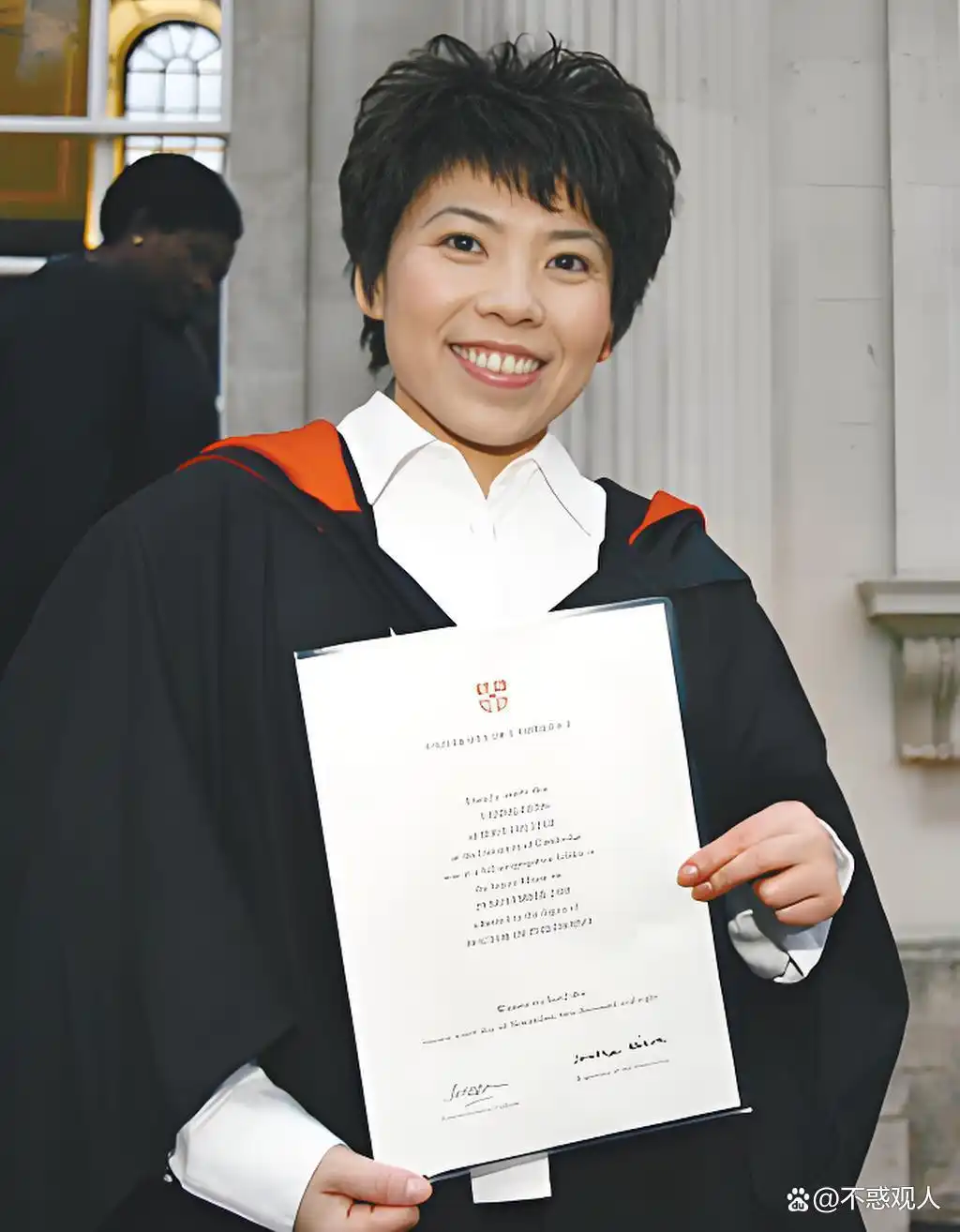
She had outgrown the metric. Then the world that had measured her small came back and asked her to belong to it.
VII. The return of the system
Here is the part of the biography that the medal lists do not mention.
After Cambridge, the offers were not for sporting roles. They were for symbolic roles. She became a senior figure in the state sports bureaucracy; she took a seat on the Chinese People’s Political Consultative Conference, where she used her position to argue, to her genuine credit, for athlete education — lobbying for exactly the second act she had been forced to invent for herself, on behalf of the girls coming up behind her. And in 2010, the People’s Daily — the central organ of the party-state — appointed her general manager of its newest venture: Jike, “instant,” a state-run search engine meant to prove that China could do without Baidu, and without Google.
Deng Yaping, who had never run a technology company, was placed at the head of a technology company. This is what systems do with symbols they are proud of: they spend them. The girl who had beaten a generation of the world’s best players across a table was now the public face of a search engine that had no chance of winning, and everyone in the room knew it. It was the mirror image of her entire career. The metric she was being measured by now was not table-tennis ability. It was loyalty.
She cooperated. “My personal value,” she told an interviewer in 2010, “is maximised only insofar as it overlaps with the interests of the state.” That sentence, quoted back at her, became its own kind of loss. The girl who had outgrown every measurement the world owned had agreed, at the last, to be measured by the most demanding standard of all — and the standard was agreement. The online mockery was thorough. The phrase follows her the way 1.50 follows her, a second drum.
Jike never came close to Baidu, or to Google before Google exited. By 2013 it was quietly wound down, absorbed back into the People’s Daily’s machinery as if it had never been launched. Deng took the blame, in the way a figurehead takes blame — which is to say she was responsible for precisely what a figurehead is responsible for, and nothing more. The failure was not operationally hers. It was the system’s. But her name was on it, the way her name was on the four Olympic golds, and the difference is instructive: the medals were earned by what she did. The search engine was lost by what she was.
Was that the price of belonging? The question stays open rather than answered. She had spent her entire life fighting to be accepted by the people who first said no. She was accepted. And the acceptance took the form of being used. Every extraordinary athlete who outgrows a system’s metrics eventually has to decide what to do when the system, impressed, embraces them — and the embrace is always, in some measure, an ingestion. The girl who was told she was too small to matter found, in the end, that being indispensable to a state has its own kind of smallness. She was deployed as proof, spent as a symbol, left standing when the venture failed, holding a statement that had been written in a language that was not quite hers.
This is not a takedown. She did real things from inside: the advocacy for retired athletes’ education, the years of ungrateful bureaucratic work, the example of a woman who answered “too small” with Cambridge. But the record would be dishonest without the accounting. The system that barred her door made her an icon, then a committee member, then a state enterprise chief — and the last of those roles was the one where the system’s judgment of her, as a person with skills and limits and a right to fail, was most plainly on display. They did not ask her to build a search engine. They asked her to be the face of one. Forty years after four selectors measured her height and found her wanting, the state had learned to measure her differently: not as a body too small for sport, but as a name too big to fail. Both measurements missed the person entirely.
This story joins an Athletes archive built around one recurring question — what a Chinese icon has to be big enough to do. The archive already records two answers from the same national sport-system: Liu Xiang carried the nation’s weight until it broke him; Li Na refused to carry it entirely. Deng Yaping is the third — the one who answered by simply stopping being measurable by whatever made her small. Three icons, one pressure, three answers.
VIII. The accounting
So what is the honest ending?
The famous frame: four Olympic golds, eighteen world titles, eight straight years at number one, a Cambridge doctorate, Female Athlete of the Century in her country. The unfamous frame: a woman who spent her childhood being told a number made her worthless, her youth proving the number wrong, her twenties learning how to be a person after the proof was complete, and her thirties discovering — politely, in committee rooms and press conferences — that a life built on proving a system wrong tends, in the end, to be handed back to that system. She outgrew the measurement. What she could not outgrow was the measuring.
Too big to fail is a phrase for banks — institutions the state cannot afford to let collapse. Too small to fail was her sentence at the door. She spent thirty years standing the two on their heads. Too small, she said, meaning: I will have to be right every time, because no one will save me if I am not. And she was right so often that the state eventually concluded it could not afford to let her fall, which is a different way of being trapped. She is the shortest champion the sport has produced, and the only one who answered “too small” by outgrowing the measurement itself — until, at the last, the system that measured her small came back and asked her to belong to it. The girl who could not be measured became, in the end, someone the state could count.
If there is a rule in this life worth taking away, hers is it. The next time you are told you are too small for something — too short, too slow, too young, too late — do not ask how to become more of the thing they are measuring. Ask whether their metric is the one that actually decides the outcome. Deng Yaping did not grow taller. She made the game come down to her, and then she made the world come up to her mind. The table could not be made taller, so the game simply had to meet her where she stood. And when the people who first said no finally accept you — ask what they are accepting you for. Ask whether the price of belonging to them is the very thing you spent your life fighting to keep.
The last image is not the podium. It is the canteen at Cambridge: a woman in her thirties queuing with a tray, no one turning to look, the most recognisable athlete in China finally, briefly, unmeasurable — learning to be small in the ordinary way, which was the one smallness she was never told she was allowed to have.
She had earned the gold. The anonymity was harder. She took it anyway.

Frequently Asked Questions
How could a 1.5-metre player dominate table tennis?
Her height forced a reinvention: an unprecedentedly fast attacking game, a low centre of gravity and foot speed that reached angles taller players could not recover, and a ferocious forehand that rewrote Chinese women's table tennis from a defensive spin game into an attacking one. The system that rejected her was answering a different question than the one she answered on the table — and her answer defined an era.
How many Olympic golds did Deng Yaping win, and against whom?
Four — women's singles and women's doubles at both Barcelona 1992 and Atlanta 1996, all with her doubles partner Qiao Hong, whom she beat to win the Barcelona singles gold. She is one of very few athletes in any sport to defend both singles and doubles at consecutive Olympics.
Was Deng Yaping really turned down by the national team for being too short?
Yes. Per Baidu Baike, four of five national-team selectors opposed her admission, citing her short stature and limited technical ceiling. She was eventually admitted in 1988 at age fifteen and won her first world title within a year. The rejection is the origin of the "too small to fail" arc the story runs on.
What did Deng Yaping do after retiring at 24?
She made a second, unprecedented leap: Tsinghua BA, an MRes at Nottingham (2002), and a Cambridge PhD in Land Economy (2008, on Olympic branding and the Beijing 2008 Games). She was named Chinese Female Athlete of the Century (2003), joined the ITTF Hall of Fame (2003), served on IOC commissions, and later ran — and faltered with — a state-run search engine.