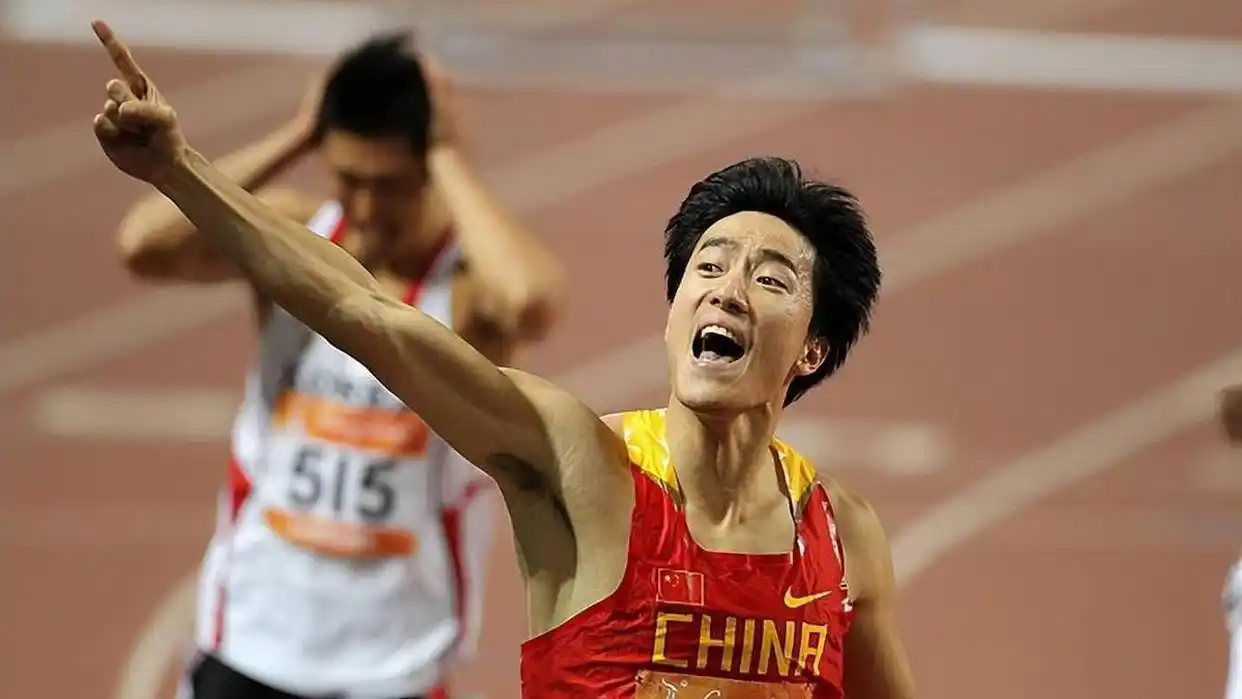
He ran the fastest 110 metres of his life in 12.91 seconds — and has spent every year since running the untimed thirteenth second: the one in which a nation’s symbol tries, without a flag or a camera, to become a man again.
01 — The Empty Lane
The morning of August 18, 2008, at the National Stadium in Beijing — the Bird’s Nest, its lattice of steel ribs visible for kilometres — the air hung thick the way Beijing air does in August, and 91,000 people had paid to watch a man run for roughly thirteen seconds. Some had paid scalpers a month’s wage. It made no financial sense. A first-round heat, on a Monday morning, of the 110-metre hurdles, sold out weeks in advance. But the man was not merely a man, and everyone in that stadium knew it. They were not there to see a race. They were there to see a proof delivered, in person, on home soil.
He was Liu Xiang, twenty-five years old, the Olympic champion, the world record holder, the first Chinese man ever to win an Olympic gold in track and field — and in this stadium, in this city, in this summer, he was the closing act of a nation’s coming-out party. The Athletes archive this story opens will hold others like him eventually, but on that Monday he was alone in what the world was asking him to carry.
The gun went. A false start somewhere in the line brought the field back. Liu stood, walked a few steps, bent, and clutched the back of his right heel. The stadium understood before the announcer did. He was not going to run. He tore the bib off his chest — the gesture seemed almost theatrical, though it was not theatre, it was grief — and he walked down the tunnel, out of the daylight, while 91,000 people sat inside a silence that had no scoreboard.
Nobody timed that silence. It is the closest anyone has come to timing the race he has been running ever since.
This is the story of how a boy from the old lanes of Shanghai got to that empty lane — and of who decided, in the end, that he should leave it.
02 — The Boy from Shanghai
Putuo District, Shanghai, 1983. The city was already the future of China, but Putuo’s streets were still the old Shanghai — narrow lanes, washing hung between windows, grandmothers squatting over basins, the smell of cooking oil and coal smoke. Liu Xiang was born there on July 13, into an ordinary worker’s family. His father, Liu Xuegen, drove for a living. His mother, Ji Fenhua, born in 1953, kept the household. Neither parent had anything to do with sport, and neither wanted their son to have anything to do with it. What they wanted for him was a safe profession — computer engineering was the dream, the kind of job that meant a desk and a salary and no broken bones.
The family was the baseline from which the rest of his life would be measured: warm, modest, unremarkable. He was an ordinary child in an ordinary lane, and the national symbol he would become was built on top of that ordinariness, never replacing it. His parents’ apartment, the neighbours, the schoolyard — these are the places the man kept returning to in interviews for the rest of his career, the way a man returns to a room he grew up in.
On weekday mornings the lanes filled with the ordinary commerce of a neighbourhood that did not yet know it was raising a national symbol: bicycles carrying children to school, old men doing tai chi in the small park, steam rising from the breakfast stalls, the shouted bargaining of the vegetable market. Liu moved through those mornings like any other boy — a schoolbag, a uniform, a mother’s instruction to come straight home. His parents had chosen the safest possible ambition for him: a quiet life, one in which no one would ever ask his body to prove anything. The boy who would one day run with a nation standing behind him was, at that age, carrying nothing heavier than homework.
One detail about his father remains unresolved, and it is worth pausing on, because it shows how even the smallest facts of a life this public can split in two.
The boy tried the high jump first. He had a runner’s legs and a jumper’s clearance, and in 1994 he won a young-outstanding-high-jumper title. But it was what happened between the jumps that caught a coach’s eye. There was a rhythm in the way he moved — a cadence, an economy — that belonged to the barriers. The 2000s were about to become the decade of Chinese sport, and Liu Xiang, accidentally, was about to become its first true face.
His body, written in the biomechanical language of the sport, reads like the factory spec of an instrument: long legs, flexible ankles, exceptional rhythm sense, a low trunk angle over the barrier, and a stride that was not the fastest in the world but the most efficient — the strongest finisher, not the fastest starter. He was an accidental hurdler. He was also, as it turned out, a perfect one.
03 — Learning to Become a Hurdler
The first coach to see it was Fang Shuiquan, who around 1995-96 recommended the switch from high jump to hurdles. But the man who made him was Sun Haiping — a coaching veteran of more than forty years who had built China’s women’s hurdles program and who, from around 1998, essentially adopted the teenage Liu. They shared a two-bedroom apartment in Beijing during training periods. Sun cooked for him, slept near him, and rebuilt his technique from the foot up. The relationship was not coach-and-athlete in the Western sense. It was a father-son arrangement inside a state system that had no word for family.
Sun’s system was technical, not brutal. Academic research on his methods identifies two core principles: static control of technical movements — precision over power — and an integrated training system that treated the athlete as a whole machine rather than a set of isolated drills. Where other hurdlers trained to be stronger, Sun trained Liu to be more exact: the starting rhythm, the three-step cadence between hurdles, the millimetre-level trunk angle over the barrier. He was not the fastest man in the world; he was the most correct one, and correctness, at 110 metres with ten barriers 1.067 metres high spaced 9.14 metres apart, beats speed more often than it loses.
The craft was almost invisible to the naked eye. The starting blocks were set with the precision of a watchmaker: the angle of the front foot, the height of the hips, the length of the first stride. Between the hurdles the rhythm ran in threes — left, right, left — each step measured, none of them a sprint, because sprinting between barriers is how hurdlers fall. Over the barrier the trunk dipped to an angle measured in millimetres, the trail leg tucked high and tight, the arms held like a man carrying something fragile. Sun watched all of it with the patience of a man reading a language only he could hear. In 2007, after his athlete had won everything there was to win, Sun told reporters that Liu had yet to reach his full potential. The sentence sounded like praise. It was also a schedule: the machine was never finished.
The results came in the ordinary order of a rising career. In 2001, at the World University Games in Beijing, he ran 13.22 and won his first international gold. In 2002, at Lausanne, he ran 13.12 — an Asian record. Each time he improved, the old assumption took another hit: the assumption, quietly governing Chinese sports policy for two decades, that explosive speed events were biologically out of reach for Asian athletes. Sun Haiping had said in the early 2000s that a Chinese man could medal in the hurdles. Inside the sport, he was regarded the way a man is regarded who says he will swim the Yangtze: charming, deluded, harmless.
Then the delusion started winning races. And in 2004, in Athens, it stopped being a delusion entirely.
04 — Athens
August 27, 2004. The Olympic final of the 110-metre hurdles, under the lights of the Athens Olympic Stadium, a hot Mediterranean night. Liu Xiang, twenty-one, drew the unfavourable lane, and for the first three hurdles he was not winning — he was gathering, the way a spring gathers before release. Between the third and fifth hurdles, the rhythm that Sun Haiping had spent six years building clicked into place. He did not accelerate; he unfolded.
The noise arrived in waves — the gun, the first drum of feet, the roar climbing with each barrier. His breath settled into a rhythm he had rehearsed ten thousand times, and the barriers went by beneath him like a series of doors he had already opened. The last hurdle. The line. He did not know the time until he looked, and when he looked, the world was already different.
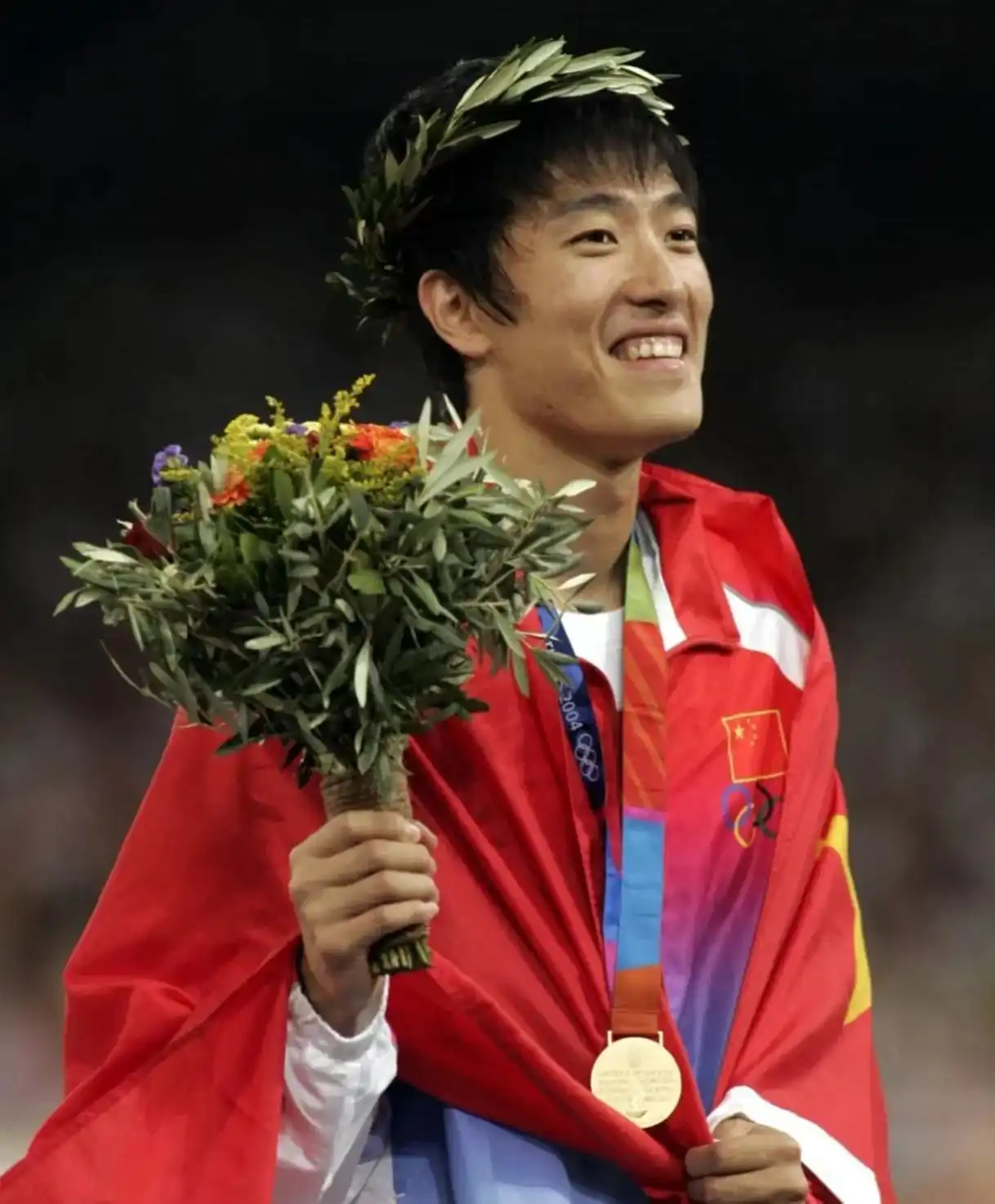
He crossed the line in 12.91 seconds. Olympic record. World record tied — Colin Jackson’s 12.91 from 1993, which had stood for eleven years. China’s first Olympic gold medal in men’s track and field, ever. He fell to the track and cried; the CCTV reporter Dongri Na, who had followed him for years and reached him before anyone else, held the microphone while he wept. The image of him pulling the Chinese flag over his shoulders and running a victory lap in the rain became one of the defining sports photographs of the decade.
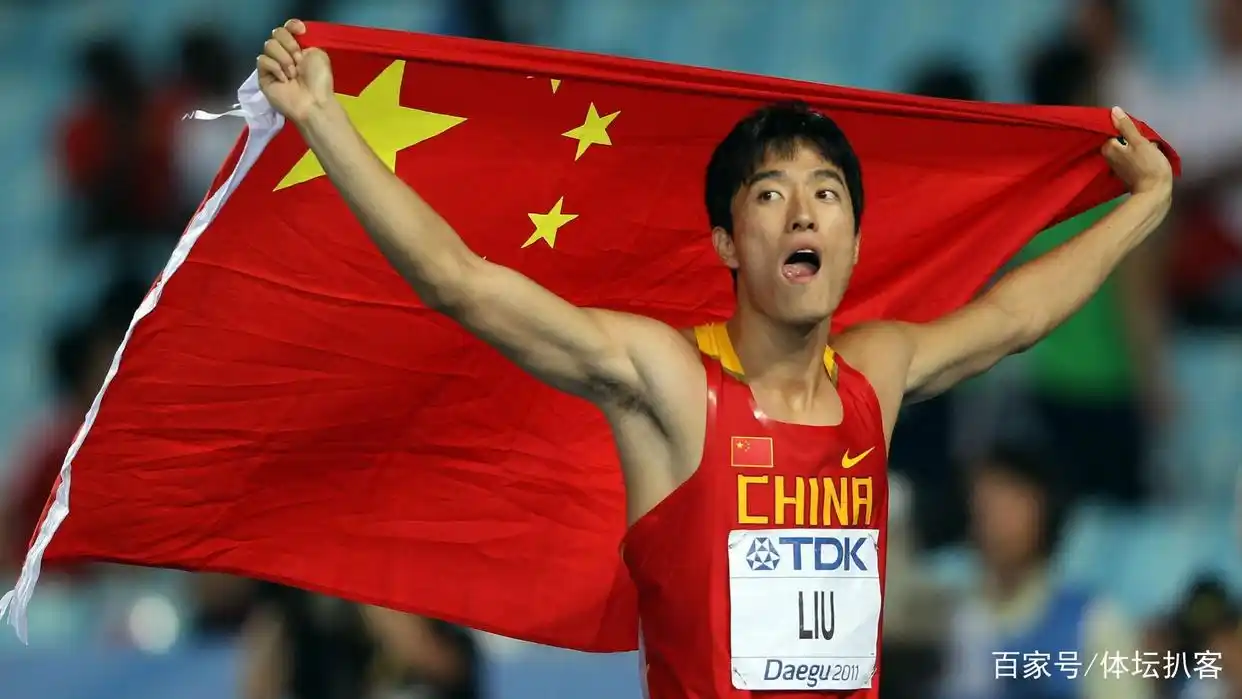
A reported quote from that night has entered the Chinese media canon:
“Who says Asians can’t make the top eight?”
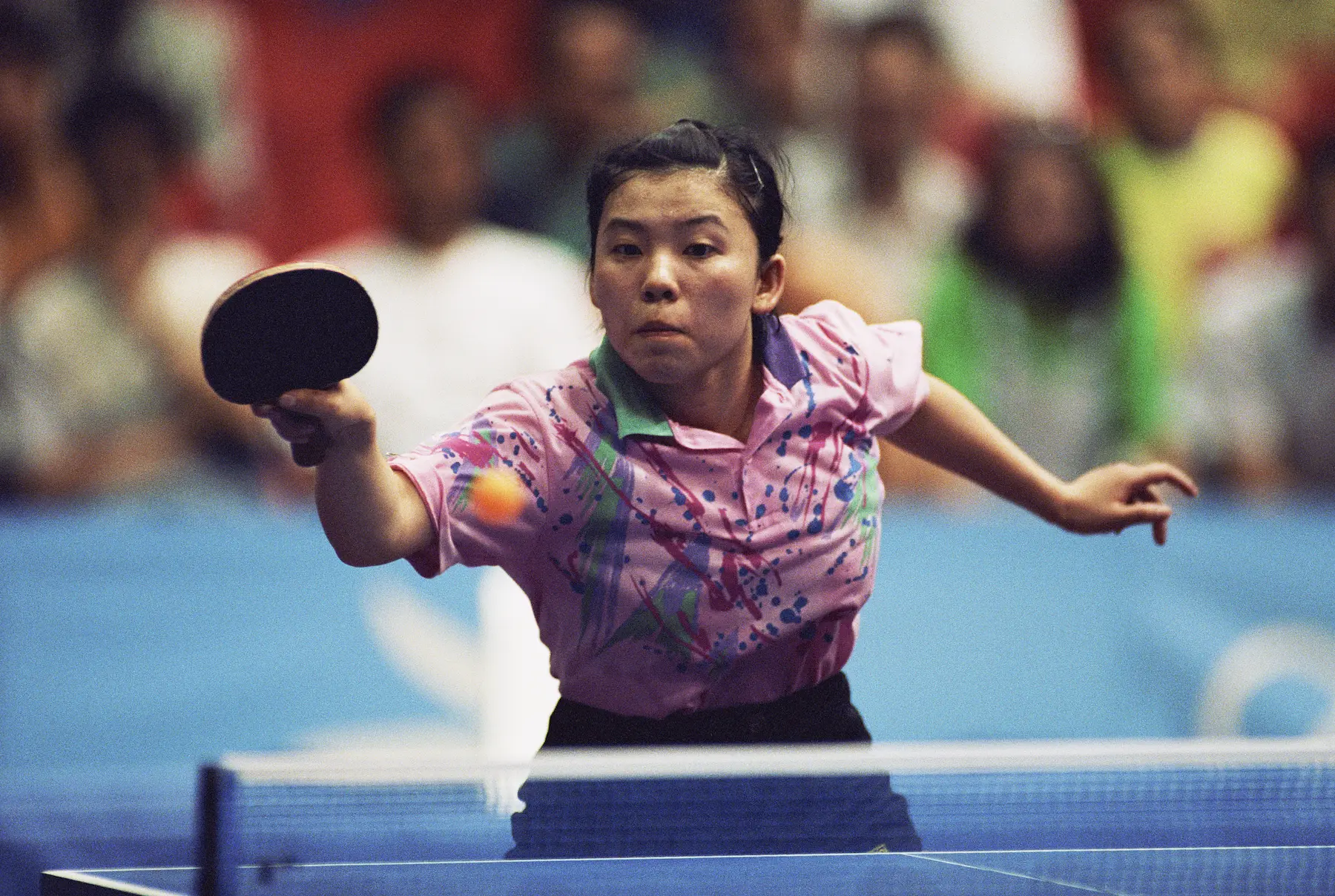
To understand why that sentence mattered, and why this race was never just a race, you need the context the English-language summaries leave out. For two decades, Chinese sports policy had been governed by a racial determinism treated less as ideology than as physiology. The national strategy, the jǔguó tǐzhì — the whole-nation sports system — funded events where China held a structural advantage: diving, table tennis — a game Deng Yaping turned into China’s first global sports dynasty — badminton, gymnastics, shooting. These were “controllable” sports: skill-based, predictable, medal-dense. Track sprints — the pure-speed events — were the implicit biological limit, the unconquered continent. Boys with fast-twitch talent were routed into other sports. The system did not build sprinters because the system did not believe sprinters could exist.
Liu Xiang’s 12.91 was not just a gold medal. It was a public refutation of a theory that had shaped Chinese sports policy for twenty years — a falsification, delivered on the world’s biggest stage, of a national belief. That is why the state media anointed him, why his face went up on billboards, why he became the face of a dozen brands at once. He was not just an athlete. He was the refutation. The distinction would matter later, when the refutation failed to repeat. For the moment, though, there was only the Olympic Stories moment itself — a nation discovering, in real time, what its bodies could do. And in Athletics, the sport page of the archive this story will one day sit beside, no Chinese man had ever stood where he stood.
05 — When the World Started Watching
Athens had the emotion. Beijing would have the tragedy. But the peak of Liu Xiang’s career — the moment he became, objectively, the greatest 110-metre hurdler alive — is the under-reported middle chapter: Lausanne 2006 and Osaka 2007.
On July 11, 2006, at the Super Grand Prix in Lausanne, he ran 12.88 seconds. The wind reading was +1.1 m/s — legal, but modest. The lane was lane 2, not a preferred lane. He broke Colin Jackson’s 13-year-old world record by three hundredths of a second, and in the same race the American Dominique Arnold also ran faster than the old record — the field itself was historic. Liu did not win by being the fastest runner. He won by being the most efficient hurdler: not the fastest start, but a fluid rhythm and technique that carried him through the barriers better than anyone who had ever done it.
On August 31, 2007, at the World Championships in Osaka, he won the world title in 12.95 seconds. The significance of that night is easy to flatten and hard to overstate: Olympic gold, world record, world title — the Triple Crown. No other modern 110-metre hurdler had held all three at once. Liu Xiang had become the first.
Give Osaka its due. Athens made him famous; Lausanne made him immortal; Osaka made him complete — the only male hurdler in history to be simultaneously Olympic champion, world record holder, and world champion. The machine that had built him, the system that had claimed him, now had its perfect proof. What nobody noticed — because the schedule never allowed anyone to notice — was what the proof was costing the instrument.
| Date | Race | Time (wind) | What it broke / equalled | Still standing? |
|---|---|---|---|---|
| 2 Jul 2002 | Athletissima, Lausanne (IAAF Grand Prix) | 13.12 | Asian record1 (prev: Li Tong, 13.37, 1991); world junior record2 (prev: Renaldo Nehemiah, 13.23, 1979) | Both later surpassed — the Asian record first by Liu himself |
| 8 May 2004 | IAAF Grand Prix, Osaka | 13.063 | Asian record, second time (prev: his own 13.12); world-leading time | Broken by Liu at Athens, later that summer |
| 27 Aug 2004 | Olympic final, Athens | 12.91 (+0.3)6 | = World record4 (Colin Jackson, 12.91, 1993); Olympic record5 (prev: Roger Kingdom, 12.98, 1988); Asian record | Olympic record: STILL STANDS (through Paris 2024) |
| 11 Jul 2006 | Athletissima, Lausanne (Super Grand Prix) | 12.88 (+1.1)6 | WORLD RECORD4 (prev: Jackson, 12.91 — stood 13 years); Asian record | WR held until 2008; Asian record: STILL STANDS |
| 31 Aug 2007 | World Championships final, Osaka | 12.95 | World Championships record; completed the “Grand Slam” — Olympic gold, world title and world record held at once | Championship record: still unbeaten as of the 2023 Worlds |
- Asian record (2002): previous holder Li Tong, 13.37 (1991, Sapporo; wind +2.0, at the legal limit). A widely repeated figure — “13.49, 1993, Kuala Lumpur” — is the Asian Championships meet record, not the continental record.
- World junior record: previous holder Renaldo Nehemiah, 13.23 (1979). Most sources say “junior”; Baidu says “world youth” — likely a translation slip between 青年 and 少年. Olympics.com dates the improvement to 2001; Wikipedia places it at this 2002 race. This table follows Wikipedia.
- Liu ran 13.06 twice — Osaka, 8 May 2004, and again roughly three months later. The table lists only the first.
- = WR means equalled, not broken: at Athens, 12.91 matched Jackson’s 1993 mark exactly. The outright world record came two years later.
- Olympic record: previous holder Roger Kingdom, 12.98 (1988).
- Wind data from World Athletics’ official record progression and the official race results.
Source: World Athletics official record progression; IOC official results.
| Holder | Time | Wind | Venue | Date | Held the record for |
|---|---|---|---|---|---|
| Colin Jackson (GBR) | 12.91 | +0.3 | Stuttgart | 20 Aug 1993 | 12 yr 11 mo |
| Liu Xiang (CHN) | 12.88 | +1.1 | Lausanne | 11 Jul 2006 | 1 yr 11 mo |
| Dayron Robles (CUB) | 12.87 | +0.9 | Ostrava | 12 Jun 2008 | 4 yr 3 mo |
| Aries Merritt (USA) | 12.80 | +0.3 | Brussels | 7 Sep 2012 | current (through 2026) |
Read it top to bottom: the world record moved along a single line — Jackson → Liu → Robles → Merritt — and in that line Liu Xiang is the only Asian name. His stay at the top lasted less than two years.
06 — The Machinery of a Hurdler
Liu Xiang won because he was more exact than anyone who had ever run the event. This is the part the injury narratives skip: the craft itself — the engineering project that turned a 100-metre runner of merely good speed into the fastest hurdler alive. Understanding it explains both the scale of what was lost in Beijing and why his technique, long after his records stopped falling, became the standard the sport still runs on.
Three numbers define the 110-metre hurdles. The barriers are 1.067 metres high, spaced 9.14 metres apart, and there are ten of them. Everything else — the training, the technique, the whole sport — is an argument about how to get from the first barrier to the last without slowing down. Most hurdlers slow down. Liu Xiang proved you could speed up.
The start: eight steps, then seven
For the first half of his career — Athens, Lausanne, the world record — Liu Xiang took eight strides to the first hurdle. It was the conventional choice for a shorter, less powerful hurdler: eight shorter steps were safer, easier to control, and left room to adjust. Most Asian hurdlers used them. For years, so did he.
But eight steps to cover 13.72 metres to the first barrier meant the final stride arrived too close, forcing a small stuttering half-step — a shuffle — that bled energy before the race had properly begun. Sun Haiping’s training notes recorded what the numbers already showed: by Liu’s mid-twenties, his strength and speed had outgrown the eight-step pattern. The technique that had carried him to the top had become the ceiling above him.
In 2011, with the Beijing wound still raw and the London Games a year away, he proposed the change almost no one in the sport would have dared. He would run seven steps to the first hurdle.
The risk was not incremental. It was total. Eight-step hurdlers lead with the right leg and trail with the left; seven-step hurdlers do the opposite. To switch meant reversing the starting foot — left forward, right back — and tearing up more than a decade of muscle memory in a single winter. The stride length between steps had to grow by twenty to thirty centimetres. The body had to rebuild its coordination from the blocks forward. Liu described it the only way that made sense: “It’s like eating with your right hand your whole life, and suddenly being told to use your left — and still pick up a peanut.”
The experiment had been attempted before, and it had mostly failed. Dayron Robles had spent a year at it and never fully adapted. The American David Oliver had needed eighteen months. Liu Xiang did it in about three. On his debut with the new start, at the Shanghai Diamond League in 2011, he ran 13.07 and beat Oliver — who arrived on a twenty-race winning streak. A year later, in Eugene, he ran a wind-aided 12.87: the fastest 110 metres of his life, under any conditions, even if the wind kept it out of the record books.
The case for the change was arithmetic. One fewer step over a fixed distance means each stride carries more momentum forward and less sideways; the models put the gain at roughly two-tenths of a second. In an event decided by hundredths, two-tenths is a different sport.
| Element | Eight-step start (pre-2011) | Seven-step start (from 2011) |
|---|---|---|
| Lead leg out of the blocks | Right (trail leg left) | Left (trail leg right) — the pattern reversed |
| Strides to the first hurdle | Eight | Seven |
| Stride length | Baseline | +20–30 cm per stride |
| Take-off distance to the first barrier | ≈2.17–2.23 m | ≈2.30 m — a “far take-off” |
| Main drawback | A cramped final step: an energy-wasting shuffle before take-off | Total rebuild of coordination and timing; extreme strength demand |
| Adaptation time | — | ≈3 months (Liu) vs ≈18 months (David Oliver); ≈1 year, never complete (Dayron Robles) |
The theoretical gain was estimated at roughly 0.2 seconds — in an event decided by hundredths, effectively a different sport. Liu’s first race on the new start, at Shanghai in 2011, produced 13.07 and a win over the previously unbeaten Oliver.
The attack: the strange trick of speeding up into a barrier
Here is the counter-intuitive heart of his technique. Most hurdlers treat the barrier as a cost — a place where speed must be paid in exchange for clearance. They arrive, rise, float, land, resume. Liu Xiang arrived accelerating.
Biomechanical analysis of his races found his centre of mass travelling at 8.895 m/s on the approach — almost identical to the world-class mean of 8.876 m/s. The difference was in the attack itself, where his horizontal velocity rose to 9.547 m/s — a 7.7 per cent increase, against an elite average of 4.8 per cent. Where the field decelerated into the jump, he accelerated through it. His take-off leg landed faster, too (6.86 m/s against an elite 6.356 m/s), planting more aggressively and driving his mass forward sooner.
The geometry of his take-off ran against instinct in the other direction. His take-off angle was 67.32 degrees; his rise angle only 12.583. The second number is the revealing one. A small rise angle means he did not launch upward over the barrier — he skimmed it, keeping his trajectory as flat as the event allows and spending his energy on the horizontal line rather than the vertical. Sun Haiping’s coaching maxim gave the principle a name: far take-off, near landing. Liu’s take-off point, pushed out to roughly 2.30 metres, was among the longest of his generation.
The event, properly understood, was not a series of jumps. It was a sprint with interruptions that Liu Xiang had taught himself to run through.
| Measure | Liu Xiang | World-class benchmark |
|---|---|---|
| Approach velocity (centre of mass) | 8.895 m/s | 8.876 m/s |
| Velocity change through the attack | +7.7% (to 9.547 m/s) | +4.8% |
| Take-off-leg landing speed | 6.86 m/s | 6.356 m/s |
| Take-off angle | 67.32° | 65–70° |
| Rise (take-off) angle | 12.583° — barely rises | Higher in most rivals |
| Centre-of-mass rise over the barrier | 13.1 cm | Often ≥15 cm |
| Clearance time | 0.32–0.34 s | ≈0.32–0.35 s |
| Ground contact on landing | 0.08 s | 0.08 s (Colin Jackson) |
| Centre-of-mass height at touchdown | 1.18 m | 1.17 m (Shi Dongpeng) |
Source: Chinese sports-science motion analysis of Liu Xiang’s barrier clearance (fifth-hurdle sample).
The scissors: the leg that never stopped moving
The most copied — and least understood — element of his technique was his clearance, the movement the sport eventually named after the tool it resembled: the scissors.
Traditional hurdling treats clearance as a two-beat manoeuvre: the lead leg lifts and clears, the trail leg follows a beat later, and only then does the athlete resume running. Liu compressed the two beats into one continuous exchange, pivoting around the hip joint so that the lead leg began pressing down at the exact moment the trail leg snapped forward — a single scissoring motion that left no dead time over the barrier. His clearance time was 0.32 to 0.34 seconds; the best in the world, including the record-holder Colin Jackson, lived around 0.32 to 0.35.
The decisive detail was the landing. Liu came down on his forefoot and did not wait for the heel to settle before loading it — an ability that depended on extraordinary ankle strength. His ground contact lasted 0.08 seconds, matching Jackson’s, and he returned to running with his centre of mass still higher than his rivals’: 1.18 metres at touchdown against Shi Dongpeng’s 1.17. Over the barrier, his centre of mass rose only 13.1 centimetres, below the fifteen or more of many competitors. Every centimetre of unnecessary rise is a centimetre of speed surrendered. He surrendered none.
The result was the sentence World Athletics would eventually use to describe him: he did not jump the hurdles — he ran them. The effect rippled outward. Dayron Robles, studying Liu’s footage in the years before his own world record, rebuilt his clearance around the scissors he saw there. The student broke the master’s record.
The rhythm: three steps, like a metronome
Between the barriers the event demands exactly three strides, and how an athlete distributes them is the closest thing hurdling has to a signature. Liu’s three steps ran 1.47 metres, 1.85, 2.12 — a small, medium, large progression, executed with a consistency that made the distance sound less like a sprint than a bar of music. Sun Haiping drilled it with a pair of opposed exercises that sound like a riddle: hurdles shortened to 6.8 metres to force a faster, tighter rhythm, and hurdles stretched to 9.20 metres to demand more speed across every gap.
The payoff showed in the only number that truly matters — the hurdle cycle, the time from attacking one barrier to attacking the next. In the Athens final, Liu ran six of his cycles under one second, his fastest at 0.96 to 0.97. For context: Chen Yanhao, an Asian champion by any measure, was three to five hundredths slower per cycle from the fourth hurdle onward. Across nine cycles that gap compounds to more than three-tenths of a second — the distance between a great hurdler and the best who has ever lived.
And then there was the finish — the quality that kept him dangerous long after his rivals should have closed the gap. Where explosive starters tend to fade after the sixth barrier, Liu held his rhythm to the line. Split by split in his peak races he ran 1.02 / 0.98 / 1.005 / 1.00; Colin Jackson ran 1.04 / 0.97 / 1.03 / 1.03, giving back time late where Liu gave back nothing. It was this late-race stability that produced the ninth-lane miracle at Osaka in 2007 — the world title won from the worst lane on the track, by a man whose rhythm did not care which lane he was in.
| Measure | Liu Xiang | Reference |
|---|---|---|
| Three-step stride lengths | 1.47 m · 1.85 m · 2.12 m | A small–medium–large progression, held with metronomic consistency |
| Hurdle cycles under 1.00 s (Athens final) | 6 of 10 (fastest 0.96–0.97 s) | — |
| Cycle time, fourth hurdle onward | Baseline | Chen Yanhao +0.03–0.05 s per cycle (≈+0.3 s over the race) |
| Peak-race cycle splits (H2 / H5 / H8 / H9) | 1.02 / 0.98 / 1.005 / 1.00 | Colin Jackson: 1.04 / 0.97 / 1.03 / 1.03 — fading late where Liu held |
Why it redefined the event
For two decades the 110-metre hurdles had been filed under raw power — an event for the long Achilles and the fast-twitch fibre — and under the corresponding assumption about who could win it. Liu Xiang did not disprove the biology. He routed around it.
His personal best over 100 metres was 10.74 seconds. Dayron Robles, the man who eventually took his world record, ran 10.71 — three-hundredths of a second faster in pure speed. Yet their best times over the barriers differed by a single hundredth: 12.88 against 12.87. Liu had closed the sport’s widest gap not with more speed but with more conversion — the ability to turn whatever speed a body has into a hurdle time at a rate no one had matched.
The system that produced that conversion was, in the context of Chinese athletics, a quiet heresy. Sun Haiping had broken with the national tradition of volume — the “pile on the training” school — in favour of something closer to a laboratory: low mileage (Liu’s basic weekly running was around 2,000 metres, less than many school teams), eight sessions a week, every repetition pushed to maximum intensity with long recoveries, competition used as training, and technique decomposed to the millimetre and rebuilt. Where the old method asked athletes to become tougher, Sun’s asked them to become more exact. It was a philosophy, not a workout, and it spread.
Which is why his influence outlived his records. When Xu Zhuoyi ran 13.12 in 2025 — the second-fastest 110-metre hurdles ever by a Chinese man — he was still 0.24 seconds behind Liu’s 12.88, a mark untouched for nineteen years. And the elite hurdlers of the intervening generation — Robles, Merritt, and the Chinese line that followed — have all run some version of the machinery Liu built: the seven-step start, the scissors, the flat trajectory, the metronomic rhythm.
He is remembered for a single morning in Beijing when he could not run. What he actually did was change how the running is done.
07 — The Cost of Becoming a Symbol
The peak was a cage, and it closed quietly.
After Athens, the commercial machinery engaged. At the height of his career — roughly 2006 to 2008 — Liu Xiang was estimated to hold contracts with around seventeen brands: Nike, Coca-Cola, Visa, Lenovo, Cadillac, China Mobile, and others. The total estimated contract value was on the order of 1 billion yuan — roughly $162 million USD at the time. These figures are dossier estimates, not audited accounts, and they should be read as such: the precise numbers were never published, and the estimates vary by source.
He became public infrastructure. CCTV appearances. The Spring Festival Gala — the most-watched television event on earth. Textbooks. Political consultative conferences. His face on billboards across every Chinese city. He was no longer an athlete with sponsors; he was a utility that the nation drew on, the way it drew on power or water.
At the Spring Festival Gala he stood on the same stage as the country’s singers and comedians, before the largest television audience on earth, and smiled in a way that belonged to the occasion rather than to him. His face went into school textbooks beside the phrase wèi guó zhēng guāng — win glory for the nation — so that children learned his name the way they learned their multiplication tables. None of it was asked of him, exactly. It was simply what happened when a country decides that one of its citizens will stand for all of them.
The body, meanwhile, was keeping its own ledger. Sun Haiping said at the August 2008 press conference that the tendon problems had plagued Liu for six or seven years — even before he won gold at Athens. But the schedule never allowed a stop. Cortisone injections. Pain management. The machine kept running because the machine was not allowed to stop. The lead leg of a hurdler absorbs six to eight times body weight on landing over each barrier; every race was a debt being taken out against a tendon that was already failing.
He posed for the ads. He accepted the narratives. He carried the weight willingly — a young man who had been told, persuasively, that he was born to bear it. There is no shame in that. There is only the invoice, which comes due later.
The invoice came due on August 18, 2008.
08 — Beijing
Return to the opening scene, at the slowest speed. The day, in minutes.
The morning of August 18, 2008. The Bird’s Nest, 91,000 people. The 110-metre hurdles first round — a heat that had sold out like a final, because the man in bib number 1356 was the reason the world was watching this Games at all. Beijing 2008 was not a sporting event; it was China’s coming-out party, a statement of arrival delivered to the world from a stadium built specifically for witness. And Liu Xiang — the Shanghai boy who had already proven what Chinese bodies could do — was scheduled to be its closing act: the proof delivered at home, witnessed by the world.
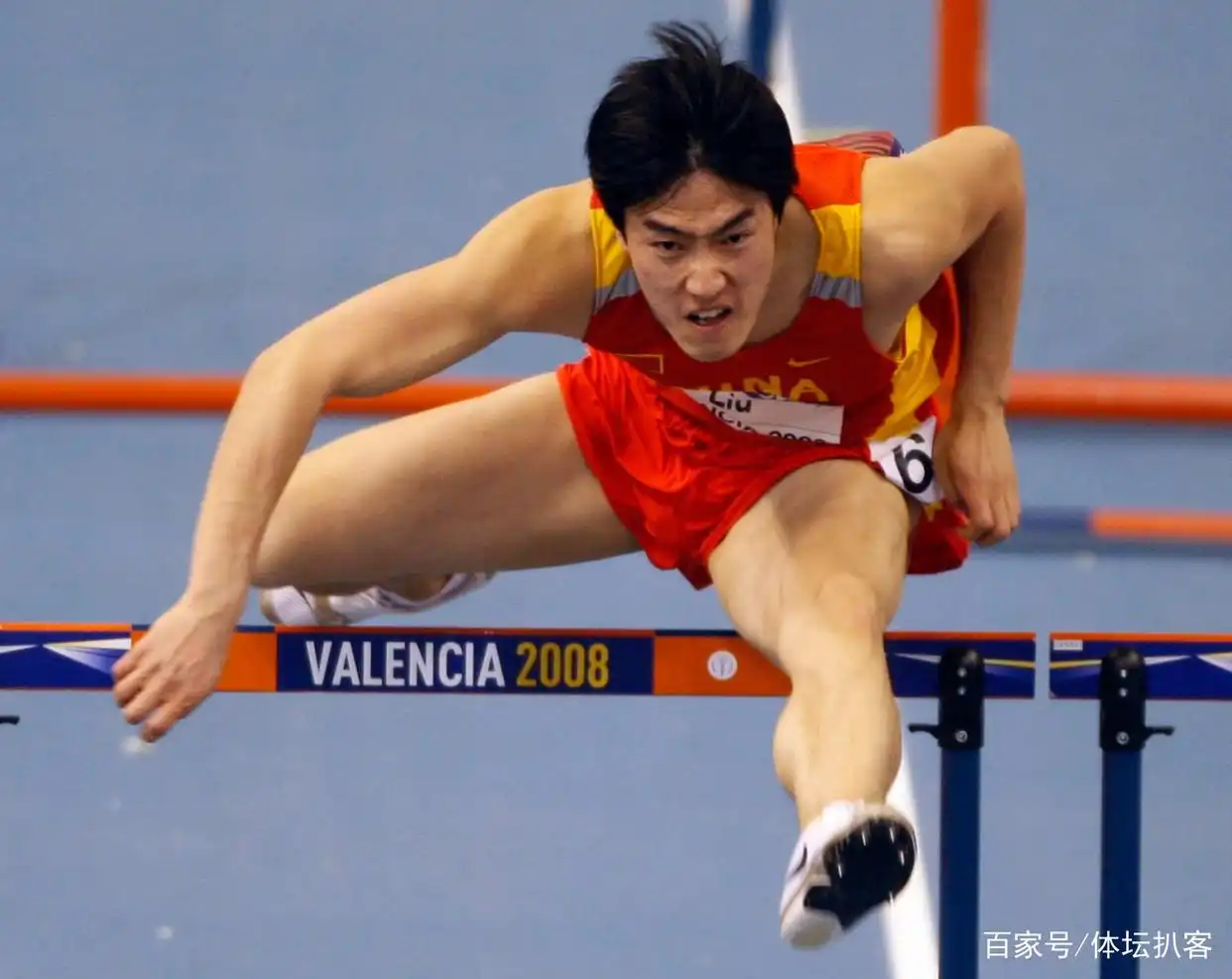
In the warm-up area, the right foot would not cooperate. He bounced lightly, trying to loosen it, the way a runner does when the tendon is screaming. The team doctor worked on him. The decision chain began — and this is the central unresolved question of his biography.
Out in the stadium the crowd was already roaring, rehearsing for a man who had not yet appeared. In the warm-up room the doctor pressed on the tendon and Liu’s face did something the television cameras, when they finally found him, would not be allowed to see. He had run on worse. He had been told, for three years, that worse was normal. But the tendon would not load, would not take the weight of a single stride, and everyone in that room understood what the schedule had been doing to the man while the country was building him a stage.
He walked onto the track. The roar of 91,000 people. He knelt at the starting blocks, adjusting them, buying time. The gun went; a false start brought the field back. He stood, walked a few steps, and clutched the back of his right heel. The stadium understood before the announcer did. He was not going to run.
He tore the bib off his chest and walked down the tunnel, out of the daylight.
Sun Haiping broke down crying in the mixed zone. Feng Shuyong, the Chinese athletics official, said Liu was “very, very upset.” And that night, on Chinese message boards and forums, the fury arrived — raw, unmodified, a documentation of a nation’s wound:
Liú Pǎopǎo — “Liu who ran away.” Yǎnyuán — “actor,” as in one who faked injury for sympathy. Duì dé qǐ mǎi piào de rén ma — “Does he deserve the ticket-buyers?”
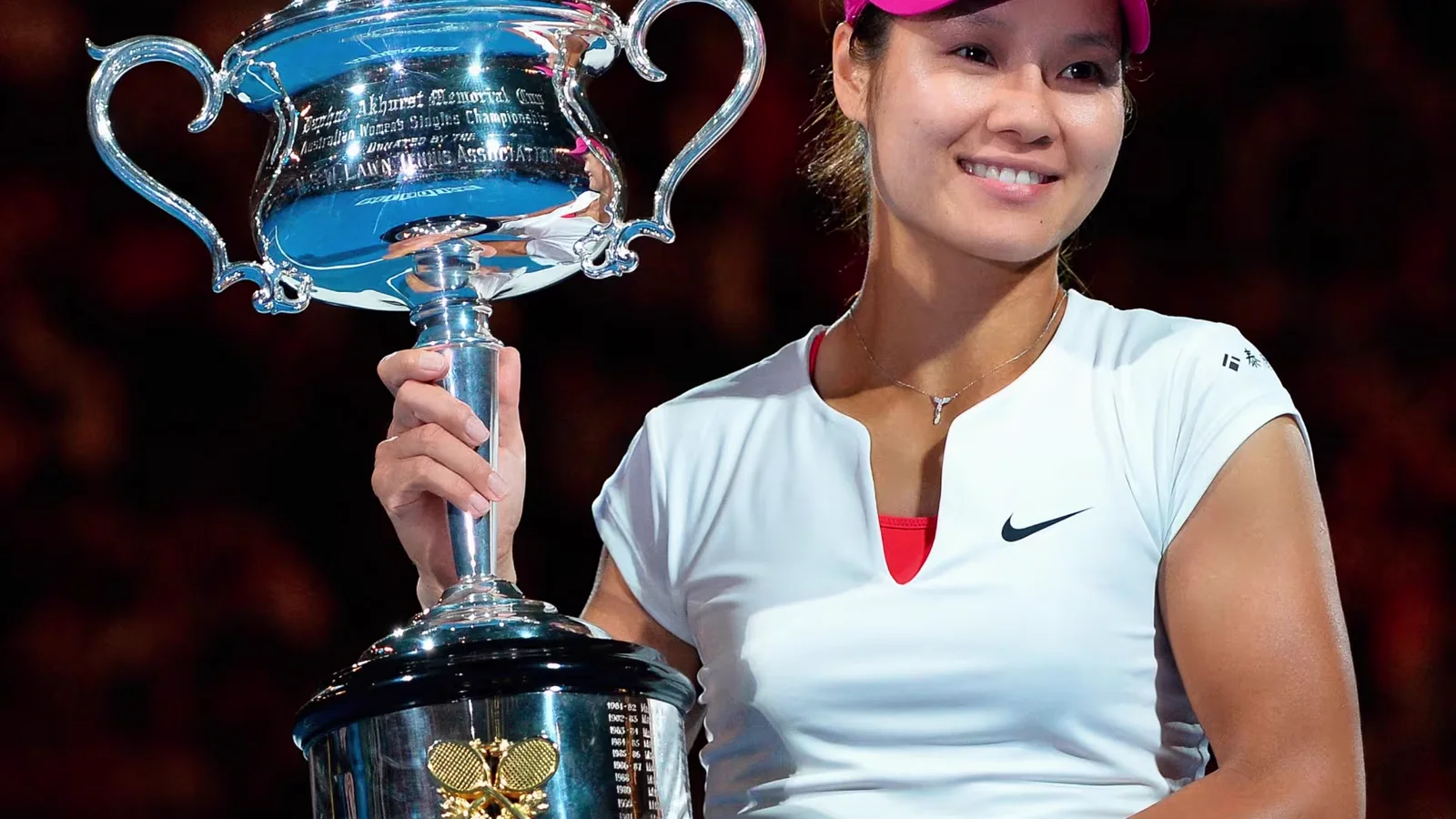
The conspiracy theories bloomed: he had withdrawn because he feared losing to Dayron Robles — who, in fact, went on to win the gold days later. The same public that had demanded he become a symbol punished him, within the same week, for having done so. That is the contract: the symbol is worshipped, and the symbol is blamed for being a symbol. There is a second way — Li Na, the Chinese athlete who refused to sign it — and the archive records them side by side.
The next morning, the newspapers. And one full-page ad from Nike, which had bet its campaign on him: “Love the sport, not the victory.” A rare case of a brand choosing the athlete over the result, in real time.
The pattern predates him by a generation. In 1984, the Shanghai high jumper Zhu Jianhua — China’s great hope in track and field, the earlier proof that a Chinese body could leap — arrived at the Los Angeles Olympics holding the world record and won only bronze. When he returned to Shanghai, someone smashed the windows of his family’s apartment. A bronze medal, a heroic result by any sane measure, and the nation broke his family’s windows over it. This is not a habit of crowds; it is a structure of the system. The crowd is only the weather.
Liu, to his health or his misfortune, got the full century’s forecast. Why did Beijing hurt so much? Because he did not fail a race. He failed a role he never asked for — and the nation that wrote the role punished him for not being able to play it with a broken body.
09 — The Comeback
After Beijing, he went to Houston for surgery. In December 2008, at Memorial Hermann Hospital, surgeons removed four bone fragments from the insertion of the right Achilles tendon — the osteophytes, the bone spurs that had grown between the tendon and the ankle bone, the physical record of years of overuse. The operation took about an hour. The scar on his right heel became the documentary evidence of everything that followed: a pale seam in the skin, the body’s own record of the schedule it had been forced to keep.
Recovery was six months to a year. And then he came back — because the machine that had scheduled his injury, then punished him for it, now scheduled his recovery to fit another Olympic calendar. The body was still not his.
Recovery happened far from the cameras. In Houston there were no mixed zones and no ticket-buyers; there was only the hospital corridor and the slow, undramatic work of teaching a repaired tendon to take weight again. And then the machine, patient as ever, put the next Olympic calendar on the wall: Shanghai, then Daegu, then London. The man who had walked off the track in Beijing had been repaired in order to be scheduled again — the nation’s instrument, retuned.
On September 20, 2009, at the Shanghai Golden Grand Prix, he ran 13.15 and finished second to Terrence Trammell in a photo finish — the “king returns” narrative, staged on home soil in front of the city that raised him. The redemption arc engaged. In August 2011, at the World Championships in Daegu, Dayron Robles struck his hand twice in the final hurdles and was disqualified; Liu, who had finished third, was promoted to silver at 13.27. The detail matters because it proves the body could still run: he was not the finished man the cynics wanted him to be.
Then London, August 7, 2012. First round of the Olympics. He hit the first hurdle and crashed to the track — the right Achilles, the same one, the repaired one, had ruptured. The stadium watched him get up and hop the length of the track on one leg, pausing at the last hurdle to kiss it before being helped away. The defining image of the second half of his career: a man refusing to leave the race except on his own terms.
Which foot? The record should be precise.
He underwent a second Achilles surgery at Wellington Hospital in London. From 2013 to 2015, he attempted to return to elite competition and failed — not with drama, but with the quiet arithmetic of a body that had been asked to break twice and could not be trusted a third time.
The chapter’s work is not inspiration. It is the cruelty of asking him to break again after being repaired. He did not argue. He said, later, the simplest true thing an athlete can say: “I did my best.” It was not enough for the people who had built him, and it was never going to be.
10 — Leaving the Track
He retired in April 2015, announcing it himself on Weibo — “Zàijiàn! Wǒ de pǎodào, wǒ de lán!” — “Goodbye! My track, my hurdles!” — a man taking back the ending of his own story from the people who had always written it for him.
Who was Liu Xiang after Liu Xiang the athlete?
The tabloids did their work. In September 2014 he had married Ge Tian, an actress; in June 2015, nine months later, they divorced, and the divorce was consumed by the same machinery that had consumed his races. The relationship history around those years is contested territory, and the article stays strictly with what Liu himself said.
He later reunited with Wu Sha, the former pole vaulter he had known years earlier. They married quietly, and she has kept a low public profile since. The tabloids moved on, eventually, to someone else’s body.
The quiet years: travel, learning to cook, variety shows, occasional appearances at sporting events. He was seen in public less and less. People who met him in those years describe the same thing, in different words: his smile changed. It became easier, and also more careful — the smile of a man who had been looked at too much and was finally, privately, learning what it felt like not to be.
He learned to cook, of all things — a small domestic fact that would have been unthinkable during the years when his meals were scheduled like his races. He travelled without an entourage, stood in ordinary queues, discovered the particular luxury of arriving early to a place where nobody was waiting for him. The variety shows paid him to be charming, and he was; the camera still loved him, and he let it. But the man those shows were filming was no longer performing the nation’s proof. He was performing, badly and happily, the ordinary act of being a person — and the audience, which had once needed him to be a symbol, gradually let him.
This is a man unlearning what a nation made of him — a man whose greatest remaining race was the one nobody was timing.
11 — Beyond 12.91
And then, in the summer of 2021, something strange happened. At the Tokyo Olympics, the Chinese sprinter Su Bingtian ran 100 metres in 9.83 seconds — a breakthrough that Chinese social media immediately, and unexpectedly, connected to Liu Xiang. The hashtag wǒmen qiàn Liú Xiáng yī gè dàoqiàn — “We owe Liu Xiang an apology” — became a trending topic on Weibo, viewed hundreds of millions of times. Commentators who had mocked him in 2008 recanted in public essays. The country confessed, collectively, in the modern manner: by posting.
Asked about the apology wave, Liu’s response — reported across Chinese media — was not what a redemption arc demands: “I don’t think anyone needs to apologize to me. Everyone grows up. When you’re young, you might say things…” He is not forgiving, exactly. He is refusing the framework of apology as too simple for what happened. The public wants absolution; he is offering only perspective.
Keep the open questions. Is an apology enough? It costs the apologizers nothing; it does not unrupture an Achilles tendon; it does not give a man back the decade his body owed to someone else’s schedule. Are the people apologizing the same people who mocked him? And if the next Liu Xiang comes — and there will be a next one, in some stadium, carrying some nation’s proof — will China do it again?
Su Bingtian is a bridge, not a biography. His full story is a future Athletics article of its own. What matters here is what his 9.83 proved: that the door Liu Xiang opened in 2004 stayed open. A generation of Chinese sprinters grew up believing it was possible, because a boy from Putuo District had already done it. That is the inheritance — not the medals, not the records, but the permission.
And what of the man himself? He has said, by all accounts graciously, that he does not need the apology, that he let it go long ago. Which is itself the final act of carrying: the symbol accepts the nation’s guilt so the nation can feel forgiven, and the man walks away still carrying the weight, because he is the only one who can.

People can apologise. The record book cannot.
Here is the hammer, and it is not a moral. He used 12.88 seconds — his own world record, the fastest he ever ran — to cover the shortest 110 metres of his life. And he has used all the time since to run the longest race of his life: the one nobody was timing. There is no record for it. No flag, no camera, no nation waiting at the tape. No one knows when he will cross that line. Perhaps he already has — perhaps he crossed it the morning he tore off his bib and walked down the tunnel, on his own feet, choosing for the first time in his adult life where they would carry him. Or perhaps he is still out there, somewhere in the thin light of an empty stadium, running the untimed thirteenth second — and not a single clock in the world is counting.
That is the answer to the last question. Why does Liu Xiang still matter? Because he ran the fastest 110 metres of his life in 12.91 seconds — and spent every year since running the one in which a nation’s symbol tries to become a man again. Every future story in this Athletes archive will be measured against that: not what he won, but what he carried — and what it cost him to put it down.
Frequently Asked Questions
Was Liu Xiang the first Chinese athlete to win Olympic gold in men’s track and field?
Yes. Liu Xiang’s 12.91-second victory in the 110-metre hurdles at Athens 2004 was China’s first Olympic gold medal in men’s track and field, tying Colin Jackson’s 11-year-old world record.
What happened at the 2008 Beijing Olympics?
Liu Xiang withdrew from the first-round heat of the 110-metre hurdles on August 18, 2008, after his right Achilles tendon failed during warm-up. He tore off his bib and walked down the tunnel as 91,000 spectators watched — and who made that decision remains the central unresolved question of his biography.
Did Liu Xiang ever compete again after the 2008 injury?
Yes. After surgery at Memorial Hermann Hospital in Houston in December 2008, he returned to finish second at the Shanghai Golden Grand Prix in September 2009 (13.15) and took silver at the 2011 Daegu World Championships, before rupturing the same Achilles tendon at London 2012.
What made Liu Xiang’s hurdling technique so different?
His technique was built on speed maintenance rather than raw power. He accelerated through the attack phase where most hurdlers decelerated, kept an unusually flat trajectory over the barrier (a rise angle of just 12.583°), and used a compressed "scissors" clearance before switching from an eight-step to a seven-step start in 2011. The effect was to turn the barriers from obstacles into strides — he ran the hurdles rather than jumping them.