Introduction: The Name Above the Stadium
On the evening of August 8, 2008, a former gymnast rose above the floor of Beijing’s National Stadium.
Suspended by cables, Li Ning travelled around the inside of the Bird’s Nest, carrying the Olympic flame toward the cauldron. Below him, tens of thousands of spectators watched. Across China, millions more followed the opening ceremony on television. The movement was theatrical, almost weightless: a man who had once made his reputation through balance, control, and extraordinary physical precision appeared to run through the air.
Then he reached the cauldron and lit the Olympic flame.
For many viewers, the image seemed to complete a circle. Li Ning had been one of China’s greatest athletes at the Los Angeles Olympics in 1984. He had later become the founder of a sportswear company bearing his own name. Now, twenty-four years after his Olympic triumph and twenty years after the end of his competitive career, he had returned to the centre of the Olympic stage.
Yet the scene was more complicated than a victory lap.
The man carrying the flame was not the same person who had stood on the podium in Los Angeles. The gymnast had retired after the disappointment of Seoul in 1988. The businessman had spent years building a company, learning a new profession, and discovering that a name famous for athletic achievement could become both an asset and a burden. The Olympic ceremony brought those lives together, but it did not erase the distance between them.
Li Ning’s story is often told as a sequence of extraordinary achievements: a gymnast who won six medals at a single Olympics, a champion whose name became attached to skills in the sport’s technical code, and an entrepreneur who built one of China’s best-known sporting-goods brands. Each achievement is important. Taken separately, however, they leave out the question that makes his life especially revealing.
What happens when a person who has spent his youth being measured by one set of rules must begin again under another?
Gymnastics had supplied Li Ning with a precise language of achievement. A routine was judged through difficulty, execution, and the standards of a sport whose rules could be studied, practised, and tested. A commercial enterprise operated differently. Customers could reject a product. Retailers could misjudge demand. A famous name could attract attention without guaranteeing loyalty. A business could survive one year and struggle in the next.
In the first part of his life, Li Ning became a national sporting figure. In the second, he attempted to turn the qualities associated with that figure—discipline, movement, ambition, and belief in the potential of the body—into an enduring institution.
The transition was not a simple story of an athlete discovering business. Nor was it a clean passage from defeat to redemption. Li Ning’s career contained triumphs, painful setbacks, public misunderstanding, commercial risk, and periods when his second profession was no less demanding than his first.
His significance lies partly in the fact that the two careers were connected without being identical. The gymnast could rely on a team, a coach, a training system, and a competition calendar. The entrepreneur had to learn to make decisions whose consequences extended beyond a single performance. In the gym, a medal could settle the immediate argument. In business, no medal could guarantee the next season.
To understand Li Ning, therefore, it is necessary to look at both lives—and at the moment when the first one ended.
01 — The Boy Who Was Supposed to Sing
Li Ning was born on March 10, 1963. Major Chinese biographies give his birthplace as Liuzhou, in Guangxi, in southern China, while some records—including the Olympic database Olympedia—list Laibin, Guangxi, which appears to reflect family or ancestral origin (祖籍) rather than the place of birth. A few English-language references have given a different birth date, but the March 10, 1963 consensus is followed by Olympedia, Baidu Baike, and IMDb. Such small documentary uncertainties are a reminder that even a celebrated athlete’s biography can contain inconsistencies. What is clear is that his early years unfolded far from the international sporting stage on which he would eventually become famous.
His father hoped that his son might develop a future in music. That expectation makes a useful contrast with the career Li Ning ultimately pursued. A musical education would have required discipline, repetition, and control, but it would have demanded a different kind of physical expression. Instead of producing sound, Li Ning would learn to turn his body into a moving structure: a sequence of balances, rotations, holds, and landings.
Accounts of his childhood describe an early attraction to physical movement. He was the sort of child who liked turning, jumping, and performing acrobatic actions. Gymnastics gave those impulses a direction. Play could become training; a natural willingness to move could be refined into something measurable.
He began systematic gymnastics training as a child. The details of his early development should not be romanticised into a story of effortless destiny. A young athlete does not become an international champion simply because he enjoys tumbling. Gymnastics requires repeated exposure to movements that are physically demanding, technically exacting, and sometimes frightening. The athlete must learn to recognise where the body is in space, how much force a movement requires, and how to correct a mistake before it becomes a fall.
The sport also asks children to accept a particular relationship with time. Progress is slow. A movement that appears simple to an audience may demand months of practice. A small error in timing can undermine an entire routine. The athlete learns to divide a performance into details, then to assemble those details into a sequence that appears seamless.
For a developing gymnast, strength alone is insufficient. Flexibility without control can be useless. Power without timing can become a dangerous overshoot. Confidence without technical discipline can lead to a failed landing. The ideal is not merely to perform a difficult movement, but to make it appear inevitable.
These demands would become central to Li Ning’s later reputation. He was known for combining strength with speed, explosive power with apparent ease, and technical difficulty with a style that could hold the attention of spectators. The effect was not accidental. It emerged from a training culture in which the smallest components of movement had to be repeated until they could be joined into a reliable performance.
Gymnastics also introduced Li Ning to a world in which individual excellence was inseparable from collective preparation. The athlete was the person on the apparatus, but coaches, training partners, and the wider sporting system shaped the performance. A routine might last only a minute or two; the preparation behind it could consume years.
In China, competitive gymnastics was developing within a national sports system that identified promising young athletes, organised specialist training, and sought success in international competition. Such a system could create opportunities that an individual child might never have reached alone. It could also impose demanding expectations. Athletes were not simply pursuing personal ambitions. Their performances could be interpreted as evidence of a school, a team, a programme, or a country’s progress.
For Li Ning, the early years of training laid the foundation for an unusually versatile career. Men’s artistic gymnastics requires athletes to master six apparatus: floor exercise, pommel horse, still rings, vault, parallel bars, and horizontal bar. Each places different demands on strength, coordination, balance, speed, and spatial awareness.
A specialist may build a career around a narrower set of strengths. An all-around gymnast must remain competitive across the full programme. The body has to adapt to different forms of work: the stillness and controlled strength of the rings, the continuous circular motion of the pommel horse, the explosive take-off and landing of vault, and the timing required for bars.
That breadth would become one of Li Ning’s defining advantages. He did not emerge as a champion in a single isolated event. He developed the capacity to contend across a range of apparatus, making him valuable both as an individual competitor and as a member of a national team.
The path from a boy fascinated by movement to a champion of international gymnastics was not a straight line. It required the conversion of enthusiasm into discipline, discipline into technique, and technique into performances that could survive the scrutiny of international judges.
By the early 1980s, Li Ning was ready to move beyond the domestic training environment. His next challenge was to prove that the skills developed in training could withstand the pressure of international competition.

02 — The Boy Who Won Almost Everything in One Night
The early 1980s were a formative period for Chinese gymnastics. China was establishing itself as a major force in international competition, and Li Ning became one of the athletes through whom that progress could be seen.
His international breakthrough gathered momentum through competitions that tested more than his ability to produce one excellent routine. The 1981 World University Games and other international events helped establish him as a gymnast capable of winning against strong opposition. He was no longer simply a promising athlete within a national programme. He was becoming a competitor whom other countries had to take seriously.
The defining breakthrough came at the 1982 World Cup in Zagreb, then part of Yugoslavia. Li Ning won six of the seven men’s gold medals available across the individual events and the all-around programme. In the remaining event, the parallel bars, he won bronze.
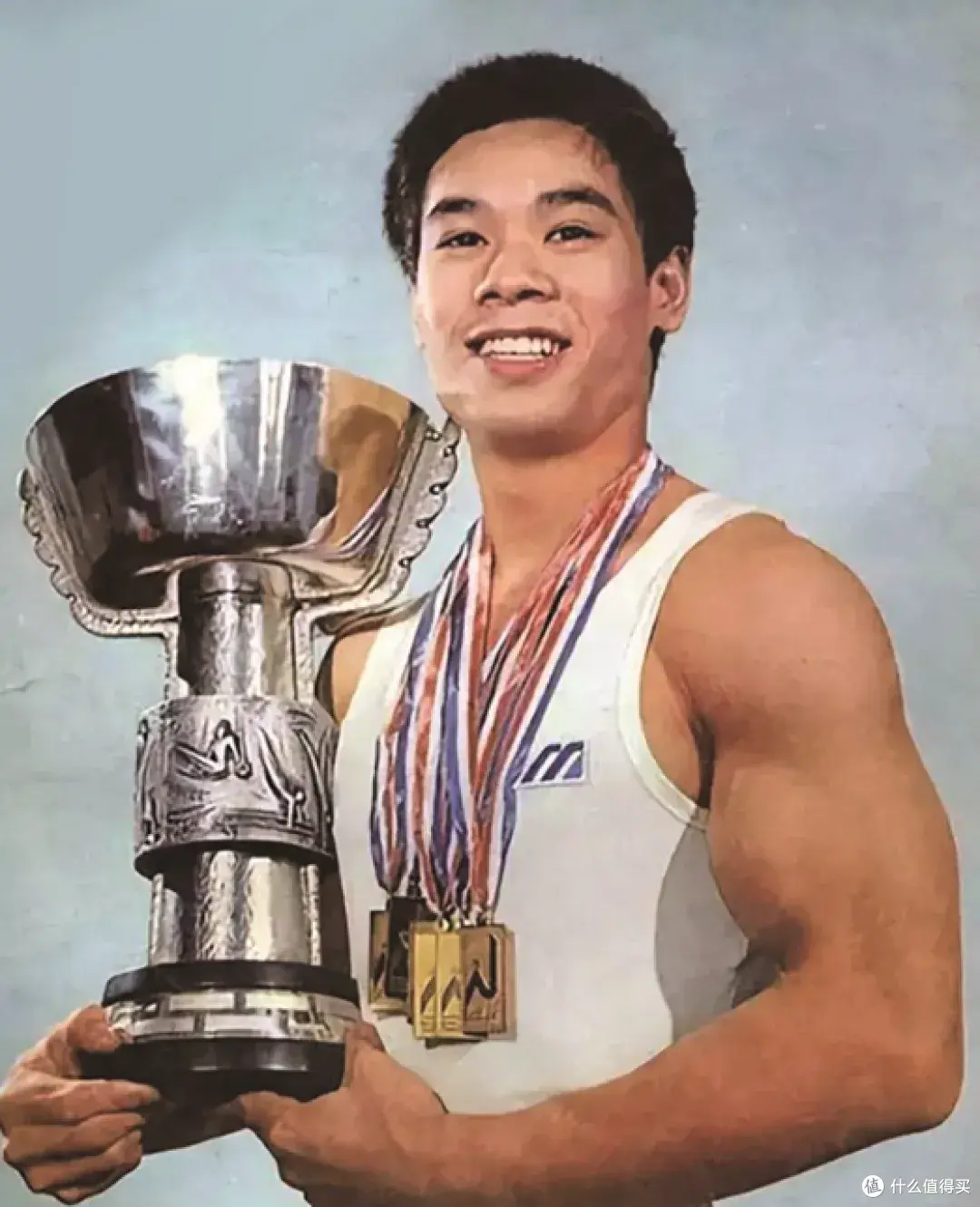
The distinction matters. He did not win seven gold medals. He won six golds and a bronze, a remarkable achievement precisely because the competition covered a broad range of gymnastics disciplines.
The result made an unusually clear statement about his versatility. Li Ning was not dependent on one apparatus, one type of routine, or one narrow technical advantage. He could compete successfully across the all-around programme and multiple individual events. A performance strong enough to win on the floor had to be translated into different physical demands on the pommel horse, rings, vault, and horizontal bar.
The World Cup also helped establish his international image. He became known as the “Prince of Gymnastics,” a title that captured both his success and the impression created by his performances. It suggested elegance, authority, and a kind of command over movement. The nickname was not a formal sporting title, but it was memorable because it seemed to express what spectators saw: a gymnast who could make difficult skills look unusually natural.
The language of athletic praise often simplifies the work behind excellence. A gymnast is called graceful, explosive, or gifted, as if those qualities were fixed characteristics. In practice, the apparent ease of a high-level routine is the product of extraordinary preparation. Every successful landing depends on timing. Every controlled hold requires strength and body awareness. Every transition must fit within the demands of the code and the rhythm of the routine.
Li Ning’s performances combined these elements in a way that made his versatility visible. He was powerful without appearing cumbersome. He could generate speed and then bring it under control. He could move through complex actions without making the audience feel that the sequence was a struggle.
The 1982 World Cup was important for another reason: it arrived at a time when Chinese gymnastics was gaining international credibility. The achievements of one athlete could be interpreted as evidence of a wider programme’s progress. Li Ning’s success therefore carried significance beyond his own medal count.
This was the beginning of a recurring tension in his public life. His personal achievements belonged to him, but they were also read as national achievements. When he won, his victories could become symbols of a country’s growing confidence in international sport. When he lost, the meaning of the result could expand far beyond the technical details of a routine.
The nickname “Prince of Gymnastics” reflected the admiration generated by his performances, but it also helped create expectations. Once an athlete is presented as exceptional, ordinary outcomes become difficult to accept. A silver medal can be interpreted as failure. A mistake can seem to contradict an entire public image. The athlete is no longer judged only against the field of competitors, but against the standard established by his own previous success.
Li Ning’s extraordinary versatility brought him to the centre of international attention. It also made his next major challenge more demanding. At the 1984 Olympic Games in Los Angeles, he would have to perform across multiple events under the most visible conditions of his career.
The World Cup had shown that he could dominate a broad programme. The Olympics would test whether that excellence could be sustained when every routine carried a larger symbolic burden.
03 — What “Complete” Actually Meant
To understand Li Ning’s gymnastics, it is useful to begin with a simple distinction: strength is not the same as control, and difficulty is not the same as quality.
Men’s artistic gymnastics rewards a combination of technical demands. The athlete must generate sufficient power to complete a skill, maintain the correct body position, connect movements in the required sequence, and finish with control. Depending on the apparatus, the ideal performance may involve stillness, continuous motion, explosive acceleration, or a precisely timed landing.
Li Ning’s reputation rested on his ability to adapt to these different demands. His achievement was not that he made every apparatus look identical. It was that he could change the way he used his body without losing the qualities that made him distinctive.
The all-arounder’s economics
The all-around gymnast faces a demanding distribution problem. Training time, physical energy, recovery, and technical attention must be divided across six apparatus. Excellence in one event cannot compensate indefinitely for weakness in another when the overall title is at stake.
Each apparatus has its own technical vocabulary. The pommel horse requires continuous movement around the apparatus, with the athlete maintaining rhythm and controlling the position of the legs and hips. The rings demand exceptional upper-body strength and the ability to hold stable positions while resisting movement in the apparatus. Floor exercise combines tumbling, acrobatics, strength elements, and choreography. Vault requires speed, a powerful take-off, flight, and a controlled landing. The parallel bars and horizontal bar demand different combinations of swing, support, release, and re-grasp.
An all-arounder must switch between these physical problems. The qualities that help on one apparatus do not automatically transfer to another. Excessive muscular tension can interfere with fluid movement. A movement pattern useful for one skill may be unsuitable for another. A training programme must develop different capacities without allowing them to undermine each other.
Li Ning’s success across the programme suggests a high level of adaptability. His 1982 World Cup performance was a particularly strong demonstration: six gold medals and one bronze across seven men’s events. At the 1984 Olympics, he won medals in the all-around, team competition, and four individual apparatus finals, with his three gold medals coming on floor exercise, pommel horse, and rings.
This versatility made him valuable in team competition as well as individual events. A team needs reliable performances across apparatus, not just a single specialist capable of winning a final. The all-around gymnast must be prepared to contribute in several contexts, often under the same competition pressure.
There is also a psychological cost. A specialist can build a competition around a limited number of peak performances. An all-around gymnast must repeatedly reset attention. The mental task after one routine is to leave it behind, recover, and prepare for a different apparatus with different technical demands. A successful performance on the rings does not make the pommel horse any easier.
Li Ning’s career shows why completeness is a demanding form of excellence. It is not simply the sum of six separate skills. It is the ability to remain competitive while moving between them.
The rings: strength made visible
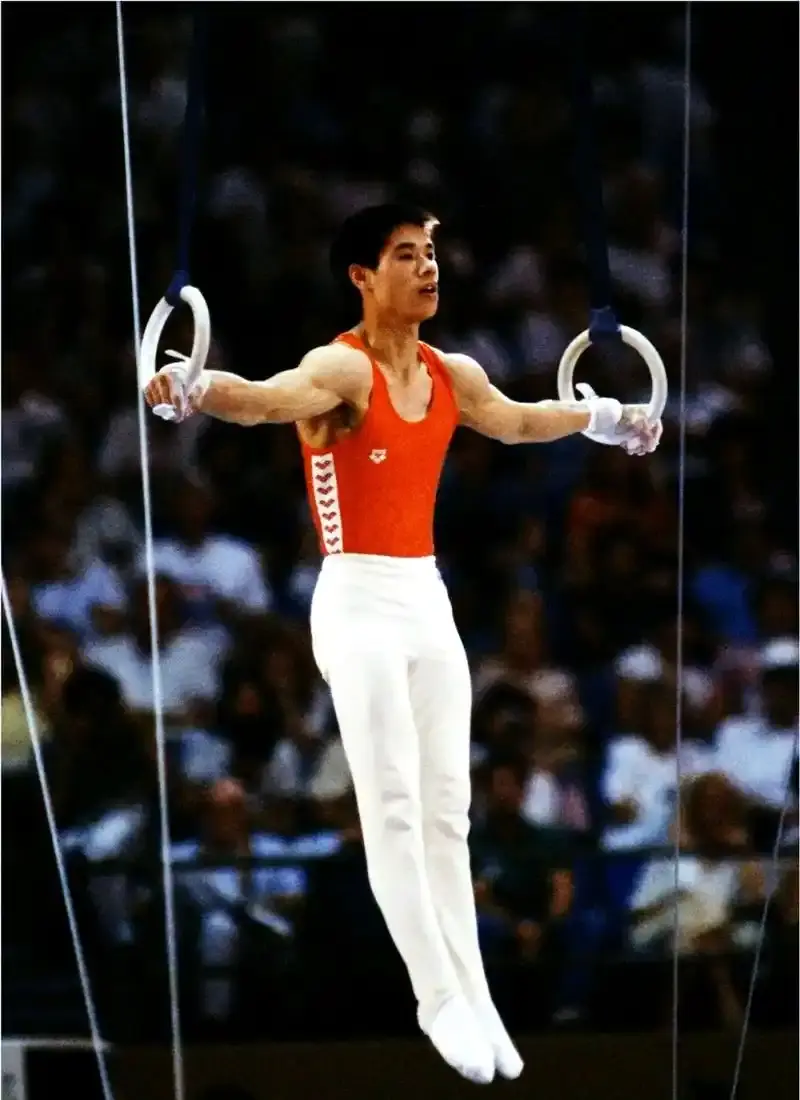
The still rings offer one of gymnastics’ clearest demonstrations of the difference between raw strength and controlled strength. The apparatus moves in response to the athlete. A gymnast must stabilise it while executing positions that demand significant force from the shoulders, arms, chest, and trunk.
A strong athlete may be able to lift his body, but the competitive challenge is to hold the required position with control. The rings can expose small instabilities. A body that shakes, a position that drifts, or a transition that lacks precision can affect the quality of a routine.
Li Ning’s Olympic gold on the rings in 1984 was one of the defining results of his career. He shared the gold medal with Japan’s Koji Gushiken, with both receiving the same score. The shared title is a reminder that gymnastics is governed by a judging system: athletes may produce different routines, yet the final ranking depends on the standards and scores assigned to those performances.
Li Ning was associated with skills carrying his name in the sport’s technical vocabulary, including movements on the rings. Such named skills are significant because they move beyond the idea of a successful routine. They indicate that a gymnast has performed a movement or combination recognised as a distinct contribution to the sport’s evolving technical repertoire.
The important point is not that a named skill makes an athlete automatically superior in every context. A skill must be executed within the requirements of a routine and judged according to the code. But having a movement associated with one’s name is a form of technical recognition that outlasts a single medal ceremony.
In the rings, Li Ning’s broader reputation for power and control found a natural expression. The event demands that strength be organised into exact positions. It rewards an athlete who can produce force without allowing force to become uncontrolled movement.
The pommel horse: rhythm under constraint
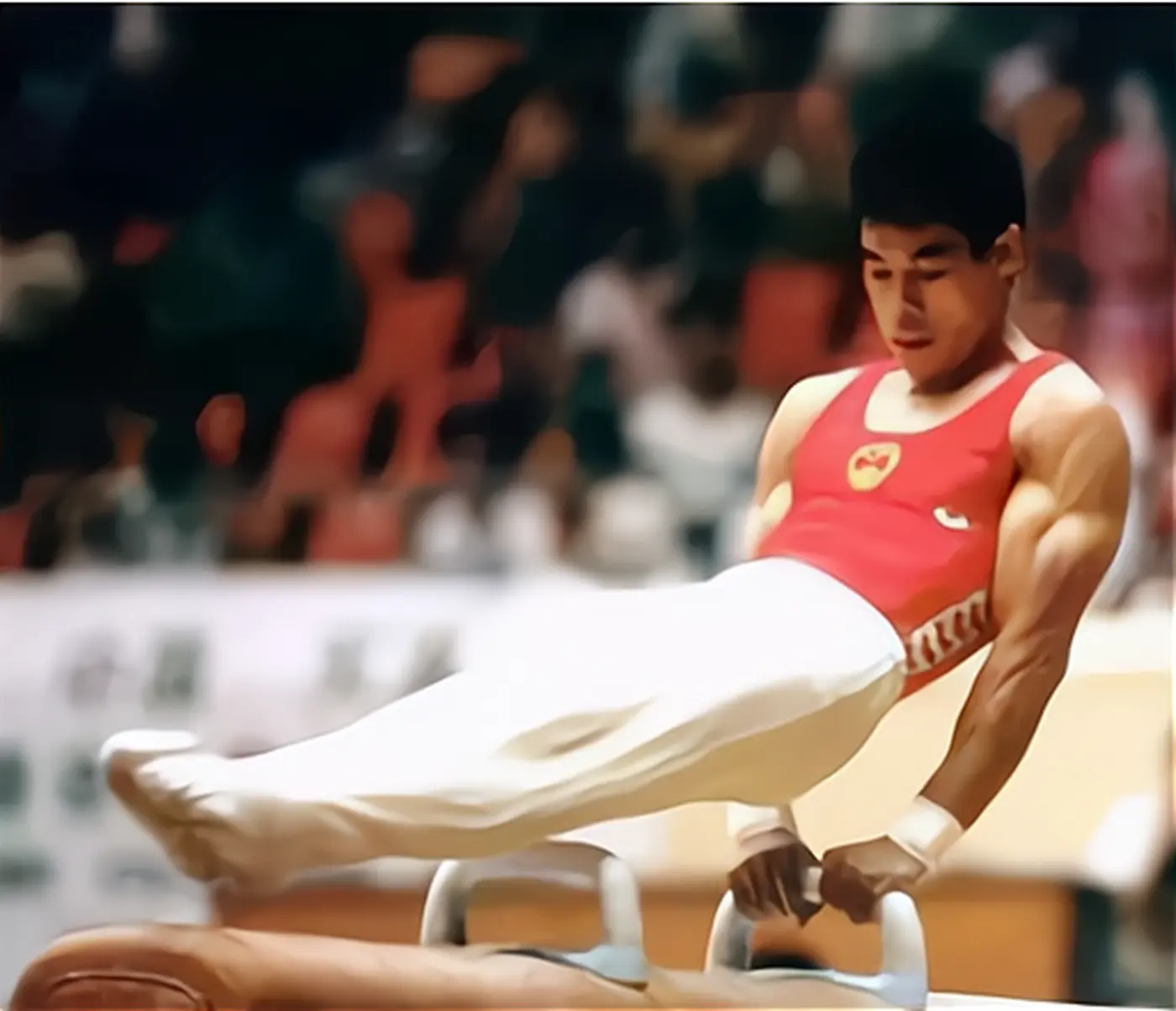
The pommel horse presents a different challenge. Here, the athlete must maintain continuous circular movement while supporting the body through the arms and controlling the legs in space. The routine is not simply a display of strength. It is a problem of rhythm, placement, and uninterrupted motion.
A small disruption can break the flow of the sequence. The athlete must move around the apparatus while maintaining technical form and avoiding contact with the horse in ways that would compromise the routine. Balance is dynamic rather than static: the gymnast is continually shifting support and position.
Li Ning shared the 1984 Olympic pommel horse gold with American Peter Vidmar. Both received 19.950. The tie placed Li Ning at the centre of a close contest between athletes who had reached the same score through the standards of the event.
The result is important because it illustrates the difference between winning through a single dramatic moment and winning through technical execution. A pommel horse routine is built from continuous actions. Its quality depends on whether the athlete can sustain a coherent sequence without visible interruption.
Li Ning’s association with a named pommel horse skill adds another dimension to his legacy. A skill becomes part of the sport’s technical history when it is recognised and incorporated into the code. It then belongs to a wider system of knowledge: coaches teach it, gymnasts study it, and judges evaluate it according to formal criteria.
The apparatus also reveals the importance of economy. The gymnast cannot waste movement. Unnecessary tension, a poor hand placement, or a disrupted rhythm can undermine the entire sequence. The strongest performance is not necessarily the one that looks most forceful; it is the one in which every action serves the next.
Floor exercise: power, timing, and the landing
Floor exercise combines tumbling, acrobatic elements, strength, and choreography across a defined area. It requires the athlete to generate momentum, orient the body through flight, and regain control at the end of a tumbling pass.
The landing is especially revealing. A difficult skill may attract attention, but the gymnast must still control the final position. A step or loss of balance can reduce the quality of an otherwise impressive pass. The routine therefore asks for a combination of risk and restraint: enough power to complete the movement, enough control to finish it.
Li Ning won the floor exercise gold at Los Angeles in 1984. He also won the gold medal in the pommel horse and rings, giving him three individual Olympic titles at the same Games.
The floor result is a useful example of how spectators experience gymnastics. Audiences see a sequence that appears to flow from one action to another. Judges assess the technical elements and their execution. The athlete must satisfy both the physical requirements of the movement and the formal standards of the sport.
The apparent ease of a successful routine can obscure the precision required to perform it. A gymnast must know not only how to generate a movement but also where it will end. The landing is not an afterthought; it is part of the skill.
The style question: elegance as a form of discipline
Chinese descriptions of Li Ning’s gymnastics have sometimes emphasised lightness, fluidity, softness, and beauty. Such language belongs to a particular sporting and cultural vocabulary, and it should not be treated as a formal international judging category. Nevertheless, it points to something meaningful about the way his performances were remembered.
In gymnastics, beauty is not separate from technique. A routine may be difficult, but if the movement is uncontrolled, the difficulty does not automatically create a compelling performance. Conversely, a movement that appears effortless may be the result of intense physical preparation.
The ideal is a relationship between power and form. The athlete must be strong enough to complete the movement and disciplined enough to prevent unnecessary effort from becoming visible. Speed must be managed. Transitions must be prepared. The body must arrive at the next position at the right moment.
Li Ning’s public image was shaped by the impression that difficult skills could be executed with unusual ease. That impression helped make him a compelling figure for audiences who did not necessarily understand the technical code. They could still see that the performance was powerful, controlled, and aesthetically coherent.
It would be an overstatement to suggest that he single-handedly created a national style or that Chinese gymnastics can be reduced to a single aesthetic. Gymnastics traditions evolve through many athletes, coaches, rules, and competitive environments. Li Ning’s contribution was more specific: he became one of the figures through whom Chinese gymnastics demonstrated its capacity to compete at the highest level.
What the named skills prove
Several gymnastics skills have been associated with Li Ning’s name. Official FIG materials reviewed for this article identify elements on the pommel horse—marked “(Li Ning)” in the rules—and a still-rings hanging position referred to as the “Li Ning.” The precise descriptions and naming histories should be checked against the relevant editions of the International Gymnastics Federation’s code, because the names and dates reported in secondary sources are not always presented consistently; only FIG-supported examples are stated here.
The significance of named skills is straightforward. They recognise a technical contribution rather than merely a competition result. Olympic medals record success within a particular event and year. A named movement becomes part of the sport’s accumulated technical knowledge.
That distinction matters for a biography. Medals can be won by many athletes, and records can eventually be broken. A recognised skill can continue to be discussed long after the athlete has retired. It becomes a point of reference for later generations, even when the sport evolves and the skill’s competitive value changes.
Li Ning’s technical legacy therefore has two parts. He was an exceptionally successful competitor, and his name became attached to elements of gymnastics itself. The first is a record of results; the second is a form of recognition within the sport’s development.
Taken together, these qualities explain why his reputation was larger than a single Olympic performance. His versatility made him a champion. His technical contribution helped make him part of gymnastics history.
04 — Los Angeles, 1984: Six Medals and a National Turning Point
The 1984 Olympic Games in Los Angeles gave Li Ning the stage on which his international reputation became unmistakable.
China returned to the Summer Olympics after a long absence from the Games. Its athletes entered a competition watched not only for individual results but also for what those results might represent in the country’s renewed participation in international sport.
For a gymnast, the Olympics are an unusually demanding test. The competition is spread across team, all-around, and apparatus events. The athlete must perform repeatedly, manage fatigue, and avoid allowing one mistake to contaminate the next routine. The audience sees separate events and medal ceremonies; the gymnast experiences a continuous sequence of technical and psychological demands.
Li Ning’s competition began with the pressures of the team and all-around contests. China won the men’s team silver medal, finishing behind the United States. In the individual all-around, Li Ning took bronze with a score of 118.575, behind Koji Gushiken of Japan and Peter Vidmar of the United States.
The all-around bronze was an extraordinary achievement by ordinary standards, but it was not the result that defined the public memory of his Los Angeles campaign. Li Ning was capable of winning more.
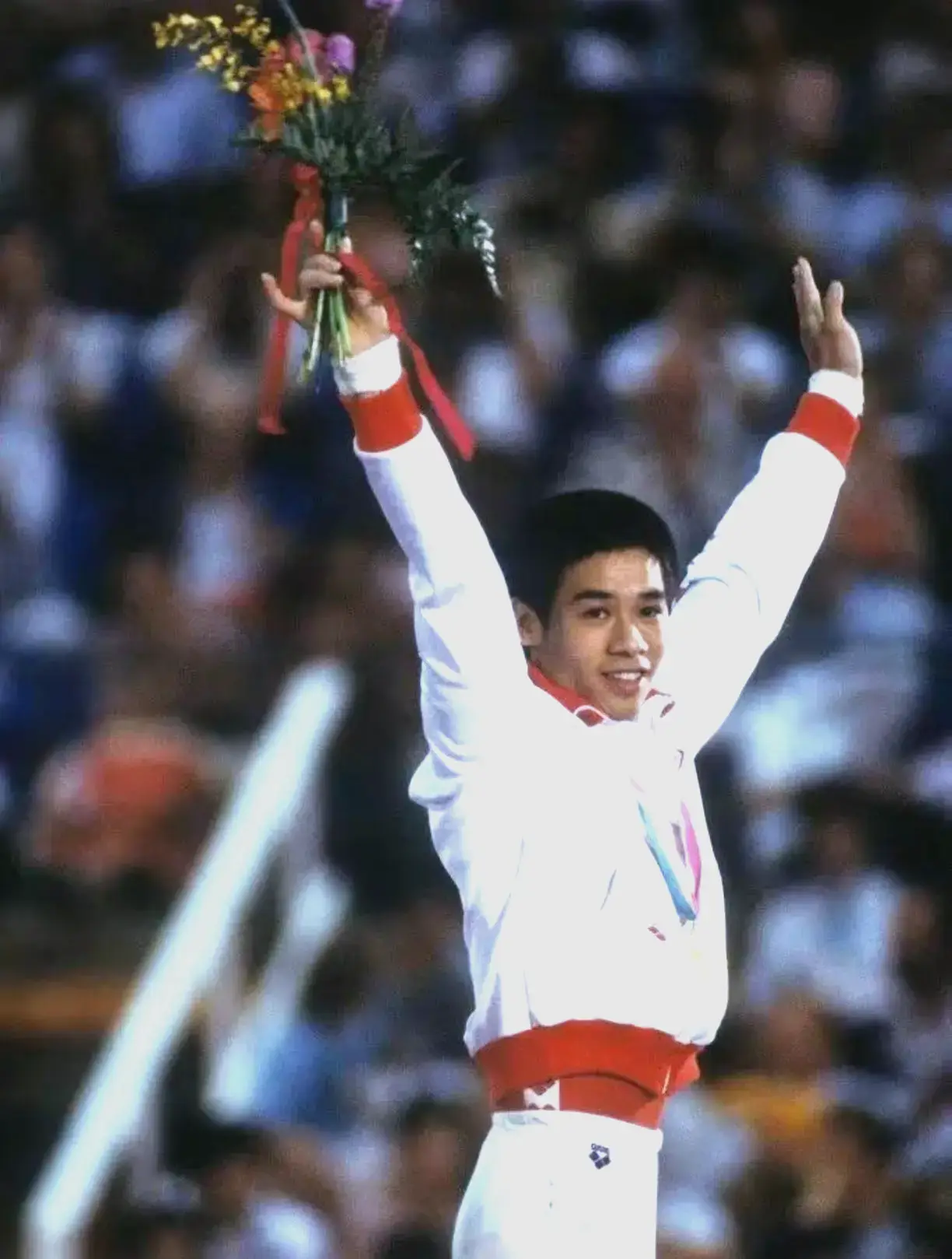
The individual apparatus finals gave him a chance to concentrate on the events in which he was strongest. He won gold on floor exercise, pommel horse, and rings. He took silver on vault, bringing his total to six Olympic medals: three gold, two silver, and one bronze. The floor-exercise gold came at 19.925, and the all-around bronze was settled by a final score of 118.575, behind Koji Gushiken and Peter Vidmar—figures that show his 1984 campaign was built on high execution as well as medal count.
The distribution is worth stating precisely. Li Ning did not win six gold medals in Los Angeles. He won six medals in total, including three golds. That distinction does not diminish the achievement; it makes the record more meaningful.
His three individual gold medals came from events with very different technical demands. Floor exercise rewarded tumbling, power, and controlled landings. The pommel horse required rhythm and sustained movement. The rings demanded controlled strength. Winning all three demonstrated the breadth of his ability.
Two of the gold medals were shared. On the pommel horse, Li Ning and Vidmar both scored 19.950. On the rings, Li Ning and Gushiken both scored 19.850. The shared titles reflected the scoring system in use at the time and the fact that two athletes could achieve the same final score.
These details are important because they show how Olympic history is made. A medal table presents a clean result, but the competition itself is a series of performances, judgments, and narrow margins. The difference between a gold and a silver can be small. The difference between a routine that holds together and one that fails can be a single technical error.
Li Ning’s six medals made him the most decorated athlete of the Los Angeles Games by total medal count. That description is different from saying that he won the most gold medals: the distinction is based on the number of medals across all colours.
The wider significance of the performance came from the context in which it occurred. For Chinese audiences, the Games offered a visible demonstration that Chinese athletes could compete successfully on a global stage. Li Ning’s medals made him a particularly powerful symbol because he won repeatedly across different events. He did not appear as a specialist whose success depended on one exceptional performance. He appeared as a complete athlete.
This helped create the public figure known as the “Prince of Gymnastics.” The title expressed admiration, but it also turned a person into a symbol. Li Ning was increasingly expected to represent not only himself but also the promise of Chinese sport.
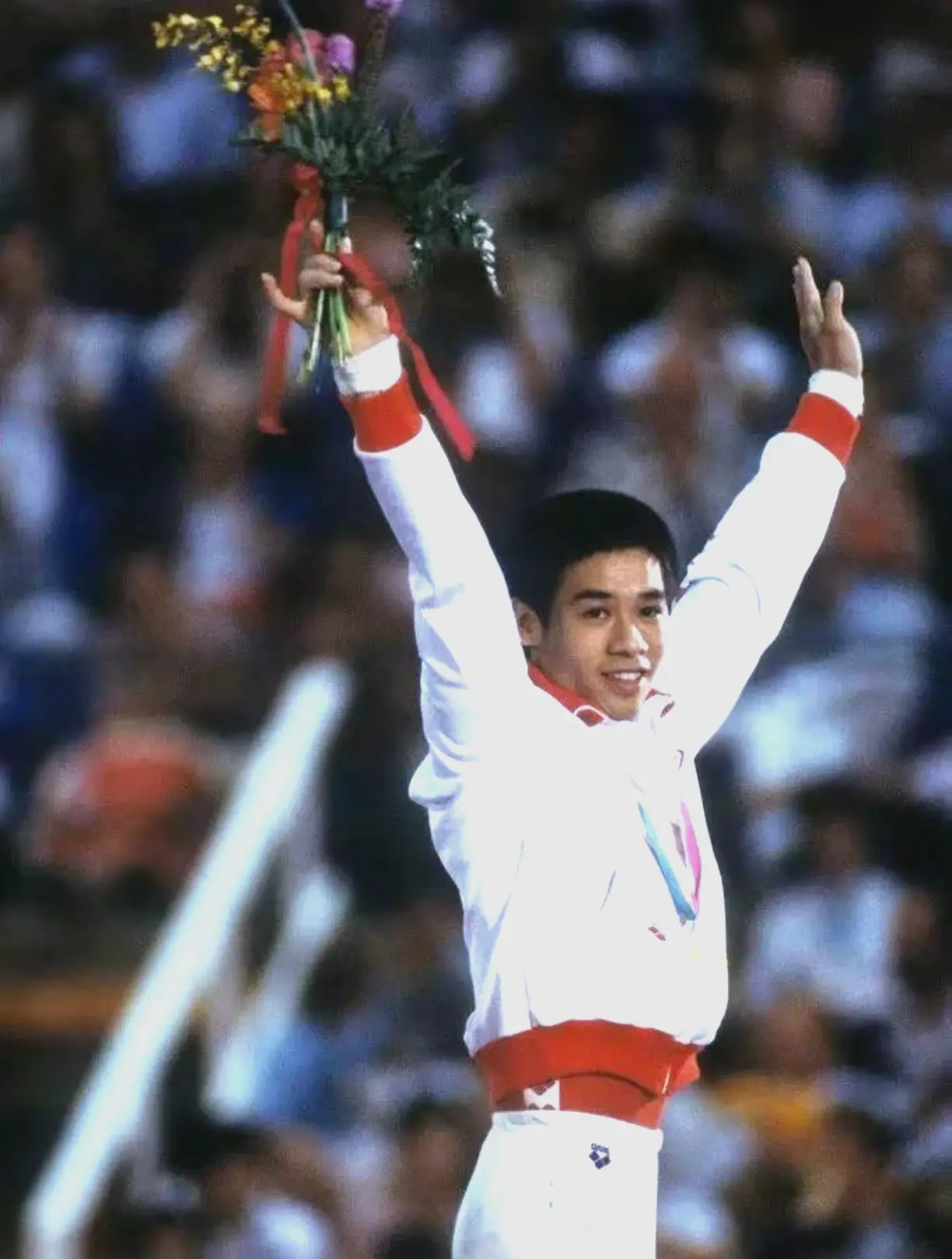
There is a tension in that transformation. Athletes often enter competition with personal goals: to execute a routine, beat an opponent, or win a medal. Public audiences may attach much larger meanings to the result. A gold medal can become evidence of national progress; a defeat can be interpreted as a failure of collective ambition.
The gymnast cannot control all those meanings. He can control his preparation and performance, but he cannot determine how millions of people will interpret a result.
Los Angeles established Li Ning as a champion and a public figure. It also helped create the expectations that would make the 1988 Olympics so painful. Once an athlete has become a national symbol, a later failure is rarely allowed to remain just a sporting result.
The six medals in Los Angeles were the high point of his competitive career. They were not the end of his story. Four years later, he returned to the Olympics carrying the memory of his triumphs, the demands of an increasingly familiar public image, and the physical wear of years at the highest level.
05 — The Smile: Seoul, 1988
By the time Li Ning arrived at the 1988 Olympic Games in Seoul, his circumstances had changed.
He was no longer the young gymnast who had astonished audiences in Los Angeles. Years of intensive training had placed demands on his body, and reports of the period describe shoulder and back problems that complicated his preparation. The sport had not become easier, but the margin between a successful performance and a disappointing one had narrowed.
The Olympics reward preparation, yet preparation is not always something an athlete can complete under ideal conditions. Injuries disrupt training. Pain changes the way a movement feels. A skill that once seemed automatic may require conscious adjustment. The athlete must decide how much to trust the body and how much risk to accept.
For a gymnast, these questions are especially difficult. The apparatus do not allow much room for uncertainty. A small hesitation can affect timing. A poorly controlled landing can turn a routine into a failure. The body must be strong, but it must also be reliable.
China’s men’s team finished fourth in Seoul, outside the medals. Li Ning did not reach the position he had occupied four years earlier. His individual results were also disappointing, and he failed to reproduce his Los Angeles success.
The contrast between the two Olympics was severe. In 1984, he had won three gold medals and six medals overall. In 1988, he returned as one of the sport’s most recognisable champions and left without an Olympic medal.
The public response was shaped by the scale of the earlier achievement. A gymnast who had won so much was expected to win again. The audience’s memory of Los Angeles became a standard against which Seoul was judged. Rather than seeing the later competition as a difficult stage in a long career, some observers interpreted the result as a failure to meet the expectations created by his own reputation.
The distinction between a sporting result and a moral judgment became particularly painful.
Reports and later interviews have described how Li Ning’s smile after the disappointing competition was interpreted by some people as evidence that he did not care enough. A facial expression that might have reflected exhaustion, embarrassment, an attempt to compose himself, or a complicated mixture of emotions became a subject of public accusation.
The episode reveals a problem in the way famous athletes are treated. Spectators often expect a visible emotion that confirms their own interpretation of an event. After a defeat, the athlete is expected to look devastated. A smile can be read as indifference, even when the observer has no reliable access to what the athlete is feeling.
A public figure loses some control over the meaning of his own expressions. The athlete experiences the result from inside the body; the audience interprets it from outside. The two perspectives can be very different.
Accounts of the backlash have also described hostile messages and threats, including reports that Li Ning received razor blades and rope. These details should be understood as part of the reported recollections of the period, rather than as independently documented evidence of every incident. Their importance lies in the atmosphere they convey: the disappointment of a sporting audience could become personal hostility toward the person who had previously embodied its hopes.
Such reactions were not a fair measure of Li Ning’s commitment. A failed routine does not prove that an athlete lacks ambition. A disappointing competition does not erase years of achievement. Yet the symbolic burden attached to an Olympic champion can make such distinctions difficult to maintain in public debate.
There is also a physical dimension to the story. Li Ning was dealing with injuries and the limits of a body that had spent years performing difficult skills. A gymnast’s competitive career depends on the relationship between strength, flexibility, timing, and confidence. When injury interferes with that relationship, continuing to compete can become a negotiation with uncertainty.
The athlete may still possess technical knowledge and experience, but knowledge cannot eliminate physical limits. A routine must be performed by the body that exists on that day, not by the body remembered from four years earlier.
After Seoul, Li Ning retired from competitive gymnastics. The retirement is generally dated to 1988, following the Games, although some secondary accounts differ on the exact timing. What matters for the story is that the competitive career ended after a disappointing Olympic return, not after another triumphant medal ceremony.
His retirement left an unusual problem. Li Ning had been famous for doing something exceptionally well. He now had to decide what remained when he could no longer pursue that achievement in the same way.
For many athletes, retirement involves a loss of routine, identity, and social position. Training has structured daily life. Competition has provided clear goals. Results have supplied a language through which effort can be evaluated. When those structures disappear, the athlete must build another way of understanding progress.
For Li Ning, the transition was complicated by the fact that his name was already widely recognised. He was not starting from anonymity. He was starting from a public identity that had been built around a particular kind of success—and had recently been tested by failure.
The question was not whether he could erase Seoul. He could not. Nor could he return to being the gymnast he had been in 1984. The question was whether the qualities developed through sport could be used in a different setting.
The next chapter of his life would test that possibility.
06 — When the Name Became a Brand
Li Ning’s move into business began soon after his retirement. In 1989, he joined the Jianlibao Group, a Chinese beverage company associated with the development of domestic sports sponsorship and marketing. He worked as a special assistant to the general manager and began to learn about commercial operations from inside an established organisation.
The move was significant because it placed him in a world governed by unfamiliar measures of success. Gymnastics had provided a clear competition schedule and a formal scoring system. Business demanded a different combination of judgment, timing, negotiation, product development, and financial discipline.
The fact that Li Ning was famous did not mean he knew how to build a company. His reputation could open doors, attract attention, and provide an initial source of credibility. It could not by itself design a product, manage production, establish distribution, or persuade customers to buy repeatedly.
In April 1989, the “Li-Ning” trademark was registered. The company began operating in Sanshui, Guangdong, in May 1990, producing and selling sportswear under the brand. The distinction between the trademark’s registration and the start of commercial operations is important: the name entered the formal business record before the company began its full commercial life.
The timing connected the new enterprise to a major event in Chinese sport. In August 1990, Li-Ning sportswear was selected for the torch relay of the Asian Games in Beijing and for the Chinese national team’s award clothing. The brand appeared in a public setting where sport, national representation, and consumer identity overlapped.
The choice was commercially valuable, but it also represented a deliberate shift in the relationship between Li Ning and the sporting world. As an athlete, he had worn competition clothing supplied within the sporting system. As a businessman, he was helping to create a domestic sportswear brand that could be worn by athletes and recognised by the public.
The name carried a particular advantage. “Li Ning” was already associated with excellence in gymnastics. It was not an invented label that needed to create meaning from nothing. The public knew the athlete, remembered the Olympic medals, and understood the symbolic value of his sporting career.
But a personal name on a product also creates a special risk. The reputation of the founder becomes inseparable from the reputation of the company. If the brand succeeds, the founder’s achievements appear to have gained a second life. If the business struggles, the same name that attracts customers can become a reminder of the gap between athletic fame and commercial performance.
The company expanded its operations in the early 1990s. In 1991, it began full-scale operations in sportswear and footwear. In 1992, Li-Ning equipment was selected as the Chinese delegation’s designated award clothing and footwear for the Barcelona Olympics. The company described the selection as ending the period in which Chinese athletes used foreign sporting goods at Olympic award ceremonies.
That claim should be understood in its historical and symbolic context rather than as a statement that every Chinese athlete immediately stopped using foreign equipment in all circumstances. The important change was visible: a Chinese sportswear brand could dress the national delegation on the Olympic stage.
The company was not simply selling clothes. It was participating in the creation of a domestic sporting identity. The athlete who had represented China through his performances was now building a company whose products could be worn by other athletes representing the country.
This was not a direct continuation of gymnastics. It was a new form of participation in sport.
A gymnast must meet the demands of a routine. A sportswear company must meet the demands of athletes and consumers whose needs differ across sports, climates, budgets, and styles. Products must work in practice, survive repeated use, and compete with alternatives. Design has to balance performance, comfort, cost, and appearance. A brand must communicate a promise that customers can recognise and judge.
The company therefore had to move beyond the fame of its founder. Li Ning’s achievements could establish attention, but long-term success required an organisation capable of producing and distributing goods consistently.
In 1993, the company moved its headquarters to Beijing and developed a nationwide franchise network. Expansion created new challenges. A brand that begins with a powerful story must eventually support that story through operations. Retailers need products that sell. Customers expect quality. A national network requires systems for supply, marketing, inventory, and management.
The Olympic connection remained central. The company sponsored the Chinese delegation at subsequent Games, including Atlanta in 1996 and Sydney in 2000. The association between the brand and Chinese sport became increasingly familiar. The founder’s athletic career supplied an origin story, while the company’s products created a continuing presence in the sporting environment.
The business also developed a public identity distinct from the founder’s competition record. In 2002, it adopted the slogan “Anything is possible,” a phrase that translated the language of athletic aspiration into a broader consumer message. It suggested that the potential associated with sport could be extended beyond the stadium.
The slogan was not proof that every ambition would succeed. Rather, it expressed the brand’s desired relationship with its customers: movement, effort, self-improvement, and the possibility of going beyond a previous limit.
The company became a listed business in Hong Kong on June 28, 2004, becoming the first mainland Chinese sporting-goods company to list on the Hong Kong Stock Exchange. A public listing marked another stage in the separation between the founder’s personal sporting history and the organisation’s commercial future. The company was now accountable to investors as well as customers, distributors, athletes, and employees.
The name remained personal, but the enterprise had become institutional.
That distinction is central to Li Ning’s second career. A champion can be remembered through photographs, medals, and statistics. A company must continue to function after the founder leaves a meeting, after a product launch, and after a major sporting event ends. Its success depends on people and systems beyond the founder’s own performance.
The gymnast had learned to execute a routine under a set of rules. The entrepreneur had to help build a structure capable of making decisions, learning from mistakes, and adapting to a changing market.
The transition did not mean that the two careers were unrelated. The habits developed in sport—preparation, repetition, resilience, and attention to detail—could be valuable in business. But they were not sufficient on their own. A company could not be run as though every problem were a competition final. Commercial judgment required a willingness to revise assumptions, study customers, and accept that a famous name did not guarantee a successful outcome.
By the time Li Ning’s company had established itself as a major domestic sportswear brand, the name had acquired a second meaning. It no longer referred only to the gymnast who won Olympic medals. It also referred to products, retail stores, design, corporate strategy, and a growing business.
The transformation was remarkable precisely because it was incomplete in the best sense: the second career did not replace the first. It added another layer to the name.

07 — The Flame and After: A Second Career Under Its Own Pressure
The 2008 Beijing Olympics brought Li Ning back into the centre of the Olympic story, but by then his relationship with the Games had changed fundamentally.
He was no longer competing for medals. He was the founder of a company that had grown alongside China’s modern sporting identity. His name was familiar to people who remembered the gymnast and to consumers who knew the sportswear brand. The opening ceremony placed those two histories in the same frame.
As the final torchbearer, Li Ning was lifted into the air and carried the flame around the stadium before lighting the Olympic cauldron. The sequence transformed a commercial founder back into a visible symbol of sport. It also made the event feel like a return: the gymnast who had won six medals in Los Angeles was once again associated with the Olympic Games, but in a role that depended on memory rather than competitive performance.
The image was powerful because it did not require the audience to know the details of his business career. They could recognise the former champion and understand the significance of his presence. For viewers who remembered the disappointment of Seoul, the scene could also be read as a reversal of the earlier narrative. The athlete who had left the Olympic stage without a medal in 1988 was now entrusted with one of the ceremony’s most important acts.
But it would be too simple to describe the 2008 ceremony as a final vindication. The flame did not erase the criticism that followed Seoul, nor did it prove that every commercial decision made by the company had been correct. It showed that Li Ning’s public identity had expanded beyond competitive results.
His second career had its own periods of difficulty. The sportswear market became more competitive, consumer preferences changed, and the company faced the challenge of maintaining a coherent brand while reaching new audiences. A founder’s fame can create initial attention, but the market does not grant permanent success as a reward for past achievements.
The company’s history included both expansion and adjustment. It invested in retail networks, design, research and development, product categories, and marketing. It also had to confront the practical problems of inventory, channel management, pricing, and brand positioning. These issues may seem far removed from the still rings or pommel horse, but they are part of the reality of building an organisation that must survive beyond its founding moment.
The commercial crisis around 2012 was a particularly important test. Like other sporting-goods companies, Li-Ning faced pressure from excess inventory and changes in the retail environment. The company’s response involved a period of restructuring and strategic adjustment. Its difficulties demonstrated that a strong origin story and national recognition could not shield a business from market forces.
This point deserves emphasis because the founder’s identity can tempt observers to turn business history into a simple story of personal willpower. In reality, a large sportswear company depends on thousands of decisions made across product development, procurement, retail, marketing, and finance. It must respond to competitors and customers whose behaviour cannot be dictated by the founder’s reputation.
The brand’s subsequent evolution included attempts to refine its positioning and reach new consumers. The “China Li-Ning” presentation at New York Fashion Week in 2018 helped bring the brand into a different cultural conversation, connecting sportswear with Chinese design references and contemporary fashion. It was an attempt to make the company’s identity relevant beyond the traditional boundaries of athletic equipment and team sponsorship.
That strategy carried both opportunity and tension. A brand rooted in sport can gain attention through fashion, but it must still maintain credibility in its core categories. A brand that uses national cultural references can create a distinctive identity, but it must ensure that those references become meaningful design rather than mere decoration. The challenge is to connect heritage with products that consumers actually want to wear.
The name “Li-Ning” made this process especially visible. It carried the history of a gymnast who had represented China in international competition, but it also had to function as a commercial identity in a market where customers compare price, quality, style, and performance.
The founder’s athletic career provided the company with an unusually strong origin story. It did not eliminate the need to earn trust repeatedly.
The business remained active decades after its founding. According to Li-Ning Company’s investor-relations disclosures: the 2025 annual results showed revenue of RMB 29.598 billion (RMB 295.98亿元), up 3.2 percent from 2024, and profit attributable to equity holders of RMB 2.936 billion (RMB 29.36亿元), down 2.6 percent; the first half of 2026 interim results showed revenue of RMB 15.235 billion (RMB 15,235 million / RMB 152.35亿元), up 2.8 percent year-on-year, with a gross profit margin of 50.9 percent, up 0.9 percentage points. (Unit caution: RMB 15,235 million equals RMB 15.235 billion, or RMB 152.35亿元—not RMB 15.235亿元.) These figures describe the company’s performance, not Li Ning’s personal wealth or the success of every product line; they are useful because they show that the name continues to operate within a substantial commercial organisation long after the founder’s retirement from gymnastics.
The company’s continued existence should not be mistaken for a simple upward trajectory. Revenue, profit, margins, and market position can move in different directions. A business can grow sales while facing pressure on profitability, or improve operational efficiency while confronting changes in consumer demand. Financial statements are not medals; they are evidence that must be interpreted in context.
Still, the scale of the enterprise makes one aspect of Li Ning’s second career clear. The brand has outlived the competitive career that gave it its name. It is now an organisation with its own employees, products, customers, and strategic decisions. Its future cannot be determined by the founder’s Olympic record alone.
Li Ning has also continued to appear in public discussions of Chinese sport. On February 9, 2026, he published an article in People’s Daily titled “Let the World See the Spirit of Chinese Athletes” (《让世界看见中国运动员风采》). Writing as a former Olympic athlete, he reflected on the development of Chinese winter sports and the meaning of Olympic participation. The article offered a reminder that his interest in sport had not ended with retirement or with the creation of a commercial brand.
That continued presence brings the story back to its central question. Li Ning did not simply leave gymnastics and become a businessman. He moved from one system of participation to another. As a gymnast, he represented China through his own body and performance. As a founder, he helped create a company that could equip athletes and reach consumers. As a public figure, he continued to interpret sport as a source of aspiration and collective meaning.
These roles overlap, but they are not interchangeable. A company is not a national team. A product is not an Olympic medal. A founder’s reputation is not a substitute for the work of designers, engineers, managers, retail staff, and athletes who give the brand its continuing life.
The 2008 torch-lighting ceremony remains an unusually effective image because it captures the overlap without resolving every difference. Li Ning carried the flame as a former athlete, a businessman, and a symbol of Chinese sport. The audience could see all three identities at once.
Yet the flame was only a moment. The second career had to continue after the stadium lights dimmed.
08 — The Accounting: What Does It Mean to Surpass Yourself?
Li Ning’s life is often summarised through two sets of achievements.
The first belongs to gymnastics. He won six medals at the 1984 Olympics, including three gold medals. He won world titles, dominated the 1982 World Cup across six of the seven men’s gold-medal events, and became one of the most recognisable gymnasts of his generation. His name became attached to skills within the sport’s technical vocabulary.
The second belongs to business. He helped build a sportswear company bearing his name, linked it to Chinese sport through major competitions, developed a national retail presence, and led it into the public markets. The company continued to evolve through commercial expansion, restructuring, and new attempts to connect athletic performance with consumer culture.
It is tempting to combine these achievements into a simple narrative: a champion won everything, suffered a defeat, and then won again in business. That version is satisfying, but it conceals the most interesting parts of the story.
The first career did not end in a perfect final performance. Li Ning’s return to the Olympics in 1988 was disappointing. His retirement followed a period when injuries and public expectations made the end of his competitive life particularly difficult. There was no final medal that neatly closed the story.
The second career did not unfold as an uninterrupted triumph. Building a company required learning a new profession, managing uncertainty, responding to market changes, and confronting periods of commercial difficulty. The name could attract attention, but it could not guarantee that customers would return.
The relationship between the two careers is therefore not one of identical victories. It is a relationship between different ways of measuring a life.
Gymnastics offered formal criteria. A routine had a start and a finish. Judges evaluated the performance. Results were recorded. A medal ceremony made the outcome visible.
Business offers no equivalent final score. Revenue can rise while profit falls. A product can be successful in one market and fail in another. A strategy that works for a period may become ineffective as consumer preferences change. The work continues because the conditions continue to change.
In this sense, the move from gymnastics to business was not a transfer of mastery. It was a transfer of habits into an unfamiliar environment. Discipline, persistence, and a willingness to practise could help. They could not replace commercial knowledge. Li Ning had to learn how a brand works, how products reach consumers, and how an organisation survives beyond the fame of its founder.
There is also a difference between being a symbol and building an institution. The gymnast became a symbol because of what he did in competition. The company could not remain a symbol alone. It needed operations, products, distribution, and people capable of doing work that the founder could not personally perform.
The name became both a source of strength and a test. It gave the company a recognisable identity, but it also tied the organisation to a public figure whose athletic career had been interpreted through intense national expectations. The brand inherited the admiration associated with the gymnast, but it also inherited the responsibility to produce something valuable in the present.
The deeper connection between the careers may lie in the idea of control.
In gymnastics, control is physical and immediate. The athlete must manage momentum, position, and timing. A routine can fail because a movement is too large, too small, too early, or too late. The body must be trained to make complex actions reliable.
In business, control is more indirect. A founder can influence strategy, product design, and organisational culture, but cannot control every customer response or market condition. The task is not to eliminate uncertainty. It is to build an organisation capable of responding to it.
The two forms of control are related, but they are not the same. A gymnast may be able to correct a movement through practice. A business must often respond to information that arrives after a decision has already been made. It must learn from outcomes without assuming that the same solution will always work.
This difference helps explain why Li Ning’s story is more interesting than a simple tale of an athlete becoming an entrepreneur. His second career required him to accept a new relationship with uncertainty. He could no longer rely on the authority of being a champion. He had to build a business whose products and systems would be judged on their own merits.
The name “Li Ning” now contains both histories. It recalls the gymnast who won three Olympic gold medals in Los Angeles and the founder whose company continued to operate decades after he left competition. It represents the power of sporting achievement to create public recognition, but also the limits of recognition when a new profession demands different skills.
The question in the title—how a champion built a second life beyond the medals—does not have a single answer. It is not that the medals were unimportant. They established the first meaning of the name and gave the second career a distinctive starting point. Nor is it that business was simply a substitute for gymnastics. The company created a different kind of legacy, one that depended on the continuing work of an organisation rather than on the performances of one athlete.
Li Ning’s achievement was to move between those worlds without allowing either one to erase the other. He remained a former gymnast whose sporting record mattered. He also became a founder whose business could not be judged solely through that record.
The torch-lighting ceremony in Beijing made the connection visible. But the real measure of the transition lies in the years before and after that night: the training that produced the champion, the disappointment that ended his competitive career, the decisions that began the company, and the adjustments required to keep it alive.
A medal can preserve a result. A name can preserve a memory. An institution must keep working.
Li Ning’s life brings those three forms of endurance together. His sporting achievements remain part of gymnastics history. His business became part of China’s modern sporting landscape. His public role continues to connect the athlete he was with the sporting culture he helped shape.
To surpass oneself, in this story, does not mean winning every contest. It means discovering that the end of one kind of excellence need not be the end of useful work. It means accepting that a new field will require different skills, different measures, and a willingness to be judged again.
The gymnast could not repeat Los Angeles forever. The businessman could not live on the memory of Los Angeles alone. The name endured because it entered a second world where it had to earn its meaning anew.
That may be the most lasting lesson of Li Ning’s career: a champion’s greatest achievement after the medals may not be to prove that he can still win the same contest, but to build something that can continue after he has left the arena.
Championship Record
Core Data Overview
| Category | Record | Notes |
|---|---|---|
| Olympic gold medals | 3 | Floor exercise, pommel horse, and rings at Los Angeles 1984 |
| Olympic medals | 6 | 3 gold, 2 silver, 1 bronze |
| Olympic appearances | 2 | Los Angeles 1984 and Seoul 1988 |
| World Championship titles | Multiple | Includes team all-around gold in 1983 and rings gold in 1985 |
| 1982 World Cup | 6 gold medals and 1 bronze | Six of the seven men’s gold-medal events; bronze on parallel bars |
| Named gymnastics skills | Several (FIG Code of Points) | Full list and recognition dates not fully established from official FIG materials |
| International Gymnastics Hall of Fame | Class of 2000 | Recognised for his contribution to gymnastics |
| Business milestone | Li-Ning Company listed in Hong Kong in 2004 | Listed on June 28, 2004 |
Olympic Games — Los Angeles 1984
| Event | Result | Notes |
|---|---|---|
| Floor exercise | Gold | Score 19.925 |
| Pommel horse | Gold | Shared with Peter Vidmar; both scored 19.950 |
| Still rings | Gold | Shared with Koji Gushiken; both scored 19.850 |
| Vault | Silver | Individual apparatus final |
| Team all-around | Silver | China finished behind the United States |
| Individual all-around | Bronze | Score: 118.575 |
| Total | 6 medals | 3 gold, 2 silver, 1 bronze |
Li Ning won six medals at Los Angeles 1984, making him the most decorated athlete of those Games by total medal count. His six medals should not be confused with six gold medals.
Olympic Games — Seoul 1988
| Event | Result | Notes |
|---|---|---|
| Team competition | Fourth | China finished outside the medals |
| Individual all-around | Did not reach the final | Eliminated in the qualifying stage |
| Individual apparatus events | No medals | He did not reproduce his 1984 results |
| Total | 0 medals | His final Olympic appearance |
World Championships and World Cup Highlights
| Year | Competition | Achievement |
|---|---|---|
| 1982 | World Cup, Zagreb | Six gold medals across the seven men’s events, plus bronze on parallel bars |
| 1983 | World Championships, Budapest | Gold in the men’s team all-around with China |
| 1985 | World Championships, Montreal | Gold on still rings |
| 1986 | World Cup | Won major titles, including individual all-around and apparatus events |
The competition record above highlights major milestones rather than attempting to list every domestic and international title. Some Chinese-language profiles report a career total of 106 gold medals across competitions at different levels. That figure should not be interpreted as 106 Olympic gold medals, and it should be used only with an explicit explanation of its scope.
Skills Associated with Li Ning
Elements named after Li Ning appear in the FIG Code of Points, notably a pommel horse element carrying the “(Li Ning)” notation and a still-rings hanging position referred to as the “Li Ning.” These are unusually specific forms of technical recognition: they record a contribution to the sport’s vocabulary rather than a single competition result. The exact number of named elements, their full apparatus attribution, and their formal recognition dates could not all be established from the official FIG materials reviewed for this draft. Only examples directly supported by the FIG rules are stated here; no single naming year is assigned, because secondary sources disagree on when each element entered the code.
Historical Status: What Endured?
Li Ning’s place in gymnastics history rests on more than his Olympic medal count.
Beyond the medals, he accumulated institutional distinctions that mark his standing in the sport. He was inducted into the International Gymnastics Hall of Fame in 2000—reportedly the first Chinese gymnast so honoured—and in 1999 was included by the International Association of Sports Press (AIPS) among twenty-five athletes considered the greatest of the twentieth century, a list inclusion rather than a single ranking. He also served on the IOC Athletes’ Commission from 1987.
First, he demonstrated unusual versatility. Six medals at Los Angeles 1984, including three golds, showed that he could compete successfully across multiple apparatus and the all-around programme. His 1982 World Cup performance, in which he won six of the seven men’s gold medals, reinforced that reputation.
Second, he became associated with skills that entered gymnastics’ technical vocabulary. Named skills preserve a different kind of legacy from medals: they connect an athlete’s work to the continuing development of the sport.
Third, he became one of the most recognisable Chinese athletes of his generation. His success arrived during a period when Chinese sporting achievements carried a wider public significance. That visibility created opportunities, but it also placed him under intense expectations, especially after the disappointing Seoul Olympics.
Finally, he built a second career that extended his association with sport beyond competition. The Li-Ning brand became part of China’s sporting and commercial landscape. The company should not be treated as a direct continuation of his athletic record, but its history shows how a famous athlete’s name can become the foundation for a much larger institution.
Li Ning’s legacy is therefore twofold: he remains a major figure in Chinese gymnastics history, and he became an entrepreneur whose company outlived his competitive career. Neither achievement cancels out the difficulties of the other. Together, they make his life an unusually rich example of what it means to begin again after reaching the top.
Frequently Asked Questions
How many Olympic gold medals did Li Ning win?
Li Ning won three Olympic gold medals, all at the 1984 Los Angeles Games: floor exercise, pommel horse, and still rings. He won six Olympic medals in total, including two silver medals and one bronze. The pommel horse gold was shared with Peter Vidmar, and the rings gold was shared with Koji Gushiken.
Did Li Ning really win 106 gold medals?
Some Chinese-language profiles and the Li-Ning brand's own history refer to a career total of 106 gold medals across domestic and international competitions. This is not a total of Olympic gold medals. His Olympic record is three gold medals, all won in 1984. Any use of the larger career figure should explain that it covers competitions at different levels and is not directly comparable with an Olympic medal count.
Why was Li Ning criticised after the 1988 Seoul Olympics?
Li Ning entered Seoul as one of China's most celebrated gymnasts but did not win a medal. China finished fourth in the men's team competition, and Li Ning failed to reach the individual all-around final. Later accounts describe how his smile after the disappointing competition was interpreted by some observers as indifference. That interpretation turned a difficult sporting result into a wider public controversy. The accounts of hostile messages and threats should be attributed to reported recollections rather than presented as independently verified details of every incident.
What gymnastics skills are named after Li Ning?
Several gymnastics elements are named after Li Ning in the FIG Code of Points, including a pommel horse element marked "(Li Ning)" and a still-rings hanging position called the "Li Ning." The exact full list and the formal recognition dates are not fully established from the official FIG materials reviewed for this article, so only directly supported examples are given.