---
title: "Xu Haifeng: China's First Olympic Gold Medalist and the Coach Who Kept Breaking New Ground"
canonical: "https://www.fitness-china.com/athletes/xu-hai-feng/"
pubDate: "2026-10-24T00:00:00.000Z"
author: Mike Sang
description: "Xu Haifeng won China's first Olympic gold medal in 1984. Explore his journey from pistol shooter to national team coach and modern pentathlon administrator."
tags: [Shooting, 1980s, li-ning, deng-yaping, liu-xiang]
---
## 1. The Man at the Fertiliser Counter
Before Xu Haifeng became the first Chinese athlete to win an Olympic gold medal, he had a life that seemed to point almost anywhere but the Olympic podium.
He had worked in a supply-and-marketing cooperative selling fertiliser. He had not built an international reputation as a young prodigy. He had not spent his childhood moving through a globally established elite sporting system. By the time he reached the 1984 Los Angeles Olympics, he was 26 years old, entering his first Olympics and competing abroad for the first time.
His route into elite shooting was not the familiar story of a child identified early, developed through a formal academy and carried towards a predictable destination. It was a less direct route, shaped by circumstance, opportunity and a growing interest in the mechanics of performance.
Xu was born in Zhangzhou, Fujian Province, on August 1, 1957. Accounts of his early life describe him growing up in Anhui, where he eventually worked in a supply-and-marketing cooperative. During roughly two years selling fertiliser, he later recalled, ammonia fumes repeatedly irritated his eyes. His eyesight deteriorated to around 0.5, accompanied by significant astigmatism.
That detail has often been presented as a contradiction: how could a man with poor eyesight become an Olympic shooting champion?
It is a useful question, but not quite the right one. It assumes that shooting is primarily a contest of visual sharpness. Xu's own explanation of the sport would point somewhere else. He did not believe that the decisive advantage was simply seeing the target more clearly. He talked instead about coordination, stability, repeatable movement and the moment at which a shot was released.
The distinction matters because it changes how his career looks. His eyesight was part of his circumstances, but it was not the method. He did not describe success as a triumph of instinct over a physical limitation. He described shooting as something that could be studied.
Before Los Angeles, he had already developed a habit that would remain important throughout his career: keeping records. He copied national and world shooting records into his diary. The act was simple, but it suggested a way of approaching sport. A result was not merely a number to celebrate or regret. It was information to preserve, compare and use.
A poem written in his diary in 1979 expressed the ambition in the language of effort and accumulation:
> *鸿鹄志,点滴功,天才出自勤奋中;苦攻书,多练功,他日煮酒再论雄。*
The wording is less important here than the attitude it reveals. Progress would come through small increments. Talent alone was not an explanation. Work had to be examined, repeated and improved.
That habit of observation would later appear in several forms: a notebook of records, a drawing of the shots fired in an Olympic final, an exercise involving a needle and a perforated box, and a coaching philosophy that rejected the idea that athletes could be improved simply by making them work harder.
For now, however, none of this guaranteed an Olympic medal. Xu was still a developing shooter in a sport where a fraction of a movement could change the value of a shot. He had records to study, a technique to refine and a great deal to learn.
The historical importance of his career would eventually be attached to one afternoon in California. But the habits that made that afternoon possible had been forming long before the cameras arrived.
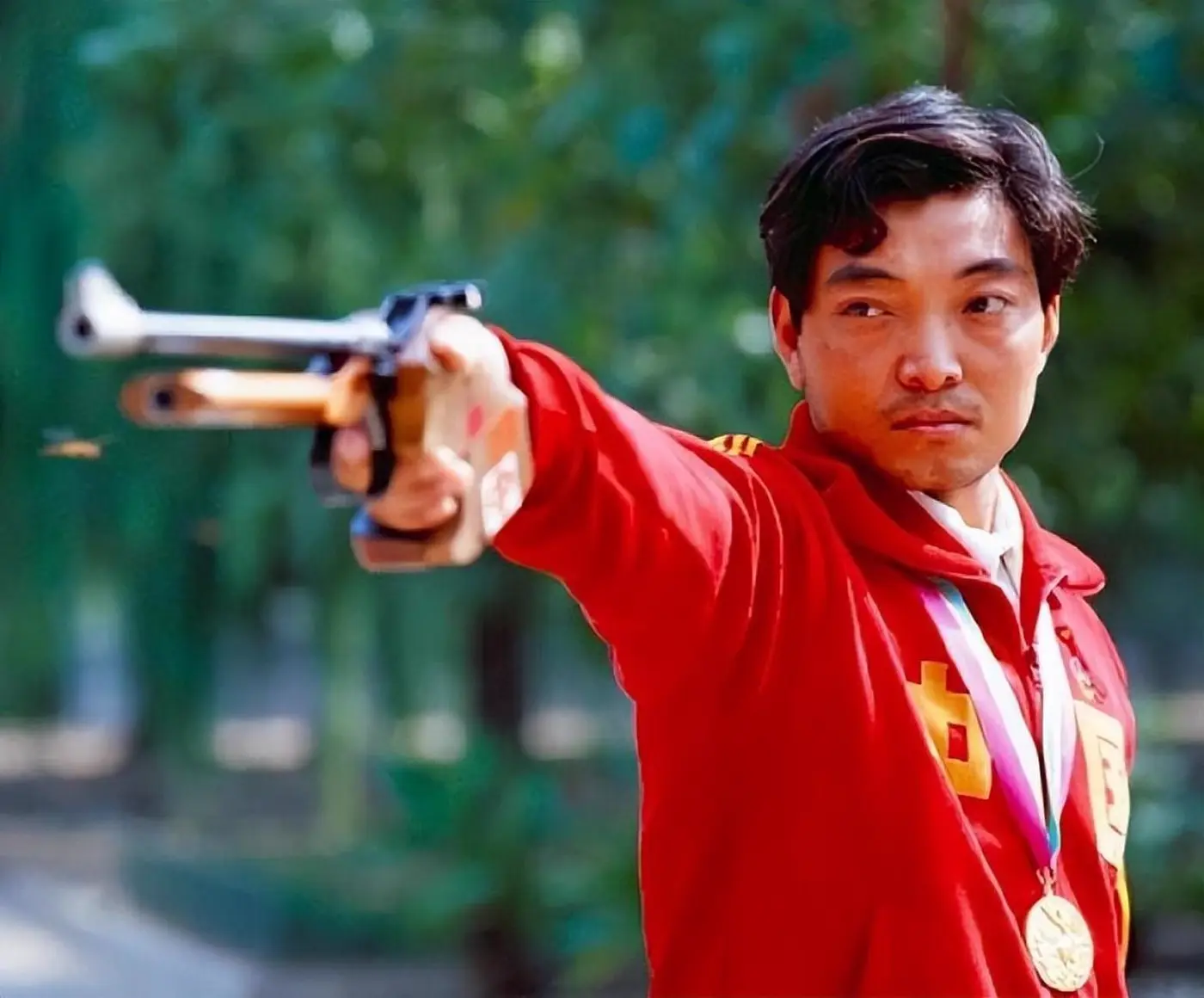
Xu Haifeng with a pistol — the implement he would turn into a method, long before the cameras of Los Angeles arrived.
## 2. The Afternoon: Sixty Shots, Six Groups, Twenty-One Minutes
On July 29, 1984, Xu Haifeng competed in the men's 50-metre free pistol event at the Los Angeles Olympics. The competition took place at the Prado Recreational Area in Chino, California. The format demanded 60 shots, divided into six groups of ten, with a theoretical maximum of 600 points.
The arithmetic looks straightforward. The task was not.
Xu's six group scores were:
| Group | Score |
|---|---:|
| 1 | 97 |
| 2 | 97 |
| 3 | 93 |
| 4 | 93 |
| 5 | 95 |
| 6 | 91 |
| **Total** | **566** |
The table tells us how the result was assembled. It does not tell us what the competition felt like.
The first two groups gave Xu a strong start: 97 and 97. Then the rhythm broke. During the third group, he fired an eight. In a precision event, a poor shot is not just a lost point. It raises a question about the movement that produced it. Was the problem in the stance, the hold, the trigger action, or the coordination of several small actions that normally happened together?
Xu's response was not to hurry through the next shot. He put the pistol down and left the firing position. He sat away from the line for roughly twenty to thirty minutes.
The explanation he later gave was strikingly practical. A shot that went wide, he said, indicated that something in the movement had gone wrong. Human beings have muscle memory. If an incorrect movement has been repeated, he believed, the athlete needs to interrupt it and allow it to fade before trying again.
This is a different picture from the familiar image of a champion overcoming nerves through sheer force of will. Xu was not simply telling himself to be confident. He was trying to stop an unwanted pattern from continuing.
When asked what he had thought about during that long pause, he later joked that he had invented the story about counting ants because people wanted an explanation. In reality, he said, he had been thinking about nothing in particular. He wanted to empty his mind.
The distinction between a dramatic inner monologue and deliberate mental quiet is important. Retrospective sports stories often make a difficult moment seem meaningful because the athlete supposedly understood, in advance, what the moment would become. Xu's account is less cinematic. He was trying to reset.
He returned to the firing line and continued. The next groups were 93, 95 and 91. The final group was not a triumphant procession towards an obvious result. It contained further difficulty, including two more eights. Xu again stopped, sat down and closed his eyes.
With 21 minutes remaining, he got up and rehearsed the full shooting action four times without loading ammunition. He raised the pistol, aimed and went through the trigger action. Only after repeating the sequence did he load and resume firing.
The distinction between an empty rehearsal and a live shot may seem small to a casual observer. For Xu, it was the point. He wanted to recover the correct sequence of movement before asking that sequence to produce a score.
The final three shots were 10, 10 and 9.
That last nine is worth preserving. Stories about Olympic pressure often turn the final shot into a perfect act of destiny. Xu later corrected that version of his own story: the final shot had not been a ten, he said; people had invented that detail. He regarded the nine as an excellent shot, missing the ten by only a very small distance.
The official total was 566. Sweden's Ragnar Skanåker scored 565, and China's Wang Yifu — himself a future mainstay of Chinese shooting — finished with 564 to take bronze. The podium was settled by a single point at every step: gold over silver by one, silver over bronze by one, with the fourth-placed shooter four points back. In the very event that delivered China's first Olympic gold, the host nation also took the bronze.
The margin is essential to the story. So is the absence of a perfect ending. Xu did not need a flawless last shot to win. He needed to recover enough control to finish the competition with a score one point better than his closest rival.
That is a more revealing kind of victory. It is not a story about a man who never lost control. It is a story about a man who recognised when his process had gone wrong and tried to restore it before the competition ended.
The 566 should also be kept in its proper historical context. It was the gold-medal score in Los Angeles, not proof that Xu had produced an unprecedented score in the event's history. Earlier Olympic competitions had produced higher totals. The achievement was not an overwhelming numerical victory; it was a narrow win under the conditions of that competition.
The difference between the result and the method is the key to understanding Xu. The result was one point. The method was the work required to find that point without allowing a bad sequence of shots to dictate the rest of the afternoon.
China's first Olympic gold medal came from that combination: an official score, a close contest and an athlete who treated a difficult performance as something to diagnose rather than merely endure.
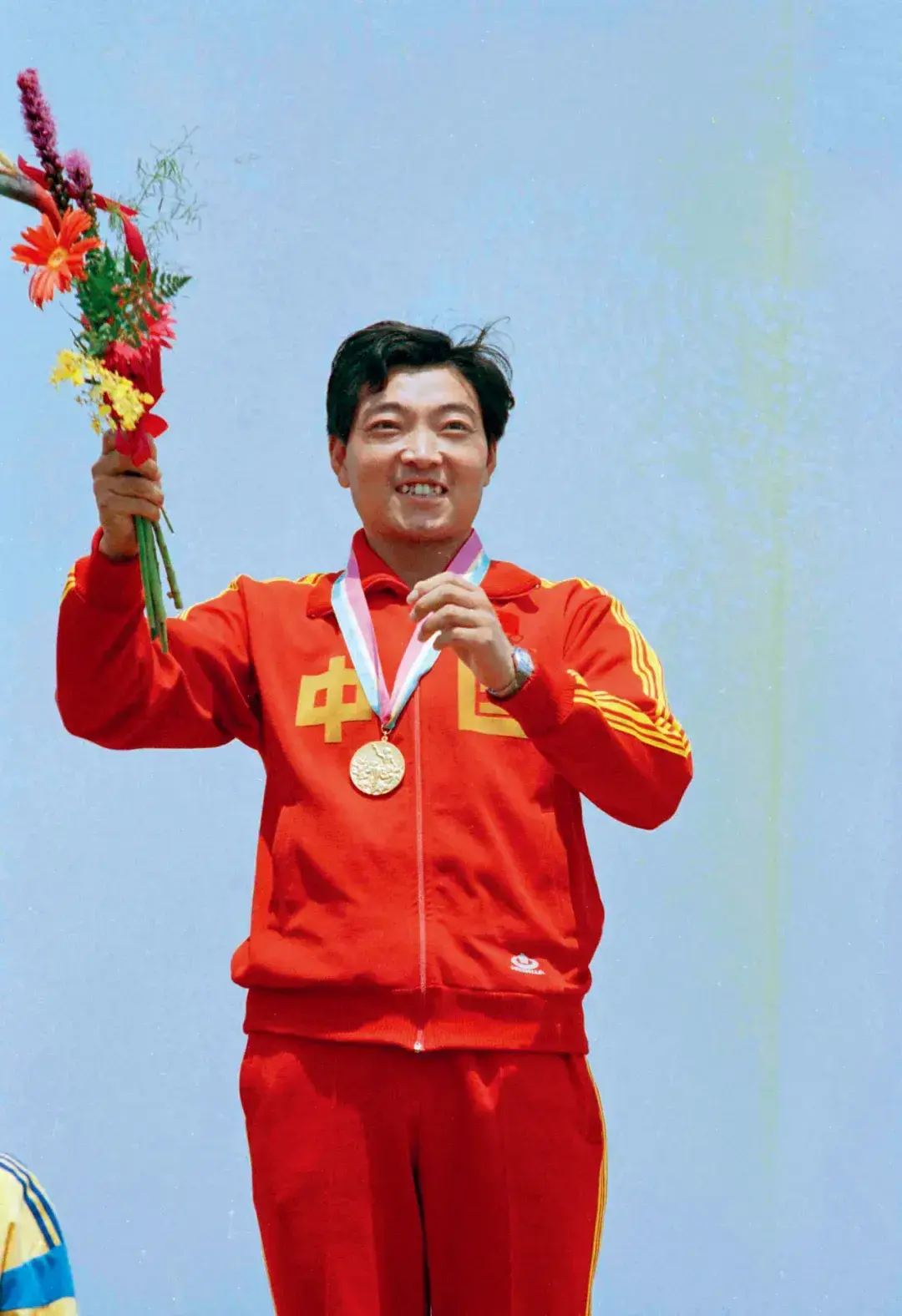
Xu Haifeng on the podium at Los Angeles 1984 — the moment that delivered China's first Olympic gold, decided by a single point over silver and bronze.
"From slingshot king to Olympic champion" — a documentary look at how the former fertiliser salesman won China's first Olympic gold.
## 3. The Race Outside the Race
The competition did not end when Xu fired his final shot. The results had to be checked, and the ceremony could not begin immediately.
In 1984, shooting scores were not displayed to spectators in the instant-by-instant manner that modern audiences might expect. The paper targets had to be checked. The gap between the end of the shooting and the public confirmation of the result gave the afternoon a second kind of suspense.
Xu's diary preserves a less dramatic account of the day than the national history that would grow around it. In the entry dated July 29, he noted that the pistol had moved more than he would have liked, but that the trigger action had felt good. The observation was specific, technical and personal. He was recording a performance, not writing a legend.
Then came the medal ceremony.
The organisers had not prepared a second Chinese flag. Wang Yifu had also won a medal, and the ceremony required another flag to be raised. A helicopter was reportedly used to bring one from elsewhere at the venue. The delay lasted about forty minutes.
The incident has become one of the memorable details of China's first Olympic gold. It also reveals how unprepared the setting was for the event's historical significance. The ceremony had to wait because the organisers had not anticipated the need to display the Chinese flag twice.
By Xu's own later account, he had not prepared a ceremony outfit. The trousers he borrowed from a teammate turned out a size too small — a little short at the ankle — so the first Olympic champion of the People's Republic went up to receive his gold in borrowed, slightly-too-small trousers. Such details can make a scene feel human, but they are not the central point. The important contrast is between the global symbolism of the ceremony and the ordinary, practical circumstances surrounding it.
Juan Antonio Samaranch, the president of the International Olympic Committee, presented Xu with his medal. The moment was later remembered as a landmark in Chinese sporting history: an athlete from a country returning to the Summer Games after a long and politically complicated absence had won the first gold medal of its Olympic history.
Xu did not leave the firing line with a carefully scripted historical image. He left with a result that needed verification. The ceremony was delayed by a missing flag. The man receiving the medal was a shooter who had been thinking about the movement of his pistol and the quality of his trigger action.
The medal would become a national symbol, but Xu's own approach to achievement remained grounded in what had happened and what could be learned from it.
Reports have also described Xu donating his gold medal to a museum after returning to China. The gesture is often explained through his belief that the achievement belonged to something larger than the individual athlete. The medal, in a museum, could be seen by many people rather than kept as a private possession.
That interpretation fits the broader public meaning of the victory, although the precise details of the donation and the museum's institutional history should be checked against original reporting before being stated more definitively. The symbolic point does not depend on embellishment: the medal was understood as a national milestone, not simply a personal trophy.
The moment also belongs to a larger set of stories from Los Angeles in 1984. [Li Ning](/athletes/li-ning/) won six medals in gymnastics. China's women's volleyball team won Olympic gold. These were different achievements in different sports, but together they helped give the Games a place in the public memory of Chinese sport.
For Xu, though, the day did not conclude with the ceremony. He still had a sport to understand, a career to continue and a method that would need to work again when the historical importance of the first medal no longer offered any practical assistance.
The medal made him famous. It did not solve the next problem.
CCTV's "吾家吾国" profile of Xu Haifeng — from the borrowed-trousers ceremony to his later life "from winning gold to making gold" as a coach and administrator.
## 4. Why Shooting, Why 1984, Why China?
The phrase "China's first Olympic gold" sounds as though it describes only an individual achievement. It also describes a particular moment in the country's sporting history.
China's Olympic participation had been shaped by decades of political division and disputes over representation. The restoration of its place in the Olympic movement in 1979 made the [1984 Los Angeles Games](/olympics/games/los-angeles-1984/) the first Summer Olympics in which the People's Republic of China competed after that restoration.
The team returned with ambition and a great deal to prove. China ultimately won 15 gold medals, eight silver and nine bronze, finishing fourth in the medal table.
Xu's medal became the first gold in that campaign. But the event in which he competed also matters. Shooting was among the earliest competitions on the Olympic programme, and the men's free pistol event began on the morning of July 29. The position of shooting in the schedule helped determine where the first gold would be won.
There is no need to diminish Xu's achievement by pointing this out. Winning the first medal was not a lottery, and the schedule did not fire the pistol for him. But history often assigns a symbolic role to the first event in a sequence, and the timing of a competition can determine which athlete becomes the person attached to a national milestone.
Xu himself later recognised the role of timing in the public memory of his victory. Being the first to win gold made his name unusually easy to remember. Yet he also suggested that his continued work in sport mattered to the lasting significance of that name. Had he retired immediately after the medal, he argued, he would still have been remembered — but perhaps not as deeply.
This is an important distinction. The first gold gave Xu a unique place in history. It did not explain everything he did afterwards.
The sporting environment of 1984 also needs to be described carefully. The Soviet Union and several of its allies boycotted the Los Angeles Games. That fact is part of the context of the competition, but it does not erase the achievements of those who took part. Nor should it be used to imply that every event was easy or that a particular result would necessarily have changed in a different field.
Xu's victory was decided by the shots fired in the competition he entered. The one-point margin over Skanåker makes that point more clearly than any grand description of the Games.
The wider importance of the medal came from what it represented to Chinese audiences. For decades, Olympic gold had been an achievement China had not secured. Suddenly, the country had a champion — and the champion came from a sport that many spectators might not have known well.
Shooting did not offer the visual drama of a sprint finish or a volleyball rally. A spectator could not easily see why one shot was better than another, or why a competitor needed twenty minutes away from the firing line. The medal made a relatively quiet sport the setting for a very public breakthrough.
That contrast helped make Xu's achievement memorable. It also created a challenge for anyone trying to explain him in the years that followed. The historical label — first Olympic gold medalist — was simple. The work behind it was much harder to describe.
The gold medal was the beginning of a new era in China's Olympic story. Xu's own story became more interesting when it moved beyond the question of who had won first.
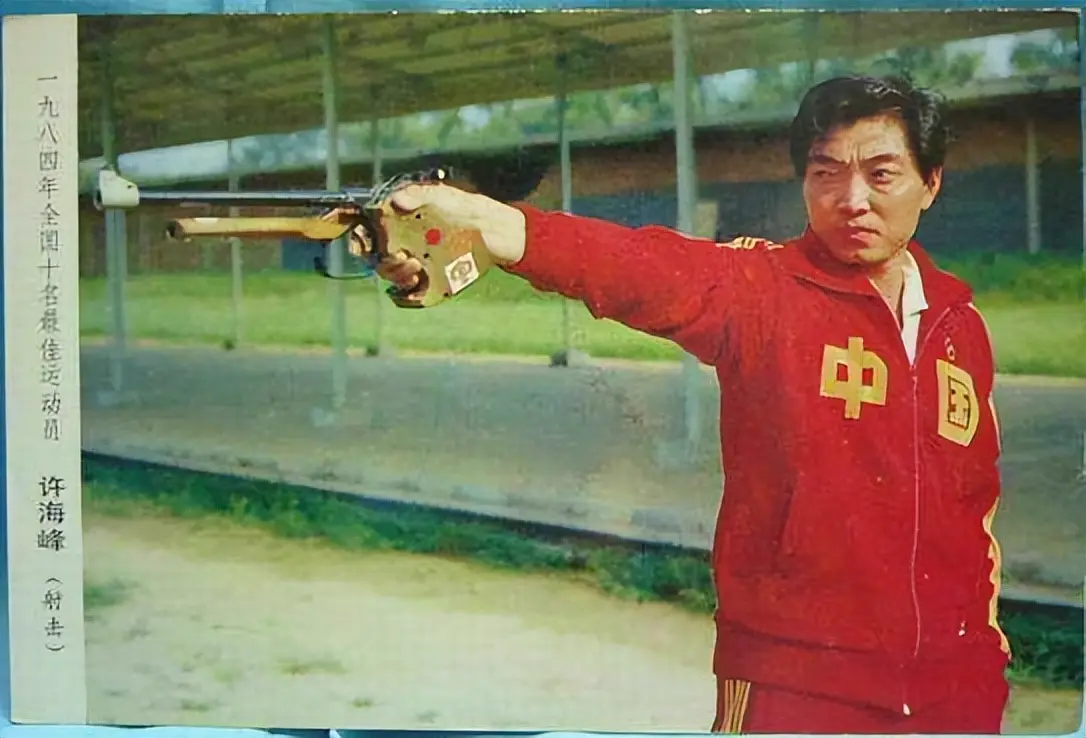
Xu Haifeng in 1984, the year he became one of the defining figures of China's return to the Olympic stage.
## 5. What the Discipline Actually Rewards
To understand Xu Haifeng's method, it helps to understand the event itself.
The men's 50-metre free pistol was a test of standing, one-handed shooting without external support. The athlete held the pistol at arm's length and fired at a target 50 metres away. The event required 60 shots across six groups, with a maximum score of 600.
The ten-ring was only 50 millimetres in diameter. At that distance, the target was small enough that a tiny change in the direction of the pistol could alter the score. The shooter could not rest the arm on a support or eliminate all movement. The pistol moved, even when the athlete was highly trained.
The challenge was not to make the body behave like a machine that never moved. It was to learn how to manage movement and release the shot at the right moment.
Xu summarised shooting technique in three Chinese words: *wen, miao, kou* — roughly, stability, aiming and trigger release. His explanation was direct: stability was the foundation; trigger release was the key. Aiming, he said, was the easiest part to learn.
The order matters. Someone unfamiliar with precision shooting might assume that the most important skill is seeing the target clearly and aligning the pistol with it. Xu's explanation placed the emphasis elsewhere. Aiming could be taught relatively quickly. The difficult work was creating a stable enough movement and then releasing the shot at the right point within that movement.
The shooter's eye cannot focus equally sharply on objects at very different distances. In pistol shooting, the front sight is close to the eye, while the target is fifty metres away. The normal technical priority is to maintain a clear relationship between the front sight and the rear sight, even though the distant target appears blurred.
The athlete is not trying to stare the target into perfect clarity. The athlete is trying to keep the sights aligned and place that alignment consistently in the appropriate aiming area.
This is one reason Xu rejected the idea that shooting success could be reduced to good eyesight. His own eyesight was around 0.5, with substantial astigmatism. He believed that was sufficient for the task he had trained to perform. His account did not suggest that visual acuity was irrelevant to every aspect of shooting. Rather, it challenged the assumption that the sharpest vision automatically produced the best shot.
His second emphasis was coordination. Stability, he argued, did not come simply from adding strength. It required the muscles of the hand, arm, shoulder and body to work together. The relationship between those parts mattered more than the crude addition of force.
Xu explicitly rejected the idea that stability could be solved by hanging bricks or sandbags from a pistol. Those stories have circulated in popular retellings of his career, but they conflict with his own explanation. His point was not that strength never mattered. It was that stability was a coordinated skill developed through sustained practice, not a problem that could be solved by making the arm carry more weight.
His third emphasis was consistency. Each shot required a repeatable sequence. The athlete could not raise the pistol one way for one shot, use a different movement for the next and expect reliable results. A technically sound action had to become something that could be reproduced.
This is where his account of trigger release becomes especially revealing.
A pistol may continue to move around the aiming area. The shooter cannot wait for an imaginary moment in which the weapon becomes perfectly motionless. Instead, the athlete has to understand the movement and develop a reliable sense of when to release the shot. Xu described it in simple terms: if the pistol was moving through the ten-ring when the shot broke, the result could be a ten; if the trigger broke while it was moving through the eight-ring, the result could be an eight.
The trigger action, in other words, was not a final mechanical detail added after aiming. Its timing was part of the score itself.
Xu said that the movement could be studied until it became more regular. The goal was not to eliminate every trace of movement but to make the movement predictable enough that the athlete could act at the right moment more often.
This is a demanding idea because it makes success less mysterious. The athlete is not waiting for a perfect feeling. The athlete is learning to recognise patterns, coordinate movement and reproduce a process under pressure.
It also explains why Xu's description of the sport returned so often to the same vocabulary. Stability, aiming, trigger release, coordination and consistency were not separate slogans. They were parts of one sequence.
The method is easier to see in retrospect when we return to the 21 minutes left in the 1984 final. Xu had produced shots that indicated something had gone wrong. He stopped. He waited. He rehearsed the sequence without ammunition. He then returned to the live competition.
It would be too strong to claim that this was a modern sports-science intervention in the formal sense. The evidence supports a more specific conclusion: Xu had developed a practical understanding of how a familiar movement could become unreliable, and he used a deliberate routine to try to recover it.
His account of good performance followed the same logic. The best result, he said, was often simply to perform at one's normal level — to reproduce in competition the standard achieved in training. An extraordinary score might happen, but it was not a dependable plan.
That idea is less glamorous than the language of genius. It is also more useful to an athlete who must compete again tomorrow.
The real subject of Xu's shooting career was not perfect stillness. It was the pursuit of a repeatable action in a sport where perfect stillness was unavailable.
## 6. 0.5 Eyesight: The Handicap That Wasn't
Xu's eyesight makes a useful entry point into his method because it exposes a common misunderstanding about shooting.
In an interview, he recalled that his eyesight had fallen to around 0.5 after he worked selling fertiliser. Ammonia fumes repeatedly irritated his eyes, and he also had significant astigmatism. His response to questions about how he could shoot with poor eyesight was characteristically blunt: relying on "feeling" because the eyes were poor, he said, would be a mistake. In his view, shooting did not demand the kind of visual sharpness many people assumed it did.
He did not claim that eyesight never mattered. He argued that the sport's technical requirements were different from those imagined by outsiders.
The distinction between the front sight and the target is central. A shooter needs to see the sights in relation to one another and maintain a consistent aiming process. The target itself is far away. If an athlete tries to make the distant target perfectly sharp, the near sights may lose the clarity needed for correct alignment.
A secondary account of Xu's explanation describes an experiment in which shooters with very good eyesight were given corrective lenses that deliberately blurred the distant target. The reported purpose was to help them work with the visual relationship required by the discipline rather than to chase a perfectly sharp image of the target. Because this detail comes from a less direct source than his main interview, it should be treated as a reported example, not as a fully documented laboratory experiment.
The larger point is supported by Xu's own explanation: visual sharpness was not the sole determinant of performance. Coordination and consistency mattered. The athlete had to control the relationship between body and pistol and reproduce the sequence of actions shot after shot.
That account also helps explain why the popular story of the "blind" marksman is misleading. Xu was not claiming that he succeeded by ignoring technique. He was explaining why the technique was not what many people expected.
His eyesight was a circumstance he had to work with. It was not a substitute for practice, nor did it make the other requirements of the sport disappear.
There is a second part to the story, and it should not be folded carelessly into the first.
In the mid-1990s, Xu was diagnosed with a retinal condition commonly translated in Chinese reporting as migratory retinitis. His eyesight deteriorated further. By 1995, he had retired from competition and moved into coaching.
The exact year of diagnosis differs across accounts, so the safest description is the mid-1990s rather than a precise date. It is also important not to imply that the later retinal condition was simply the same problem as the reduced eyesight he described around 1984. The accounts refer to different stages in his life, separated by roughly a decade.
This is where an easy inspirational story would be tempting. The champion with poor eyesight wins a gold medal, then loses more of his sight, then somehow triumphs again. But that would turn a complicated career into a fable and make his physical circumstances carry more meaning than the evidence supports.
Xu's own approach suggests a different interpretation. He did not make eyesight the centre of his explanation for winning. He talked about technique, coordination and consistency. And when his competitive career ended, those were precisely the ideas he could continue to use.
The most significant continuity is not that he overcame one physical problem twice. It is that his knowledge was not confined to his own ability to shoot. The movements he had studied could be taught to someone else. The habits of observation and adjustment could be carried into coaching.
A career in sport is often described as a contest between an athlete and the limits of the body. Xu's later career raises another question: what remains when the athlete can no longer compete in the same way?
In his case, the answer was a body of practical knowledge — some of it written down, some of it embodied in routines, and some of it turned into training exercises. The medal was evidence of what he had done. His coaching would test whether he could help other people do it too.
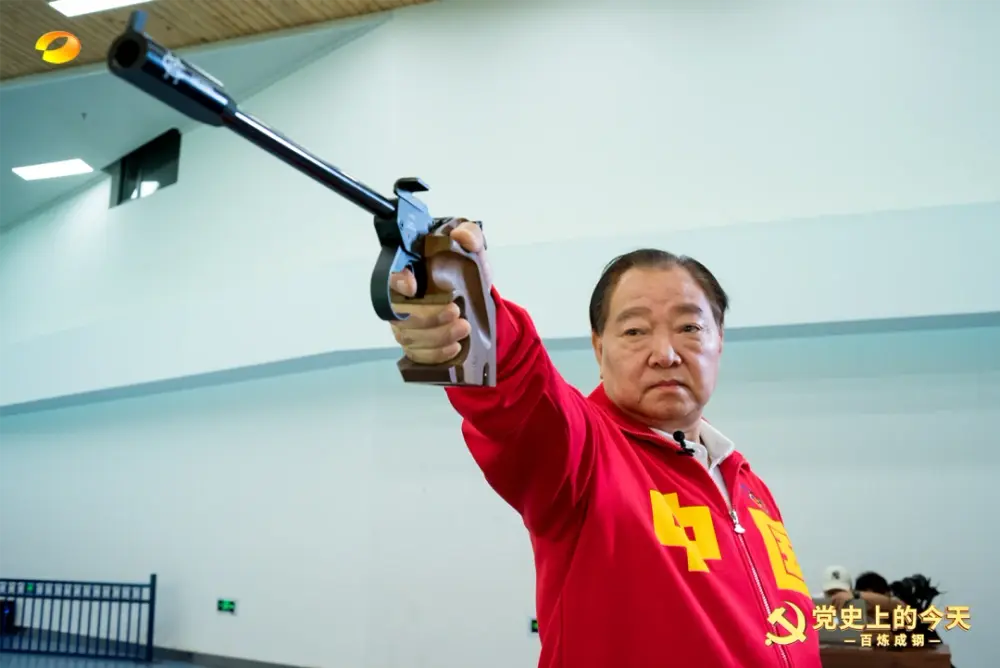
Years later, Xu Haifeng still with a pistol in hand — the instrument had become a method he would spend decades teaching to others.
## 7. From Winning Gold to Making It: The Coach
Xu retired from competition in 1995 and moved into coaching, working with China's women's pistol programme. This was not a complete break with his earlier life. He remained in shooting, the sport he understood from years of practice. But his role had changed. He could no longer measure his work only through the shots he fired himself.
A coach has to identify what an athlete needs, understand why a movement fails and find a way to help the athlete reproduce a better one. The knowledge that works privately for a champion may not transfer automatically to another person. A method has to become teachable.
Xu's own description of his approach was almost deliberately unheroic. People often called him hardworking, he said, but he did not think of himself as someone who simply trained harder than everyone else. "I trained with my brain," he explained. The key word was research.
He did not believe that all athletes should receive the same training merely because they belonged to the same team. The task was to work out what each athlete needed and train that specific requirement.
One of his most distinctive exercises involved a needle and a small box.
The details vary slightly between accounts. An Xinhua report from 2002 described Xu making numerous tiny holes in a small empty cardboard box. He gave athletes needles threaded with string and asked them to suspend the needles by the thread, raise their arms and guide the needles through the holes one by one.
In a later television interview, Xu described a version using a plastic ammunition box, a one-millimetre drill bit, twenty holes and a thread at least ten centimetres long. The longer the thread, the more the needle swung. The athlete had to wait for the needle to settle enough to guide it through each hole. The fastest athletes, he recalled, could complete the task in about forty seconds.
The purpose was not to teach athletes to handle needles. It was to make instability visible.
A suspended needle reacts to tiny movements. If the hand shifts, the needle moves. If the athlete becomes impatient and tries to force the task, the needle swings and the attempt becomes harder. The exercise turns an abstract instruction — keep the arm stable — into a concrete problem that the athlete can feel.
Xu explained the psychological element with equal directness: the more impatient you become, the more nervous you get, and the harder it is to put the needle through the hole.
The exercise linked physical control with attention. The athlete had to maintain a stable position, observe the needle's movement and act at the right moment. The same basic problem appeared in shooting, but the training exercise made the relationship between movement and timing easier to see.
It was also a way of teaching without relying on a long explanation. The needle provided immediate feedback. The athlete could see when a movement had disturbed the task.
Another method was empty-gun rehearsal. Without ammunition, the athlete would repeat the raising, aiming and trigger sequence. Xu had used the approach himself in the final stages of the 1984 Olympic competition. As a coach, he used the same principle to help athletes reproduce the action without the additional consequence of a live shot.
His work also extended to equipment. Xu was known for inspecting and adjusting pistols, including domestic Dongfeng models. In reports from the 2002 Busan Asian Games, athletes recalled his willingness to repair and tune equipment rather than assume that an imported pistol was automatically better. He helped adjust a Dongfeng pistol used by Li Duihong, replacing components and working to improve its accuracy.
The significance of such work is easy to underestimate. A shooting result is not produced by technique alone. The equipment has its own mechanical behaviour, and a coach who can distinguish a technical problem from an equipment problem has another way to improve performance. Xu's approach treated the pistol as something to understand, not simply an object to be issued to an athlete.
The same habit of recording and reviewing that had appeared in his early diary continued into his coaching philosophy. Before a major competition, he wanted preparation to cover six areas: psychology, technique, tactics, physical condition, equipment and the management of information. He also insisted on having a method for each major competition and a review afterwards.
The list is revealing because it does not isolate psychology from everything else. A poor performance might be caused by a technical weakness, an equipment issue or a tactical error. Telling an athlete to be confident would not solve all of those problems.
Xu's work with Tao Luna before the 2000 Sydney Olympics illustrates that principle. Accounts of the preparation describe him preventing athletes from becoming distracted by live scores displayed during training. The intention was to keep attention on the shooting process rather than encourage athletes to react to each number. On competition day, when bright photographic lights disturbed Tao, Xu reportedly gave her his black cap to help block the glare.
These are small interventions, not grand theories. Their value lies in the way they identify a specific problem and make a practical adjustment.
The results of his coaching years were substantial. Li Duihong won the women's 25-metre pistol gold medal at the 1996 Atlanta Olympics. Tao Luna won the women's 10-metre air pistol gold at Sydney in 2000. Chinese shooting then enjoyed major success at the 2002 World Championships and Asian Games. At Athens in 2004, China's shooting team won four Olympic gold medals, with Xu serving as head coach.
These outcomes should not be reduced to one man's work. Olympic results are produced by athletes, other coaches, technical staff, sports institutions and years of preparation. But Xu's coaching record makes one thing clear: he had moved beyond the role of an athlete remembered for a single medal.
He had found ways to make his own understanding useful to other people.
The needle exercise was not a miniature version of the Olympic final. A threaded needle could not reproduce the full demands of a major competition. What it could do was isolate one aspect of the task and allow an athlete to practise it repeatedly. That is the essence of a training method: identify a component, make it observable, create a repeatable exercise and use the results to improve performance.
Xu's gold medal had come from recovering a repeatable action under pressure. As a coach, he built exercises that helped other athletes work on the same problem.
## 8. The Third Zero: A Sport He Didn't Know
On November 22, 2004, Xu moved away from the shooting programme that had defined much of his career. He became a deputy director of China's Cycling and Fencing Administrative Centre, with responsibility for modern pentathlon.
The change was more than an administrative reshuffle. Modern pentathlon was a sport he did not know well. Shooting had been his technical home for decades; now he was responsible for helping a programme succeed in a multi-discipline event that demanded a different combination of abilities.
Modern pentathlon has traditionally combined fencing, swimming, equestrian competition, running and shooting. Its format has changed over time, so the modern version should not be confused with the precise format athletes encountered in the early 2000s. The essential challenge, however, is clear: a competitor must perform across several very different disciplines rather than specialise in one.
Xu reportedly admitted that when he first took on the responsibility, he did not even know all five components. His response was to start with the rules. He read a substantial rulebook and spent several months studying the sport and investigating what the programme needed.
The first task was not to impose a shooting coach's routines on a different sport. It was to understand the sport itself.
That distinction is central to the story. Xu's experience gave him a framework for thinking about performance, but it did not mean that every discipline could be treated as pistol shooting. The first step was to learn the requirements, constraints and competitive structure of [modern pentathlon](/olympics/events/modern-pentathlon-mens-individual/). Only then could he begin to work out where his experience might be useful.
In August 2005, Chinese pentathlete Qian Zhenhua won the men's individual title at the Modern Pentathlon World Championships in Warsaw. The result was a landmark for Chinese modern pentathlon and was widely treated as a breakthrough against a field long dominated by European competitors.
The result should not be presented as proof that Xu alone had transformed the sport in a few months. Qian was the athlete who had to perform across the event, and the result depended on his preparation and execution. Xu himself was reported to have acknowledged the role of performance on the day and the importance of the athlete's overall execution.
The more important point is what happened next. China's modern pentathlon programme continued to produce significant results. In 2009, Chinese athletes won further world championship titles in the individual events. At the London 2012 Olympics, Cao Zhongrong won the men's silver medal, becoming the first Asian athlete to reach the Olympic podium in modern pentathlon.
The sequence was not a simple, uninterrupted climb. Results in a multi-discipline sport depend on many moving parts, and no single administrative decision can guarantee success. Yet the progression shows that Xu's work in modern pentathlon was not limited to one isolated result.
He had entered a field he barely knew, begun by studying its rules, and worked within a programme that went on to achieve results of international significance.
The parallel with shooting is not that he used the same exercise everywhere. A needle threaded through a tiny hole cannot teach an athlete how to fence, swim or ride. The parallel lies one level above the exercise itself.
In shooting, Xu had asked what the sport actually rewarded. He had separated stability, aiming and trigger release into distinct problems. He had studied movement, equipment and preparation rather than relying on the vague instruction to try harder.
In modern pentathlon, he had to begin again with a different question: what did this sport require, and how could those requirements be understood well enough to support athletes?
This was another kind of first. In 1984, he had helped China cross the threshold of its first Olympic gold medal. In the coaching years, he had helped turn individual technique into repeatable training. In modern pentathlon, he was learning a new system from the ground up.
The "zero" in this part of the story is not a claim that China had no previous experience or that Xu began alone. It describes his own starting point: he was entering a discipline outside his expertise. His response was to study before pretending to know.
That is a less dramatic form of courage than winning an Olympic final. It is also a more transferable one. A person can be highly accomplished in one field and still need to become a beginner in another. Xu's later career was shaped by his willingness to accept that position.
His story therefore does not end with an athlete becoming a coach. It continues with a coach becoming a student again — and then using what he learned to help a different group of athletes compete.
## 9. The Diary and the Museum
Return to the diary.
Xu's notes contained national and world records copied down for study. They contained a poem written in 1979. They contained his preparations for major competitions. And on the page dated July 29, 1984, they included a reconstruction of the 60 shots he had fired in the Olympic final.
The drawing is a particularly revealing object. During the competition, Xu had asked someone to record the shots. Afterwards, he recreated the pattern in his diary, using different marks and colours to distinguish the impacts.
The act turns a famous result into something that can be examined. A medal tells us who finished first. A score tells us how many points the athlete earned. A drawing of the shots preserves another kind of information: the shape of the performance that produced the total.
The diary and related materials are preserved by the Anhui Sports Museum. They offer a view of Xu that is different from the familiar image of a champion holding a medal. Here, he is a person recording details, keeping track of records and attempting to understand the relationship between preparation and outcome.
The first Olympic gold was a moment. The diary suggests a process.
That process continued after his retirement. Xu moved from the firing line to the coaching position, where he developed exercises to train stability and attention. He learned to work with equipment as well as athletes. Later, he took responsibility for a sport he did not know and began by studying its rules.
The sequence connects three roles without pretending they were identical. As an athlete, he tried to reproduce a reliable action. As a coach, he tried to make parts of that action teachable. As a sports administrator working with modern pentathlon, he had to learn a new set of demands before he could help a programme address them.
Each stage began with a question rather than a legend.
What had gone wrong with the shot?
What did the athlete need to practise?
What did this unfamiliar sport actually require?
These are ordinary questions. Their value comes from the discipline with which they are pursued.
Xu's place in Chinese Olympic history is secure because of the gold medal he won in Los Angeles. His career afterwards complicates the idea that the medal alone explains him. He remained involved in sport for decades, continuing to work after the original achievement had made him famous.
His story also provides a useful contrast with other champions of the 1984 Games. [Li Ning](/athletes/li-ning/) built a second public life after gymnastics. Xu stayed within sport, moving from competitor to coach and administrator. Neither path is inherently more meaningful. They show different ways of responding to the end of an athletic career.
For Xu, the important work was not finished when he received the medal. The gold made him the first. It did not mean that every subsequent challenge had already been solved.
The point is not that he broke every record or that every programme he touched succeeded. It is that he repeatedly returned to a method: study the task, identify the parts that matter, practise them deliberately, and examine the result.
In Los Angeles, that method helped him recover from a difficult sequence of shots and win by one point. In coaching, it took the form of empty-gun rehearsal, needle exercises, equipment adjustment and competition reviews. In modern pentathlon, it began with a rulebook and the humility to acknowledge what he did not yet know.
The medal is the easiest part of the story to remember. The harder part is recognising what the medal cannot show.
A single shot can make a person famous. It cannot, by itself, explain forty years of work.
Xu Haifeng's lasting significance lies in what he did after becoming the first: he kept trying to turn performance into knowledge, and knowledge into something another person could use.
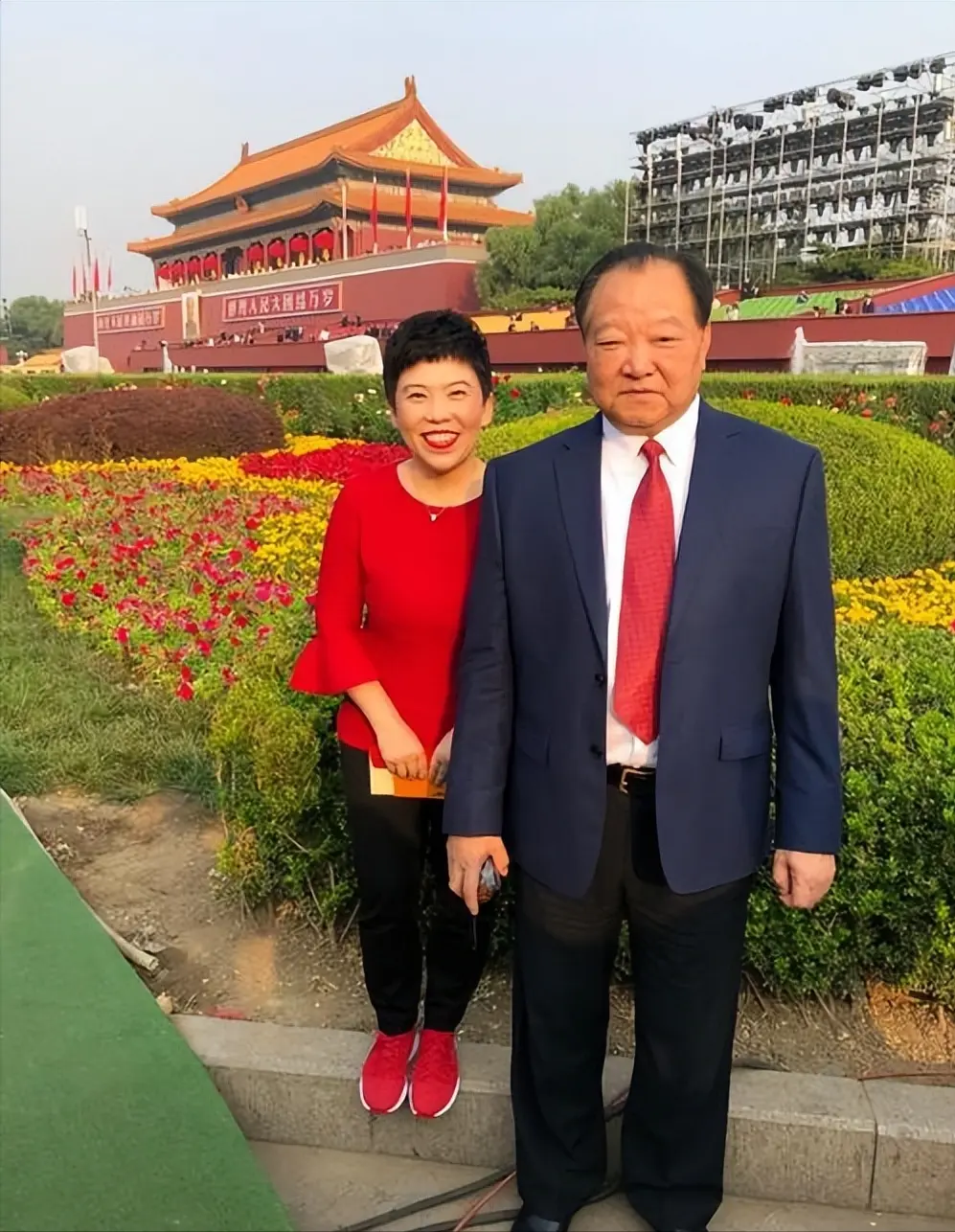
Xu Haifeng (left) with fellow Olympic champion Deng Yaping — two figures from different sports whose careers helped define China's place in Olympic history. See also [Deng Yaping](/athletes/deng-yaping/) and [Liu Xiang](/athletes/liu-xiang/).
**"The best performance is to perform at your normal level."**